Why The Secret History deserves every bit of its cult status
I picked up The Secret History in order to indulge myself in another dark academia aesthetic, but it left me somewhere else entirely.
Why The Secret History deserves every bit of its cult status
I picked up The Secret History in order to indulge myself in another dark academia aesthetic, but it left me somewhere else entirely.
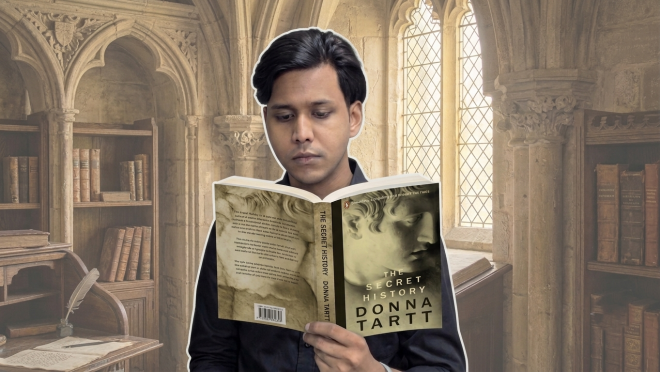
I was unable to function for some time after finishing this long book and couldn’t explain it to anyone either. Some hate it, some curse it. Some say the book is the most hyped and stupid dark academia book of all time. But for me, it was something else.
The book starts with a death announcement. And it’s announced in the past tense, which hints at everything that’s about to unfold after the death. What kept me reading was not the cause of death but the events that were about to happen afterwards. Because it was not the death of an ordinary person, it was the murder of Bunny Corcoran, the most interesting loud character of the book. With that being said, let’s dive into the book and unveil the beauty of Donna Tartt’s version of slow tragedy.
The story revolves around six students of Hampden College studying Greek under a highly selective professor, Julian Morrow. The narrator, Richard Papen, is a latecomer to the group and the most introverted one. I personally didn’t like the protagonist for a particular reason, which I will mention at the end. Back to the story, I loved how the story progresses by navigating us into a world that feels extremely familiar and non-fictional. The magnetic professor teaches them not only the Greek language but also some parts of ancient ethics, drama, sociology, history, etc. Henry Winter was the most obedient and passionate pupil in that class, and I liked him the most. He became an unofficial leader of the group, although it’s not mentioned anywhere, but anyone can get the gist of it.
It is written in an unhurried manner that shouldn’t work for a book that opens with a murder, but it did. The slow build-up didn’t bother me because I’m used to it, but for many, it might. The group of six students in the novel is obsessed with Greek tragedy, particularly Dionysian frenzy. They try to perform some acts as well, which doesn’t turn out to be as fascinating as they thought it would. I turned the pages fast after that incident. So if anyone is about to put down this book halfway through it, stay with it, friend. You are about to witness something you might never expect. It’s not like there’s an insane twist. It’s more about a twist in style than a twist in plot.
I won’t say that the book is flawless. The book moves slower than I expected, especially before the death. I said earlier that I personally didn’t like the main character. It has multiple reasons, but one of the main ones was the outro of that character. It slowly becomes clear that the story is being told entirely by Richard Papen, and that he isn’t a reliable narrator. It made me look back and reconsider everything Richard Papen said throughout the book. This is the kind of thing that makes me want to re-read the book, and it will be worth it, trust me. When I reread the book, I noticed so many things that I missed earlier.
I would recommend this book to anyone who wants to be in a room surrounded by mysterious elite students and observe their lives closely. What surprises me most is that even after decades, people still talk about this book, and the author’s writing is still relevant long after the dark academia craze is gone. One might get judged if they are in a bookshop or a café, reading this book attentively, which I felt quite a few times. But if we ever meet, we might have a long conversation about it.