The syntax of eternity: How Dark tells time
The very essence of Baran bo Odar and Jantje Friese’s Dark on Netflix lies in the paradox that the characters strive to make themselves count, to be remembered, to be seen in any way, and yet the very medium through which they seek permanence, time, proves to be a closed loop with no real beginning and no real end.
The syntax of eternity: How Dark tells time
The very essence of Baran bo Odar and Jantje Friese’s Dark on Netflix lies in the paradox that the characters strive to make themselves count, to be remembered, to be seen in any way, and yet the very medium through which they seek permanence, time, proves to be a closed loop with no real beginning and no real end.
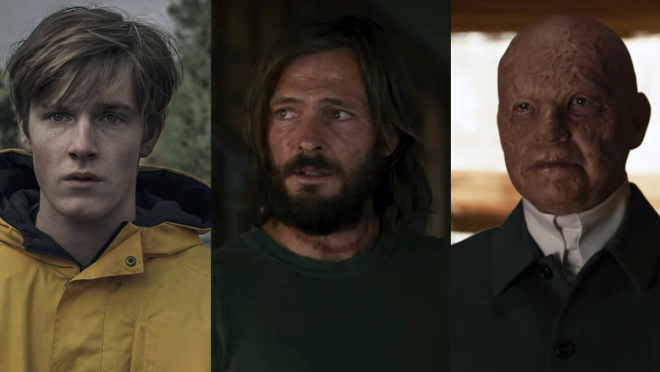
How does it feel to wish to be relevant in a universe where nothing, in the end, is ever truly new? Dark reaches this conclusion not through exposition but through form: through language as spoken, withheld, gestured, and structurally built. It is this formal construction that bears the series’ central claim that time is not merely a law of nature but a scaffold around which language creates its repetitions.
Firstly, there is the exploitation of verbal echo throughout the television series. Almost word-for-word statements made by a father in one timeline are repeated either by his younger self in another timeline or by his son many years later. Ulrich explains to Mikkel the very evils that he himself will later commit; Jonas explains to the boy the very evils that he, as a boy, had once heard would befall him. This cannot be dismissed as mere thematic doubling; it is a formal disintegration of the division between creator and heir.
When the same sentence can justifiably be attributed to both father and son, to teacher and pupil, the question of the precedence of speech becomes not merely unsatisfactory but fundamentally unsound, just as the problem of determining the origin of a circle is. This recursion occurs both at the level of individual sentences and at the level of the plot itself, conditioning the viewer to abandon any belief in linear authorship.
Parallel to this is the destabilisation of naming. Different characters are addressed differently across different periods of time. A woman known as Claudia Tiedemann in one decade becomes “Frau Tiedemann” in another, a title that she has either not yet earned or has already left behind. Elsewhere, one character encounters an older or younger version of someone they love, and identity itself begins to dissolve, with the name overtaking the face, or the face overtaking the name. This instability of the proper noun mirrors the instability of the self across time. When a name can no longer locate a person at a single fixed point within chronology, selfhood itself becomes transitional, and the name is continually rewritten rather than anchored to any stable essence.
The television series extends this linguistic structure beyond dialogue into a non-verbal lexicon of recurring images: the yellow raincoats, the Ariadne triangle drawn in chalk upon the cave walls, the clocks that stop and start, and the doorways that lead nowhere and everywhere simultaneously. These objects function as vocabulary within a language rather than as isolated symbols.
A glance exchanged between two characters who have not yet become close, or a hand resting upon a doorframe in exactly the same way decades apart, communicates continuity and disruption simultaneously, often before the characters themselves consciously recognise it. Dark contains almost no empty silences; instead, its silences are grammatical, carrying the weight of dialogue that has not yet caught up with itself.
Lastly, the editing of the series functions as a narrative syntax in its own right. The cross-cutting between 1953, 1986, 2019, and 2052 performs the work of conjunction and subordination within a sentence. Two scenes placed beside one another compel the viewer to infer causal or temporal relationships, only for the plot itself to undermine those assumptions. This is not merely an incidental stylistic choice but an argument made through form. The television series trains its audience to abandon the expectation of linear causality and instead adopt its own cyclical logic of understanding. We are taught to read Dark in the same way its characters are eventually taught to live within it: by recognising that sequence is merely a mode of thought rather than the reality of existence.
Together, these four registers, recursive discourse, unstable nominalisation, a visual vocabulary of recurring signs, and a discontinuous editorial grammar, reveal that Dark is not merely an account of determinism and identity but a practical enactment of those very theories through its own language. In this regard, the television series belongs to a tradition of speculative fiction extending from Borges’ forking garden to Tarkovsky’s dilated experience of time, in which language is understood as ontologically constructive rather than merely descriptive.
The telling does not simply describe the world; it becomes the world. The quiet but profound achievement of Dark is to suggest that the human desire to matter is not diminished by the loop but intensified through it, that to speak, to be named, to gesture, or simply to be woven into a story at all is already an act of significance, regardless of how many times that story folds back upon itself.