Asian University for Women climate conference urges community-led climate action, direct finance
The two-day conference, held on 7-8 August at Sonapahar Farmhouse Resort in Cox’s Bazar, brought together more than 150 researchers, policymakers and students from Bangladesh and other countries in the Global South.
Asian University for Women climate conference urges community-led climate action, direct finance
The two-day conference, held on 7-8 August at Sonapahar Farmhouse Resort in Cox’s Bazar, brought together more than 150 researchers, policymakers and students from Bangladesh and other countries in the Global South.
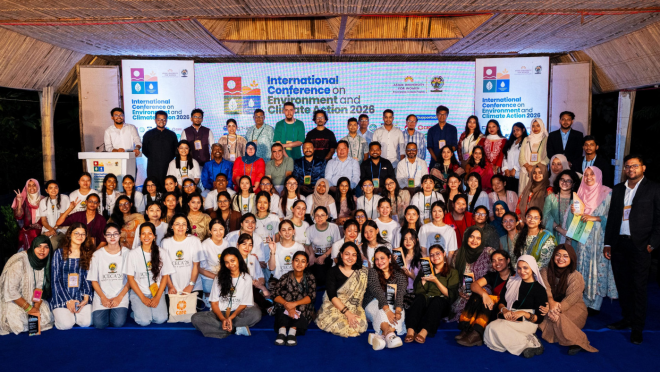
The 2nd International Conference on Environment and Climate Action organised by the Asian University for Women (AUW), ended on Saturday with calls for community-led climate action, greater participation of women and marginalised groups in policymaking, and direct access to climate finance for frontline communities.
The two-day conference, held on 7-8 August at Sonapahar Farmhouse Resort in Cox’s Bazar, brought together more than 150 researchers, policymakers and students from Bangladesh and other countries in the Global South, according to a press release.
Organised by AUW’s Environmental Sciences Program in collaboration with the Green Bangle Movement, Sonapahar, KFL, YPSA and Change Initiative, and powered by MTB, the conference focused on the theme “Commoning Our Futures with Climate Justice”.
In his opening address, organising chair Dr Mosae Selvkaumar Paulraj urged policymakers, industrialists and political leaders to prioritise sustainable development to prevent future generations from bearing the cost of environmental degradation.
He also called on COP31 to ensure carbon credit financing directly reaches farmers, environmental activists and local women involved in planting, restoring and protecting ecosystems.
The conference’s keynote sessions highlighted the gap between those most affected by climate change and those who govern climate responses.
Dr Nancy Mock of Tulane University said climate-vulnerable communities, particularly women, must have a role in shaping climate policies rather than being consulted only after decisions are made.
M Zakir Hossain Khan, co-founder and chief executive of Change Initiative, called for natural rights-led governance, arguing that nature should be recognised as a rights-bearing entity and that communities should have a greater role in environmental stewardship.
Several plenary sessions examined climate science, finance and policy. Researchers from Bangladesh, India, Thailand and Türkiye discussed climate-resilient agriculture, infectious diseases, ecosystem monitoring, carbon emissions and nature-based solutions.
A session on evidence-based climate policy for COP31 focused on international climate finance, with speakers calling for reforms to ensure climate funding reaches Least Developed Countries and does not deepen their climate-related debt burdens.
Shamsuddin Illius, Chattogram Bureau Chief of The Business Standard, stressed the need for investigative climate journalism to track international climate finance and amplify the voices of communities on the frontline of climate change.
The conference also featured sessions on women in environmental sciences, student and researcher presentations, poster exhibitions and documentary screenings on climate injustice, forest restoration, coastal resilience and circular economy initiatives.
Dr Md Masud-All-Kamal of the University of Chittagong and AUW researcher Afra Nawar Rahman received top honours for their oral presentations. The organisers also recognised AUW faculty members Dr Tuhin Biswas and Nazifa Rafa with the Best Young Researcher Award for being listed among Stanford University’s World’s Top 2% Researchers.
On the second day, participants visited Dulahazara Safari Park and coastal areas of Cox’s Bazar to observe climate adaptation challenges and environmental initiatives firsthand.
The conference concluded with a call to move beyond top-down climate policies and build responses around scientific evidence, social justice, equity and the leadership of local communities, particularly women and other marginalised groups.