Rare total solar eclipse on 12 August: Where will it be visible
Rare total solar eclipse on 12 August: Where will it be visible
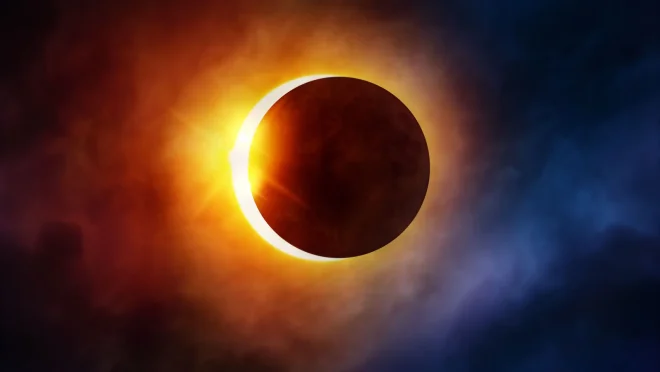
A rare total solar eclipse is set to take place on Wednesday (12 August), with parts of Europe, North America and North Africa set to witness the celestial event.
The total eclipse will be visible along a narrow path about 290 kilometres wide, where the Moon will completely block the Sun. Totality will last for a maximum of 2 minutes and 18 seconds.
The main path will pass through eastern Greenland, western Iceland and northeastern Spain, turning daytime skies temporarily dark and allowing bright stars and planets, as well as the Sun’s outer atmosphere or corona, to become visible.
The eclipse will begin at 4:35pm local time in Scoresby, Greenland, followed by totality in Reykjavik, Iceland, at 5:48pm. The maximum eclipse will occur between 8:28pm and 8:31pm in parts of Spain, including León, Soria and Mallorca.
Madrid, however, will narrowly miss totality. Although about 99.9% of the Sun will be covered, the city lies just outside the path of totality.
Where else will it be visible?
Most of Europe and parts of northwestern Africa will experience a significant partial eclipse.
In Spain, about 99.9% of the Sun will be covered in Madrid and 99.8% in Barcelona. Coverage will reach about 96% in Algiers, 95% across parts of France and 94% in Lisbon and Dublin.
Parts of the UK will also see a substantial partial eclipse, with about 91% to 93% coverage in London, Cardiff and Belfast.
North America will mostly experience a partial eclipse, with the largest coverage expected across northern and eastern Canada, Alaska and the northeastern United States.
About 61% of the Sun will be covered in Iqaluit, Canada, while coverage will reach around 53% in St John’s. Fairbanks and Anchorage in Alaska will see about 37% and 28% coverage respectively. Smaller partial eclipses will also be visible in cities including Boston, Quebec City, Montreal and New York.
How to watch safely
Astronomers have warned people not to look directly at the Sun during the partial phases of the eclipse, even while wearing ordinary sunglasses. Doing so can cause permanent eye damage.
Anyone viewing the partial eclipse should use certified solar-viewing glasses or a proper solar filter.
Direct viewing is safe only during the brief period of totality, when the Moon completely covers the Sun. Once any part of the Sun becomes visible again, viewers must immediately use proper eye protection.