DU's concrete-choked trees expose Bangladesh's defunct urban climate governance
It fell without even strong winds to push it over. According to media report, Professor Jashim Uddin, director of the university’s Arboriculture Centre, diagnosed the structural failure.
DU's concrete-choked trees expose Bangladesh's defunct urban climate governance
It fell without even strong winds to push it over. According to media report, Professor Jashim Uddin, director of the university’s Arboriculture Centre, diagnosed the structural failure.
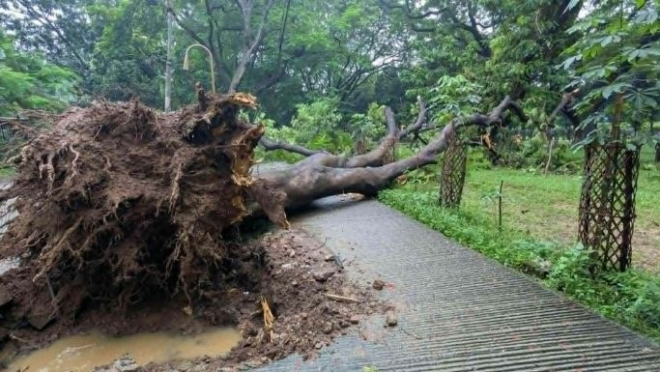
Last month, amidst heavy rainfall, a magnificent 60-year-old Krishnachura tree on Mall Chattar at Dhaka University (DU) uprooted itself and crashed onto the pavement.
It fell without even strong winds to push it over. According to a media report, Professor Jashim Uddin, director of the university’s Arboriculture Centre, diagnosed the structural failure.
Years of concrete infrastructure choking its roots prevented them from spreading, leaving the giant unstable.
This is not merely an unfortunate accident caused by ageing or weather. It is the physical manifestation of a systemic collapse in climate governance. When we look closely at the numbers, the picture becomes not just alarming, but economically and ecologically terrifying.
A comprehensive tree census at DU identified 17,161 trees, of which over 2,213 are classified as hazardous. More than 1,052 trees have crowns crashing into buildings, and 569 have their root growth completely blocked by roads and walls.
If Bangladesh’s most prestigious institution cannot protect its own urban ecosystem, what state are we leaving our cities in? What is happening in the bustling avenues of Dhaka South and Dhaka North, or on the busy streets of Chattogram, Rajshahi, and Khulna? If the roots of a university tree are suffocating under concrete, surely the same is happening to the very lungs of our metropolises. We must face the cold, hard truth that we are paving over our future, and the economic as well as ecological costs are already being tallied.
This incident should be seen as a serious warning for the whole nation. The falling of mature trees in our cities shows a failure in climate planning and environmental management. For many years, uncontrolled urban growth and the spread of concrete have destroyed important natural systems. These systems once worked as carbon storage areas and protected cities from climate risks, but now they have become sources of public danger.
A carbon sink is a natural or human-made system that absorbs and stores more carbon dioxide (CO₂) than it releases. This process is known as carbon sequestration. Plants act as important carbon sinks through photosynthesis. They take CO₂ from the atmosphere and use the carbon to grow their trunks, leaves, and roots, while releasing oxygen into the air. When plants die, part of the stored carbon moves into the soil, where it can remain for hundreds of years.
Besides forests and plants, oceans also play a major role in storing carbon. The ocean absorbs CO₂ directly from the atmosphere because gases can naturally dissolve in water. Marine organisms, including phytoplankton and corals, use this dissolved carbon to create their shells and structures. After these organisms die, some of the carbon sinks to the ocean floor, where it can remain stored for a long period.
Similarly, healthy soils and peatlands help control carbon levels. They preserve decaying organic materials and slow down the process of decomposition. As a result, carbon remains trapped instead of returning quickly to the atmosphere as CO₂.
However, natural systems do more than store carbon. Many of them also work as climate buffers. Climate buffers are natural or human-made systems that reduce the harmful effects of climate change. Unlike carbon sinks, their main role is not always to remove CO₂. Instead, they help protect people and ecosystems from problems such as extreme heat, storms, and rising sea levels.
For example, coastal ecosystems such as mangrove forests, salt marshes, and coral reefs act as natural barriers. Their strong roots and structures reduce the force of waves and storm surges. In this way, they help prevent coastal erosion and reduce flooding risks.
Urban vegetation also helps cities manage rising temperatures. Tree canopies provide shade and release water vapour through a process called transpiration. This cools the surrounding environment and reduces the urban heat island effect, where cities become much hotter than nearby rural areas. This cooling function is known as thermal regulation.
Many natural systems perform both roles at the same time. Mangrove forests are a clear example. First, they work as carbon sinks because they store large amounts of carbon in their wood and in the muddy soil beneath them. Their carbon storage capacity is often higher than that of many land-based forests. Second, they work as climate buffers because their dense root networks protect coastal areas from storms and rising sea levels.
However, these systems are not unlimited. When forests are burned or peatlands are damaged, they can stop storing carbon and begin releasing it back into the atmosphere. In the same way, when oceans absorb excessive amounts of CO₂, they become more acidic. This threatens marine organisms that play an important role in storing carbon.
Therefore, the destruction of urban trees represents a larger environmental failure. It reflects a common problem known as the tragedy of the commons, where individuals or businesses gain short-term benefits from shared resources while ignoring the long-term damage to society and nature. In many cities, immediate profits from land development have been given more importance than ecological protection and future survival.
The biological and spatial data is staggering. Across Dhaka, green space has shrunk from 46% in 1991 to a mere 9.5% in 2021.
According to a report published in The Business Standard (TBS) June 03, 2023, in the last 28 years, the green space in Central Dhaka has fallen to 7.09%, while wetlands occupy a depressing 2.9% of the city.
Researcher Nowshin Nawar and her colleagues revealed in 2022 that Dhaka North City Corporation’s ‘healthy’ vegetation cover decreased from 17% in 1989 to only 2% in 2020, the result of a 65.9% decrease in vegetation cover and a 95% increase in urban areas from 1992 to 2022, revealed by Mashura Shammi and her colleagues in 2023. This mass conversion of natural land to impervious concrete has created severe Urban Heat Island (UHI) effects. Research by Abdulla – Al Kafy and his colleagues published in 2021 shows that between 2000 and 2020, land cover changes in Dhaka resulted in a 7.24°C increase in Land Surface Temperature.
Dhaka’s urban green spaces harbour 45% of the country’s butterfly diversity, yet 40% of these species are nationally threatened, revealed by Shawan Chowdhury and his colleagues in research published in the Journal of Urban Ecology in 2021. The trees at DU are holding an estimated 9,900 metric tons of above-ground biomass and 4,650 metric tons of carbon stock. When we lose these trees, we are not just losing shade; we are haemorrhaging our capacity to fight climate change.
This is where our reality crashes headlong into our international promises and domestic fiscal realities. Bangladesh is a leading voice in climate justice. It has signed the Paris Agreement and the Sendai Framework for Disaster Risk Reduction, and it has committed to the Sustainable Development Goals, including SDGs 11, 13, and 15.
Article 7 of the Paris Agreement emphasises adaptation planning and building resilience. The Kunming-Montreal Global Biodiversity Framework calls explicitly for protecting biodiversity and increasing urban green and blue spaces. The IPCC Sixth Assessment Report (AR6) highlights urban forests as critical climate adaptation infrastructure and warns sternly against maladaptive urban development.
Yet, on the ground, our actions betray these commitments. The economic toll of our failures is massive. Bangladesh ranks second globally in population exposure to extreme heat. In 2024 alone, heat-related physical and mental health conditions led to the loss of about 25 crore workdays, costing the economy up to $178 crore, or around 0.4% of GDP.
Furthermore, Bangladesh faces an average annual loss of nearly $300 crore from extreme floods, droughts, storms, and heatwaves, according to Germanwatch’s ‘Climate Risk Index 2025’. In cities such as Dhaka, replacing permeable soil with asphalt reduces infiltration, increases runoff, and worsens recurring urban flooding. The economic cost of these floods, through lost productivity, damaged goods, and disrupted transport, runs into billions of taka each year.
Meanwhile, Bangladesh’s climate finance system is still not addressing the main causes of the problem. UNDP Bangladesh’s current estimates show that the country needs more than $2,600 crore in climate finance every year. International Centre for Integrated Mountain Development (ICIMOD) revealed last year that Bangladesh will need about $14,681 crore in climate finance by 2050. Of this amount, $8,604 will be needed for climate adaptation, while $6,077 crore will be required to support climate mitigation between 2021 and 2030. Although the government has proposed Tk51,746 crore for climate change in the FY27 budget, which is 25.57% higher than the previous year, this still represents only 5.52% of the total national budget of Tk9,38,000 crore.
Is it simply like pouring water into a sieve? The figures suggest a serious failure in planning and management. The DNCC’s environment wing reportedly spent only Tk8 crore 64 lakh (42.15%) out of the Tk20 crore 50 lakh allocated for tree plantation over eight years until 2024.
Officials said the remaining amount could not be used because there was not enough available space for planting trees. If a city authority allocates money for tree plantation, the availability of planting spaces should normally be assessed before preparing the budget.
So, the explanation may indicate a planning problem, because space availability is a basic factor that should be considered before allocating funds. It does not automatically prove corruption, although possible, but it suggests a possible gap between budgeting and actual implementation.
According to 2023 study by Professor Mashura Shammi of department of environmental sciences at Jahangirnagar University, and Associate Professor Farhadur Reza of Department of Urban and Regional Planning, it is true that barren land areas for tree plantation in Dhaka North have declined from around 11 sq-km in 2012 to 2.2 sq-km in 2022, this situation makes it even more important for the city corporation to find new and creative ways to increase green coverage. Limited open space cannot be an excuse for inaction. Instead, it calls for better planning, such as rooftop gardens, vertical greenery, roadside plantation, and the protection of existing green areas.
Report by Sajjad Hossain, published in The Daily Star in 2024 revealed that during the tenure of Atikul Islam, who was supported by the Awami League (AL), the DNCC allocated Tk14 crore for tree plantation but used only Tk5 crore 25 lakh. As a result, 62.5% of the allocated fund remained unused. These figures raise questions about whether the city’s tree plantation efforts were properly planned and effectively implemented.
We have paved over our future and now stand helpless to restore it. Nature-based Solutions (NbS) can play an important role in improving climate governance in Dhaka. These solutions focus on protecting, managing, and restoring natural systems to address urban problems while supporting people and biodiversity. Defined by the IUCN in 2016, NbS use natural processes to tackle challenges such as extreme heat, flooding, water shortages, and climate risks instead of depending only on concrete-based infrastructure.
For a densely populated city like Dhaka, NbS can include restoring urban wetlands, protecting canals, expanding roadside greenery, creating rooftop gardens, and increasing tree coverage in public spaces. These actions can help reduce heat, improve air quality, manage rainwater, and make the city more resilient to climate impacts.
Based on the FEBA Urban EbA Technical Paper (August 2021), several practical solutions can help make Dhaka greener and more climate-resilient by learning from global case studies and survey findings.
As Bangladesh seeks international climate finance and makes stronger climate commitments, this situation raises an important question: are we investing in long-term, nature-based urban adaptation, or are we spending money to repair environmental damage caused by weak planning and poor management?
Dhaka needs to move beyond symbolic tree planting on occasions like World Environment Day. The focus should be on solving the deeper problems behind the loss of urban greenery. The solutions must be realistic and match Bangladesh’s administrative, legal, and financial conditions. Instead of only setting ambitious goals, we need practical steps that government agencies and communities can actually implement.
Urban planning should also move beyond planting trees only for decoration. New buildings and infrastructure projects should include enough open soil areas and space for tree roots. This approach follows integrated urban planning principles and the Nature-based Solutions (NbS) framework.
Dhaka also needs native tree corridors along roads, rivers, and open spaces. Tree selection should consider Bangladesh’s tropical monsoon climate and urban conditions. Different species can provide different benefits. Rain trees are useful in large open spaces because their wide canopies provide shade and help reduce heat. Neem and Bakul trees are suitable for roadsides as they can survive pollution and difficult city conditions. Jarul and Kadam trees can support urban biodiversity by providing habitats for birds and other wildlife. Around wetlands and canals, Hijol and Arjun trees are better choices because they can grow in moist areas and protect natural ecosystems. For streets where flowering trees are preferred, Krishnachura and Sonalu can improve urban beauty while adding more greenery.
Dhaka must also restore and protect its remaining wetlands, many of which have been lost because of illegal occupation and unplanned development. Creating detention ponds and using bioswales can help manage heavy monsoon rainfall and reduce flooding. Rooftop farming and urban agriculture on unused lands can also support food security while increasing green spaces. A similar community-based approach has been seen in Kayole, Nairobi, Kenya, where local people were involved in urban greening efforts.
The Palmiet River Rehabilitation Project in Durban, South Africa (FEBA Urban EbA Technical Paper, pp. 20-21) provides another useful example. The project involved local communities in restoring damaged urban rivers through artificial wetland creation, removal of invasive plant species, and community-based river management. Similar approaches can be applied to Dhaka’s Buriganga, Turag, and Balu rivers, which face serious pollution and encroachment problems. Community-led river protection models from Durban can offer valuable lessons for Dhaka.
Women’s participation should also be ensured in urban greening projects because women often play a central role in household water and food management. In addition, green corridors should connect Dhaka’s urban areas with nearby floodplains and natural ecosystems like the Sundarbans to maintain ecological links.
Local communities should be involved in protecting parks and green spaces. Training residents in tree care and environmental protection can create long-term stewardship. However, any green development plan must prevent displacement and ensure that climate benefits reach low-income communities, not only wealthy neighbourhoods such as Gulshan, Banani, Baridhara, Basundhara, Mirpur DOHS, Mohakhali DOHS, and cantonment areas.
Protecting existing mature trees must become a priority. Dhaka University’s plan to cut down 2,213 hazardous trees and replace them with new trees may address immediate safety concerns, but it cannot recover the carbon storage and ecosystem benefits lost from old trees. A young sapling cannot provide the same environmental services as a mature tree that has grown for decades. Instead of removing trees whenever problems appear, city authorities should establish Urban Tree Health Units with proper funding and legal authority. These units can remove damaging concrete around tree roots and take steps to save mature trees before they become dangerous. Preservation should come before destruction.
Dhaka also needs to rethink its tree plantation targets. The DSCC’s plan to plant 300,000 trees by 2030 is a positive step, but plantation numbers alone will not restore the city’s lost urban ecology. Tree planting must be connected with proper soil space, regular maintenance, and long-term survival of tree canopies.
Climate finance should also support Nature-based Solutions. Bangladesh can seek funding from organisations such as the Green Climate Fund, World Bank, and bilateral partners like Japan and Germany for large-scale urban greening projects. At the same time, local funding methods, including stormwater fees and green bonds, can be explored.
The Sendai Framework for Disaster Risk Reduction highlights the importance of ecosystem-based approaches to reduce disaster risks. Bangladesh’s national budget should follow this principle by investing in wetlands, forests, green infrastructure, and other natural protection systems as part of climate resilience planning.
Finally, public awareness is essential. Citizens need to understand the harm caused by activities such as driving nails into trees to hang banners. A census at Dhaka University found that 159 trees were damaged in this way. Protecting trees is not only an environmental responsibility; it is also a way to protect public health, safety, and the future of the city.
The sight of a fallen tree should break our hearts, but it should also sharpen our resolve. The crisis of Dhaka University’s trees is a mirror reflecting our own failure to balance development with nature. But it is not too late. By grounding our solutions in reality and adhering to global best practices, we can reclaim our cities. We can build urban environments that are breathable and safe. The roots of change must begin today, before the last great tree falls.
Niemur Rahman Emon is a Master’s student of Department of Mass Communication and Journalism at University of Dhaka. He is a climate and public health activist. He is a Dhaka University Correspondent at The Daily Observer. He is also serving as the Finance Secretary at Dhaka University Journalists’ Association (DUJA). He is a fellow of Johns Hopkins Bloomberg School of Public Health in the United States.