ULAB Language Club hosts seminar on Corpus Linguistics and data-driven language research
ULAB Language Club hosts seminar on Corpus Linguistics and data-driven language research
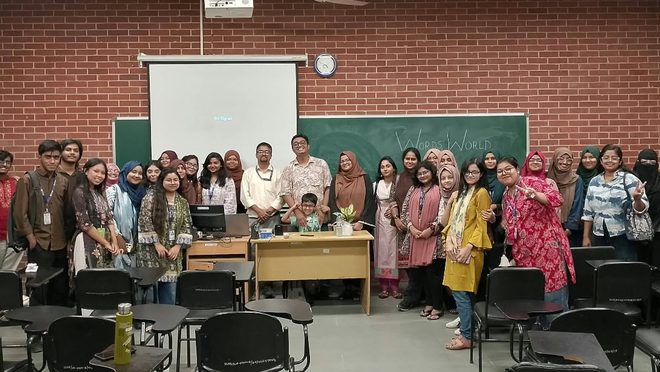
The ULAB Language Club hosted a seminar titled “Words, Worlds, and Data: An Introduction to Corpus Linguistics” at the University of Liberal Arts Bangladesh (ULAB) on October 8, 2026, introducing students to the role of authentic language data in understanding linguistic patterns and conducting language research.
The seminar was conducted by Kazi Amzad Hossain, a lecturer in the Department of English at the University of Asia Pacific. The session explored the fundamental concepts of corpus linguistics and demonstrated how large collections of real-world language data, known as corpora, can be used to examine vocabulary, grammar, meaning and variations in language use across different contexts.
The seminar highlighted how corpus-based approaches can help researchers identify recurring patterns, investigate language in context and develop evidence-based interpretations of linguistic phenomena. It also emphasised the relevance of corpus linguistics to academic research and its potential applications in linguistics, literature, English language teaching (ELT) and related fields.
The session provided students with an opportunity to expand their understanding of contemporary linguistic research methods and explore the connection between theoretical knowledge and practical applications. Participants also gained insights into the growing importance of empirical approaches to language research through the systematic collection and analysis of data.
The ULAB Language Club expressed its gratitude to Kazi Amzad Hossain for sharing his expertise and contributing to the participants’ academic learning experience. The club also acknowledged the students and other attendees whose participation contributed to the seminar.
The initiative reflects the ULAB Language Club’s commitment to fostering academic engagement, promoting language-related research and creating opportunities for students to explore emerging areas of linguistic inquiry.