How Dipro Prattoy turned his study abroad experience into DP Tutorials
In April 2020, a young man who had recently worked out how the maze of foreign university admissions really functions found himself answering the same questions over and over, from friends, from juniors, from cousins, and from strangers who had simply found him on Facebook, and he kept answering them for hours at a time because he remembered how bewildering it had all felt from the other side.
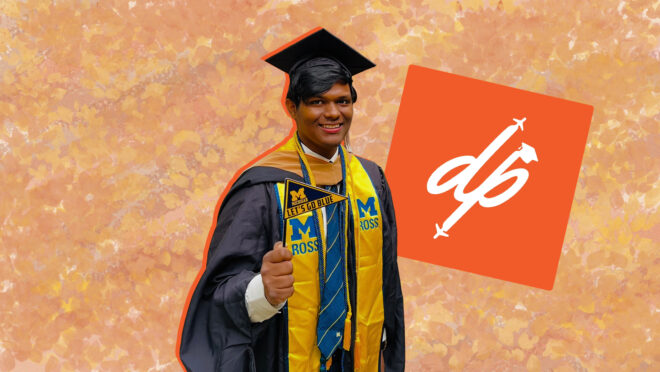
Dipro Prattoy had no idea he was laying the first bricks of anything, and he says so himself with a smile: “In April 2020, there was no master plan to build an education company.”
What began with a first student, has since grown into DP Tutorials (DPT), a Chattogram-based ed-tech platform that offers a Bangla-language Study Abroad 101 course, SAT and IELTS preparation, an extracurricular community called ECA Adda, essay correction, admission cohorts and Masters/PhD packages for students across Bangladesh, Nepal, India, Pakistan and beyond, and Dipro, who studied computer science and management and now works in cybersecurity consulting, sat down with us to talk about how that early flood of questions turned into something much larger.
The questions arrived because of how his own applications had gone, and he describes that period with the cheerful honesty of someone who learned most things by getting them wrong the first time.
“When I was applying, I was just trying to figure things out for myself. I applied very broadly, made a lot of mistakes, learned how financial aid worked, learned how different countries approached admissions, and eventually received more than 30 acceptances across five countries.” “After that, people around me naturally started asking questions. At first it was friends, juniors, cousins, random people messaging me on Facebook. I would spend hours explaining SATs, essays, financial aid, extracurriculars and university choices.”
He realized soon enough what he had become, and he is still amused by it. “At some point I realized I had basically become the unpaid “study abroad guy” in everyone’s inbox. That eventually became one of the reasons DP Tutorials started.” His first student, he adds, is someone he now shares his life with: “Sadikshya was technically my first student, which is funny considering she is now my wife.”
In the beginning, DPT was simply Dipro doing everything, from teaching and checking essays to making videos and talking with parents, so the moment it became something more is one he remembers clearly. “The moment I realized it had become something bigger was when students started joining who had never heard of me personally. They knew DP Tutorials as an organization.” Mentors, instructors and product managers followed, and by his count the reach has grown a long way since. “Today, more than 18,000 students have gone through different DPT programs and services.”
A heavier sense of responsibility came with that growth, and he talks about it without any bravado, because families were trusting his team with some of the biggest decisions of their lives. “There have definitely been many “what have I gotten myself into?” moments. Especially when you realize that students are making decisions involving years of their lives and sometimes their families’ life savings based partly on your guidance.” “That responsibility changed how I thought about the organization. It could no longer just be about giving advice. We needed systems, quality control, training, technology, accountability and people who genuinely cared about student outcomes.”
Dipro has firm views on what the wider study abroad industry often gets wrong, and they come from the concern of someone who has watched anxious families make enormous decisions rather than from any wish to criticise. “I think the biggest mistake is treating university admission like a transaction.” “A student walks in, receives a list of universities, submits applications and leaves. But choosing where to spend four years of your life should not work like buying a plane ticket.” At DPT, he says, the aim is to move in a different direction. “At DPT, we have tried to move toward education and decision-making rather than simply application processing. We teach students why they are making a decision rather than just telling them what decision to make.” He is just as candid about the risk his own team faces as it grows, and it is clear that he thinks of every student as a person before a case. “But DPT can absolutely get things wrong too. Our biggest risk as we grow is losing personalization. So one thing I constantly remind our team is that what may look like “application number 72″ to us could be the most important decision that student has ever made.”
Much of what drives him is how unevenly opportunity is spread across the country, and he speaks most warmly about the students who have to travel the furthest, in every sense, to reach good guidance.
“A student in Chattogram should not need to travel to Dhaka every week simply to receive good university guidance. A student from outside a major city should not be disadvantaged because the best mentor is physically hundreds of kilometres away.” For him accessibility also means affordability and independence, and he hopes students will leave DPT understanding the process well enough to manage without it. “The long-term goal is not to create students who constantly need us. It is to create students who eventually know how to make informed decisions themselves.”
He believes international admissions advice often overlooks the realities Bangladeshi students live with every day. “A student at a school in Bangladesh may have never had a college counsellor. Their school may not offer twenty clubs. Their parents may know very little about the American admissions system. They may be preparing for the SAT while simultaneously dealing with HSC, coaching centres, family expectations and financial uncertainty. And yet some of these students are extraordinarily talented.” What he asks of every mentor is to meet students where they actually are. “The job is not to copy an American student’s extracurricular profile. The job is to understand what opportunities existed in the student’s actual environment and what they did with those opportunities.”
When a student arrives fixed on a famous name, Dipro is glad to encourage ambition but wants the decision to rest on more than a ranking, which has sometimes meant kindly advising a student not to apply at all. “I have nothing against ambitious applications. In fact, I encourage students to have a few dream schools. But rankings should never replace thinking.” “Getting admitted to a famous university is exciting. Spending the next twenty years paying for the decision may not be.” The same gentleness shapes how his team treats essays, which he regards as among the most personal things an applicant will ever write. “The student’s story has to remain the student’s story. If I rewrite someone’s essay until it sounds like me instead of them, I have failed. Good mentorship should improve the student’s ability to communicate. It should not replace their voice.”
After years of watching students move through the process, he has a clear sense of where they place their worry, and he hopes they can lighten that load while still planning for the practical side of the dream. “Students overestimate individual numbers: one SAT score, one ranking, one GPA point, one rejection. They underestimate consistency and fit.” “An acceptance letter feels emotional. Debt is mathematical. Both need to be considered.”
His own career can look like a collection of unrelated chapters, yet Dipro sees one thread running through it, and he is thoughtful about what scaling DPT has cost him personally, since the work he enjoys most is the work he now gets to do less of.
“I studied computer science because I was fascinated by technology. I studied management because I wanted to understand how organizations actually use technology and make decisions.” “Teaching is still probably my favourite part of DPT. There is something very rewarding about explaining something directly to a student and watching the confusion disappear. But I also realized that if every student had to speak to Dipro for DPT to work, then I had not built an organization, I had built myself a very exhausting job.”
When asked what the Dipro of April 2020 would make of the present, he reaches for the people behind the numbers rather than the numbers themselves. “But I think 2020 Dipro would be happiest about the messages from students. When someone tells you that something you taught them helped them earn a scholarship their family could never otherwise afford, or reach a university they thought was impossible, that still feels different.”
It is the road ahead that he talks about with the most energy, and he begins with an idea he keeps returning to as DPT grows. “One thing that has become increasingly important to me is understanding how technology can make educational guidance more scalable without making it less human.” He is quick to point out how far the work has already travelled from a single classroom into the wider education community. “DPT has now worked with schools, universities and other educational organizations in Bangladesh, and we have had opportunities to contribute to initiatives such as the national round of the Bangladesh Olympiad on Astronomy and Astrophysics. Students who have learned through our programs and content have gone on to receive substantial scholarships and admissions to highly selective universities.”
His day job has given him a second lens on the same questions, and he sees his two worlds growing closer. “At the same time, my professional work in cybersecurity has made me think much more deeply about responsible technology adoption, privacy, governance and AI.” “Over the next few years, I want the intersection of those experiences to become a bigger part of what I work on: using technology to make high-quality education and decision-making more accessible, while making sure the technology itself is deployed responsibly.”
For all that he is building toward, the advice he offers students is wonderfully simple, and he gives it like an older brother who has been through the same nervous wait for an answer and wants to make it a little easier for whoever comes next.
Looking back at his own application years, he says, “At 18, I thought admissions were much more formulaic than they actually are.” “I would probably spend less time trying to look like the “perfect applicant” and more time developing a coherent story about what I genuinely cared about. And I would worry less.” To every student still waiting on a decision, he leaves a reminder that carries both comfort and perspective. “Your first acceptance will not define you, and neither will your first rejection… Looking back, university mattered tremendously to me. Michigan changed my life. But what you do once you arrive matters even more. So I would probably tell myself: work hard on the application, but do not confuse getting into a university with succeeding in life. Those are two very different things.”