BAU team wins National Research Project Contest 2026 championship
BAU team wins National Research Project Contest 2026 championship
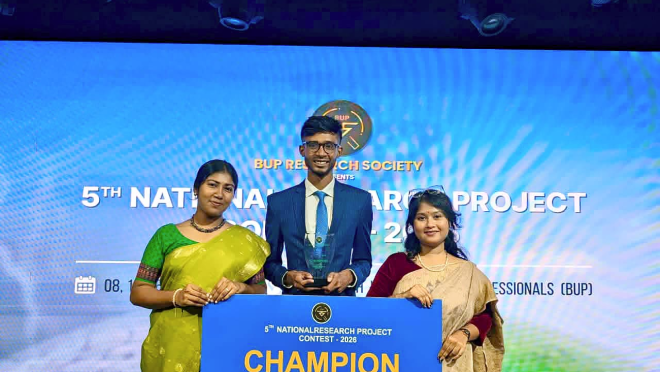
A three-member research team from Bangladesh Agricultural University (BAU) has won the championship in the ‘A’ category of the fifth National Research Project Contest 2026, organised by the BUP Research Society at Bangladesh University of Professionals (BUP).
The final round of the national competition was held on 16 August (Sunday) at the Bijoy Auditorium of BUP, according to a press release.
The winning team comprised Nashmin Ferdous, a fourth-year student of the Faculty of Agriculture at BAU, and third-year students Chapal Kundu and Mushfiqur Ibn Zahid from the same faculty.
Around 250 research abstracts were submitted online by students and researchers from nearly 50 public and private universities across the country. Following an initial screening, 32 research projects were selected for offline presentations.
In the final round, the selected teams presented their research findings before a panel of judges. The projects were evaluated based on presentation quality, scientific significance, relevance of the research topic and overall findings. The BAU team was selected as the champion in the ‘A’ category based on these criteria.
The competition featured two segments, Research Project Paper and Critical Essay Writing. The BAU team competed in the ‘Research in Science, Engineering and Technology’ category under the Research Project Paper segment.
The team presented research titled ‘Activation of Autophagy Mitigated the Salt Stress Sensitivity in Rice Seedlings’. The research was based on findings from a project titled ‘Effects of Autophagy Activator and Inhibitor on Salt Stress Sensitivity in Rice Seedlings’, funded by the Bangladesh Agricultural University Research System (BAURES).
The project was led by Dr Md Arif Sakil, Associate Professor of the Department of Biochemistry and Molecular Biology at BAU. The three students worked as research assistants on the project and contributed to the research.
Nashmin Ferdous said the team was proud to win the competition and had been interested in research from an early stage of their undergraduate studies. She said they approached Dr Md Arif Sakil about getting involved in research, after which he gave them the opportunity to work on the project.