10 very important 'don'ts' for the metro rail
The advent of the Dhaka Metro Rail marks a transformative chapter in Bangladesh’s urban transportation narrative.
10 very important 'don'ts' for the metro rail
The advent of the Dhaka Metro Rail marks a transformative chapter in Bangladesh’s urban transportation narrative.
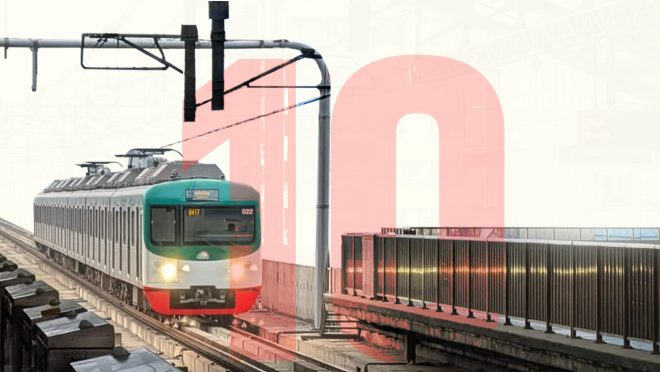
Designed to alleviate congestion, restore predictability to daily commutes, and elevate civic discipline, the metro rail is not merely a transport system; it is a social contract.
Yet, as with any public infrastructure, its success depends less on engineering, travellers or beautification and more on human behaviour. What follows is a carefully considered, professionally satirical top ten things one must absolutely not do while using the metro rail in Bangladesh. Each point reflects deeper social patterns and cultural contradictions.
1. Do not treat the metro as a moving drawing room
One of the most fascinating tendencies in South Asian urban culture is the domestication of public space. The metro is not an extension of your house. It is not the place to sprawl, conduct loud family discussions, or reorganise your shopping bags as if preparing for a weekend inventory audit. The temptation to recreate personal comfort in public often stems from a lack of spatial boundaries, but in a high-density transport system, such behaviour erodes efficiency and mutual respect.
2. Do not ignore the line
Queue formation in Bangladesh often operates as a theoretical construct rather than a practised habit. The metro rail challenges this norm. Attempting to bypass lines, pushing ahead, or forming ambiguous clusters near the door defeats the purpose of a rapid transit system. The irony is stark. A system designed for order becomes dysfunctional when users insist on improvisation. Queue discipline is not merely etiquette. It is infrastructure in human form.
3. Do not turn the train into a studio
The rise of digital exhibitionism finds fertile ground in aesthetically pleasing environments, and the metro rail is no exception. However, prolonged photo sessions, video recordings, or live streams inside crowded compartments compromise both privacy and safety. The deeper issue here is the prioritisation of performative presence over collective convenience. Public transport is not a backdrop for curated identities. It is a shared utility requiring minimal disruption.
4. Do not block doors
Standing at the doorway without intention to disembark reflects a peculiar blend of indecision and territorial instinct. It creates unnecessary bottlenecks and delays. This behaviour often arises from a fear of missing one’s stop, yet ironically increases the likelihood of exactly that. Efficient passenger flow depends on clear entry and exit pathways, an elementary principle frequently undermined by human hesitation.
5. Do not open your mouth
Acoustic pollution is an under-discussed yet pervasive issue in public spaces. The metro rail, designed for efficiency and relative calm, is not the venue for high-volume conversations or theatrical phone calls. This includes the habit of placing phones on speaker mode, thereby involuntarily including dozens of strangers in personal affairs. Silence, or at least moderation, is not repression; rather, it is consideration.
6. Do not be disgusting
A newly established system like the Dhaka Metro Rail inevitably reflects the habits of its users. Discarding wrappers, bottles, or tickets within the premises reveals a persistent cultural detachment from shared responsibility. Cleanliness in public infrastructure is not maintained by staff alone. It is co-produced by every individual who chooses not to litter.
7. Do not become a woman unless you are one.
Seats or compartments designated for women are not symbolic gestures; they are functional necessities. Occupying them without need, or refusing to vacate them when required, reflects a deeper ethical lapse. A society’s maturity is often measured by how it treats its most vulnerable members, and the metro rail offers a daily test of that principle.
8. Do not attempt to override informal authority
There exists a deeply ingrained belief that rules are negotiable, especially when one can invoke personal connections or perceived status. Attempting to bypass ticketing procedures, security checks, or staff instructions undermines institutional integrity. The metro rail operates on standardised protocols. It is indifferent to hierarchy and immune to informal influence, at least in theory. Respecting this neutrality is essential for its long-term credibility.
9. Do not convert transit time into commercial opportunity
Unauthorised vending, solicitation, or promotional activities within metro premises disrupt both order and safety. While entrepreneurship is commendable, the metro rail is not an open marketplace. Allowing such activities would not only clutter the system but also compromise its primary function. The broader issue here is the inability to distinguish between appropriate and inappropriate contexts for economic activity.
10. Do not underestimate
Perhaps the most subtle yet significant misstep is failing to recognise the metro rail’s broader societal role. Treating it casually, disregarding its rules, or comparing it simplistically with buses or rickshaws overlooks its transformative potential. It demands punctuality, discipline, and mutual respect, qualities that extend beyond commuting into the fabric of civic life.
The metro as a mirror
Every action within Dhaka Metro’s compartments, whether orderly or chaotic, contributes to a larger narrative about urban citizenship in Bangladesh. Riding it without any civic sense is another alarming fact.
Pushing women, sitting while elderly people or pregnant women are standing, taking unethical advantage of the crowd, and other such acts state the uneven decline of civic sense that depicts why ethical knowledge is important in this country.
The success of the metro rail will ultimately depend not on its speed or capacity, but on the willingness of its users to adapt, to internalise discipline, and to respect the invisible contract that binds strangers in shared spaces. In essence, the metro rail asks a simple yet profound question: can a society accustomed to improvisation embrace structure without losing its identity? The answer, unfolding daily between stations, remains a work in progress.