AIUB hosts first ‘QS Bangladesh Forum 2026’; Education Minister announces PhD plans for private universities
AIUB hosts first ‘QS Bangladesh Forum 2026’; Education Minister announces PhD plans for private universities
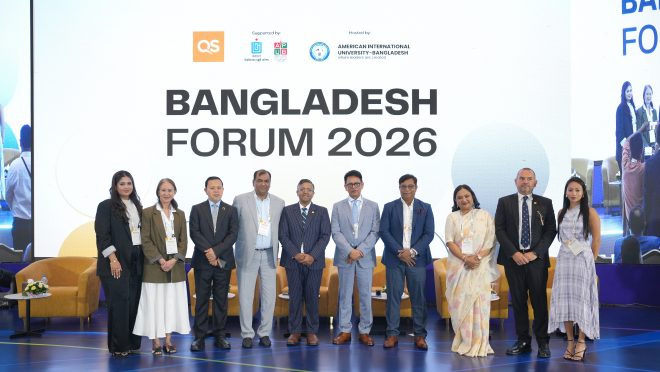
Minister for Education and Primary and Mass Education Dr ANM Ehsanul Hoque Milon has signalled that initiatives will soon be taken to introduce PhD programmes at private universities, stressing the need to expand advanced research opportunities in Bangladesh’s private higher education sector.
He made the remarks at the inaugural QS Bangladesh Forum 2026, held at Sheraton Dhaka on Monday (17 August). American International University-Bangladesh (AIUB) hosted the forum, organised by QS (Quacquarelli Symonds) with support from the University Grants Commission of Bangladesh (UGC) and the Association of Private Universities of Bangladesh (APUB), according to a press release.
Held under the theme “Benchmark Bangladesh: Building World-Class Universities Through Global Standards”, the first-ever forum brought together key stakeholders to discuss the future of higher education, adherence to global standards and ways to improve the international standing of Bangladeshi universities.
Dr ANM Ehsanul Hoque Milon attended the inaugural session as the chief guest, while University Grants Commission of Bangladesh Chairman Professor Dr Mamun Ahmed was the guest of honour.
Questioning why private universities should not be permitted to offer PhD programmes, the education minister stressed the importance of creating broader opportunities for advanced research in the private higher education sector.
Referring to the development of private universities in Bangladesh since 1992, he said the country must now provide greater opportunities for advanced research at such institutions. Bangladesh needs cross-border education and stronger research capacity at private universities, he added.
The minister said the country had no shortage of teachers and researchers, with thousands contributing to national development through their knowledge, expertise and “Made in Bangladesh” capabilities. He called on all stakeholders to work together to build a stronger Bangladesh.
Professor Dr Mamun Ahmed said private universities in Bangladesh still had significant room for improvement in global rankings.
He stressed that universities must take the lead in improving academic quality and making their institutions more attractive to students. Such efforts could draw more international students to Bangladesh for higher education, he said.
The UGC chairman also urged private universities to set aside institutional differences and work collectively to improve the quality and internationalisation of higher education.
QS Vice President – Strategic and International Engagement Dr Ashwin Fernandes, Chief Commercial Officer Jason Newman and Director of Regional Partnerships Rami Awad also addressed the forum.
AIUB Founding Member of the Board of Trustees and APUB Secretary General Ishtiaque Abedin delivered the welcome address, while APUB President Dr Md Sabur Khan also spoke.
AIUB Founding Member and Chairperson of the Board of Trustees Nadia Anwar delivered the vote of thanks at the inaugural session.
Three dedicated sessions were subsequently held on the QS Rankings Methodology, Bangladesh’s QS ranking landscape and the QS Rankings 2028 Cycle.
The forum also featured two high-level panel discussions involving vice-chancellors from leading universities across Bangladesh. The sessions were titled “From Campus to Capability: Closing Bangladesh’s Future Skills Gap in the AI Era” and “Accelerating Digital Transformation in Higher Education”.
The discussions focused on the skills students will need in the age of artificial intelligence, aligning education with industry requirements, using technology in higher education and accelerating digital transformation across universities.
AIUB former vice chancellor, Academic Adviser and Member of the Board of Trustees Dr Carmen Zita Lamagna delivered the vote of thanks during the closing session.
The forum brought together vice-chancellors and senior university representatives, academics, members of boards of trustees, UGC members, policymakers, government representatives, diplomatic missions, international organisations, development partners and representatives from the industrial sector.
The event placed particular emphasis on the internationalisation of higher education, improving the global visibility of research, enhancing student outcomes and capabilities, and strengthening international partnerships.
With the QS World University Rankings 2028 cycle approaching, participants also discussed developing a common, practical and strategic roadmap to help universities prepare for the process and improve their global competitiveness.
The forum opened new avenues for collaboration among universities, the government, international partners and industry, and is expected to contribute to strengthening Bangladesh’s higher education sector and advancing its universities towards globally recognised standards.