GhushSite: The bribe, the bureaucracy and the website keeping score
What happens when the purest vices everyone knows is finally put into one public record?
GhushSite: The bribe, the bureaucracy and the website keeping score
What happens when the purest vices everyone knows is finally put into one public record?
In Bangladesh, bribery is a known major national issue. Yet not much has been done to solve it. Ordinary people standing at any government office are facing it every day. A passport file needs to move. A driving licence needs to be processed. A birth certificate or NID issue is deliberately delayed. And behind all of these is an unofficial demand.
But how much is usually asked for? Is the amount normal for that service or is someone simply trying to charge more? And where, in which offices, has this become a regular notion?
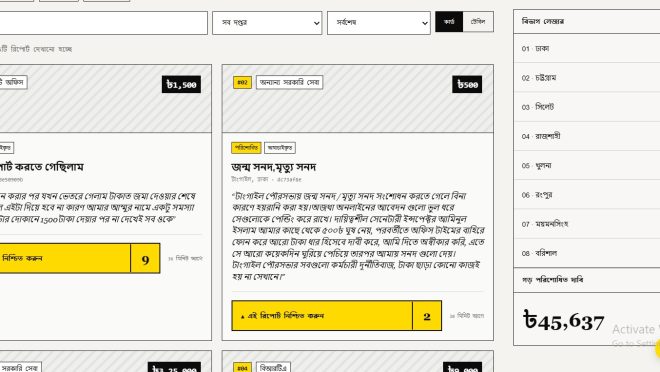
This information gap is what two young Bangladeshi creators are trying to address through their creation, GhushSite. This is a public platform where people from all over the country can anonymously report alleged bribe demands.
The website was created by Saif Kabeer, 23, and Shahed Sharif, 18. Neither comes from an anti-corruption or activist background. Saif runs two studios and is completing a double major in Computer Science and Marketing at BRAC University, while Shahed is an A Levels student, full-stack developer and product engineer.
“We are two people who build things on the internet and this was a thing that clearly needed to exist,” Saif said.
The idea came after Saif found an Indian website, bribes.fyi, which works in a similar way. He sent it to Shahed and suggested that someone should build a Bangladeshi version. Then they decided not to wait. “We built and shipped the Bangladesh version in a day,” Saif said. GhushSite went live on 21 August.
The idea came and, instantly, the initiative was taken.
The platform does not claim that a website can solve corruption. Instead, it aims to make information public. A person can browse reports and see alleged demands connected to departments, services and locations. If someone approaches a counter already knowing that many others have reported similar demands, they may be in a stronger position than someone who arrives with no idea what to expect.
The website was also designed around anonymity. Users do not need to create an account or provide a name, email address or phone number. They can submit the department, service, approximate location, amount demanded, outcome and a short description.
The reason, Saif said, is simple: “Without it, the site is empty and useless.”
Many people who experience bribery may still be dependent on the same office to complete their work. Asking them to reveal their identities could create additional risks. At the same time, the creators acknowledge that anonymity creates another problem: false or exaggerated reports. “Yes, and I would not trust anyone who claimed otherwise,” Saif said.
To deal with this, every published entry is marked as “Unverified”. The site does not name individual officials and the creators say they are not trying to investigate or prove each allegation. Instead, they focus on the wider pattern created when many reports point towards the same experience. Readers can also confirm reports if they have experienced something similar. “One person saying it is a claim,” Saif said. “Nearly four thousand people saying the same thing independently is a pattern.”
However, not every submission is published. Reports first enter a moderation queue. Spam, personal information, names, phone numbers, incitement and other unsafe content can be rejected or edited before publication.
The possibility of political or institutional pressure was also considered before the website was launched.
According to Saif, it shaped the platform’s design “more than anything else did”. GhushSite does not name individual officials or claim to investigate, verify or judge allegations. “We are an awareness ledger,” he said. The creators are publicly known because they believed a platform built around transparency should not hide its own operators. As Saif said, “If we are asking people to trust how we handle their reports, they should at least know who is handling them. We are publishing self-reported, clearly labelled allegations about offices and processes.”
This concern about personal information is currently the creators’ biggest worry.
“If a name, a phone number, or a detail specific enough to identify a real person gets past moderation and goes live, that is real harm to a real individual,” Saif said.
The response, surprisingly, has been much faster than they expected. A day and a half after launch, the site had already published 522 reports from all eight divisions, recording roughly Tk3.41 crore in alleged demands. Dhaka had the highest number of reports, followed by Chattogram. More importantly, some users are already using the platform in a way the creators had not originally planned. Instead of reporting after an experience, they want to check the website before visiting an office. “They wanted to check what a service currently costs at a given office before walking in,” Saif said.
That may eventually become one of GhushSite’s most important functions.
The creators do not present their data as a scientific measurement of corruption in Bangladesh. The reports are self-selected, self-reported and unverified. But they believe the data can still reveal patterns over time. GhushSite is built around a simple idea: one story may be easy to ignore, but hundreds of similar stories are harder to dismiss.
In the end, a success for the creators means, “A very unglamorous outcome: somebody checks the site before going to an office, sees what has been reported for that service, and refuses to pay more than that. Or refuses at all. I do not need to be told it happened. I just need the mechanism to be real.”
“Everyone knows” may remain a common phrase in Bangladesh. But perhaps a public record can finally turn that common knowledge into something people can see, compare and question.
“Your single report does not have to prove anything on its own,” Saif said. “One story is an allegation. Many records reveal a system.”