A classroom without a future for Rohingya children
There wasn’t any formal or informal education from 1991 to 2000; there was no classroom to speak of. There was no proper structure for an entire generation of Rohingya children.
A classroom without a future for Rohingya children
There wasn’t any formal or informal education from 1991 to 2000; there was no classroom to speak of. There was no proper structure for an entire generation of Rohingya children.
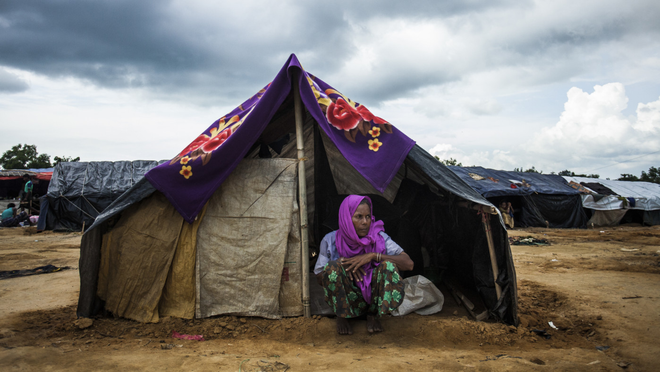
But things eventually changed. Fast forward to 2024, Rohingya children had access to internationally recognised education for the first time, through the Pearson Edexcel curriculum.
From an unaccredited Myanmar curriculum to a proper, certified syllabus. That was real progress. But it reached only two of the total thirty-three camps in Cox’s Bazar, and this is the story of what got built in the other thirty-one, and what still hasn’t.
Two men have spent their lives inside this system. Abdul Hamid is Principal of Bright Future Academy and President of the Association of Rohingya Students Development (ARSD). Imran Mohammed became the camps’ first elected refugee representative in 2015 and has spent 35 years as a human rights advocate in Kutupalong.
Together, their voices trace a system that shows the unfiltered education reality of the Rohingya community.
A system built on improvisation
There are a total of 33 camps in Cox’s Bazar. Only two, Kutupalong and Nayapara, are formally registered.
The other 31 camps are home to most Rohingya who arrived after 2017. They run differently. They follow a Burmese curriculum that sometimes goes up to Grade 12, plus informal private centres run by educated community members.
None of it is formally recognised. None of the certificates are accepted by universities anywhere. Mohammed sums up three decades of this: “There haven’t been any significant improvements in the camp’s education systems.”
Why children disappear from the system
Access is only half the story. The other half is who stays once the door is open. Hamid’s numbers are stark. An estimated 300,000 children, about 60 per cent, are enrolled in UNICEF and NGO-supported learning centres following recent expansions of the Myanmar curriculum. Between 150,000 and 200,000, roughly 40 per cent, are out of school entirely or attend irregularly.
Three things explain the gap. Both Imran and Hamid described similar gaps.
First comes poverty. Parents are barred from formal work, so incomes stay low and children get pulled out to work informally, to help the family survive.
Gender and safety come second. “For girls, the barriers are doubly complex,” Hamid said. Due to conservative norms and safety concerns in the crowded camps, families prefer to keep girls at home. Mohammed adds that learning centres aren’t built as female-friendly spaces either.
And lastly, hopelessness. With no recognised certificate waiting at the end, students start asking the obvious question, in Hamid’s words: “What will I do after studying? What will my future look like?” When the honest answer is nothing will change, motivation naturally goes out the window.
Teachers under strain
The people running these classrooms face the same constraints as their students. Salaries are too low for teachers to commit fully to the job. Classrooms are short on materials. Facilities are limited.
And still, Hamid says, Rohingya teachers are running extra courses and training with foreign donors, because the alternative is watching their students hit a wall with nothing behind them. It isn’t enough, but it’s what’s holding the system together right now.
There is one recent shift on this front that came through the government’s February 2026 funding package, which is expected to bring over 7,800 volunteer teachers into UNICEF-run centres, paid an honorarium under the project’s terms.
What Bangladesh did
In December 2015, the government and UNHCR allowed Rohingya refugees to elect a representative from their own community for the first time since displacement. Most Kutupalong residents had never experienced anything like it. “Many refugees who were born and grew up in the Kutupalong camp had no idea what an election even was,” Imran said. He won it.
By February 2016, he was coordinating directly with UN agencies, NGOs, and government bodies for roughly 17,000 people.
In 2024, the Pearson Edexcel curriculum came through, which was the first structured, internationally recognised education.
Lastly, in February 2026, when foreign donors pulled back sharply, about half of the camps’ 8,000 learning centres shut down. At that time, Bangladesh stepped in with World Bank-backed funding to keep them open. It was the first time it had funded Rohingya education directly rather than leaving it to donors.
What students are actually asking for
The demands from Rohingya youth, as Hamid hears them through ARSD, aren’t vague. Students want colleges and universities built inside the camps, real campuses with recognised degrees, not another informal centre. They want scholarships that let them compete on equal footing, in Bangladesh and abroad. And they want to study without hiding who they are.
On this point, Hamid’s own story comes. To keep studying past the seventh grade, he hid his Rohingya identity to complete his education. Hamid talks about the current students of the camp: “They do not want to hide their heritage or live in the shadows just to get an education.”
What both men say needs to change
I asked Hamid and Mohammed separately what needs to change, and their answers line up almost word for word.
Hamid suggested three: formal, internationally accredited certification; real higher education pathways through university partnerships and technical institutes; and employment or vocational pathways so credentials actually lead somewhere.
Mohammed suggested another three, given independently: accredited education, a pathway to higher education, vocational training.
Two men, two generations of leadership in the same camps, landing on the same list without comparing notes. That’s the strongest evidence in either interview that the fix isn’t a mystery. It’s a matter of will and funding.
What happens if nothing changes
Both men were asked what happens if nothing changes in the next five to ten years.
Hamid warned of “massive dropout rates” and a generation that loses “all motivation to stay in school.”
Mohammed put it more plainly: without accreditation and real opportunity, “many refugee children remain illiterate, which will affect future generations in the camp and beyond.”
What he wants instead is specific. He wants Rohingya girls especially, “with power and intelligence in society.” His closing message to donors and policymakers is simple: a formal, accredited education policy for Rohingya children is a door that will open many opportunities.
Closing note
Rohingya Genocide Remembrance Day falls on 25 August marking nine years since the 2017 displacement. The clearest measure of what Bangladesh has done sits in that February 2026 approval: Tk203.87 crore, jointly funded with the World Bank, reaching more than 256,000 Rohingya students through UNICEF-run learning centres.
It is the first time Bangladesh has funded Rohingya education directly rather than leaving it to NGOs and foreign donors, and it came at a moment when funding shortfalls had already forced camp learning centres to close. It did not open the door Hamid and Mohammed are still asking for. But it kept the door from closing entirely.
Nine years on, Bangladesh has moved from permitting access to funding it directly, from an election in 2015 to a curriculum in 2024 to a budget line in 2026. Each step arrived narrower and later than the crisis demanded. But each one arrived. And somewhere inside that record is a smaller, harder shift, from a student hiding his identity just to stay in school, to a principal building one for students who refuse to hide their identity. That is the record so far, and it is one worth building on rather than waiting on.