How one musician is nurturing Bandarban’s next generation of guitarists
From a rented room and a single guitar to performances on bigger stages, Amlai’s journey reflects a larger dream: giving the children of Bandarban a space to create, collaborate and find their voice
How one musician is nurturing Bandarban’s next generation of guitarists
From a rented room and a single guitar to performances on bigger stages, Amlai’s journey reflects a larger dream: giving the children of Bandarban a space to create, collaborate and find their voice
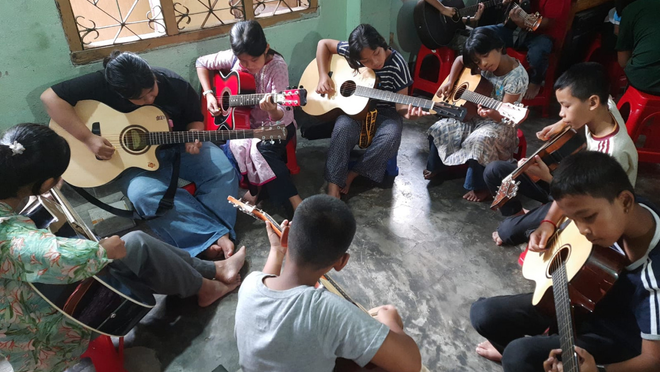
Scrolling through Facebook one day, I came across a group of children singing Level Five’s Tumi in perfect sync, with guitars in their hands. Their soothing voices made me stop scrolling. I became curious about where they were from and, more importantly, who had taught them.
That curiosity led me to Bawm Ram Tiam Amlai, a local musician from Bandarban who has spent years teaching guitar to children and young people through his Basic Guitar Learning School.
From one guitar to a classroom
In 2017, a friend introduced him to a student who wanted to learn to play the guitar. By 2018, Amlai decided to take teaching seriously.
He started with one guitar in a rented room and gradually built the school into what it is today.
His classes are now held at the Marma Artists Group training room in Bandarban town, accommodating around 20 students. Most are aged 10–17 and come from 10 different communities, drawn largely to band music and songs from their own communities.
Amlai teaches the fundamentals of guitar, including finger exercises, chords, strumming, chord progressions, saregama and basic vocal control. Students also learn about sound systems.
But he sees guitar lessons as more than simply learning to play an instrument. Learning a new chord or melody requires repeated practice. For Amlai, that process teaches children patience and perseverance. Regular practice also helps them manage their time and remain focused on a goal.
Playing together teaches another lesson.
“When they play in a group or band, they have to match their sound with one another,” he explained. “It develops mutual respect and teamwork.”
Listening is equally important. A good musician must pay attention to what others are playing, something Amlai believes can translate into a broader ability to listen to other people’s opinions.
Performing in front of classmates and audiences, meanwhile, can help children overcome shyness and develop confidence.
At the school, mistakes are treated as a natural part of learning rather than something to fear. Because every student has a different pace and ability, Amlai tries to provide individual guidance instead of forcing everyone through the same process.
“There is no harmful competition among the students. Instead, they help one another,” he said.
Parents, he believes, have an equally important role to play. Encouragement at home, regular practice and a calm environment can determine whether a child continues with music when the initial excitement fades.

Bawm Ram Tiam Amlai has spent years teaching guitar to children and young people through his Basic Guitar Learning School.
The musician behind the teacher
Amlai’s connection with music began in childhood in Bengchhari Munthar Bawm Para, Rowangchhari. In Class 4 or 5, he started playing a guitar shared by people in his village.
“There was a guitar in our village and everyone used to play it. I watched them and started playing too,” he recalled.
Church gatherings, community events and school competitions deepened his interest. He credits the local musicians he watched growing up with shaping his ambition.
“Thwe Thwe Da, Koko wai Da, Sweting Da, Ukhyai Da, Chaw Thwe Phru Sir, and many others used to sing and play. Watching them made me think, ‘If only I could play like them,” Amlai said.
In 2005, Chathui Pru Sir encouraged him to learn bass guitar, he said. He has been playing in a local band named Chimbuk since 2007.
Taking the classroom to bigger stages
For some students, the guitar lessons have also opened doors beyond the classroom.
His students have performed at the National Parliament complex and shared the stage with legendary rock band Warfaze. Amlai believes such opportunities can change how young performers see themselves and what they believe they can achieve.
One former student, Primi Provaa Das, stands out in his memory. Amlai taught her guitar in 2017 and introduced her to the fundamentals of music. She later completed her studies in music in Kolkata and now teaches music in Bandarban.
For Amlai, her journey reflects what he hopes his students will eventually become: musicians who can pass what they learn on to others.
The struggle behind the music
The music may sound effortless when the students perform, but keeping the school running has been anything but easy. In the early days, three or four students often had to share one guitar, while strings, picks and tuners added to the cost. Bandarban’s climate can also damage wooden instruments and wear out strings quickly.
Finding a suitable space and bringing students from remote hill areas, particularly during the monsoon, have made things harder. Instruments and accessories often have to be brought in from Dhaka or Chattogram.
Still, support has come from unexpected places. After the school gained attention on Facebook, two women from Dhaka gifted their guitars to his students.
“I never imagined that I would receive this kind of love and support,” Amlai said.
A bigger dream for the hills
For Amlai, the school is also about the children growing up in the hills. He wants music to keep them connected to learning and creativity, while giving them a space away from mobile games, online gambling, drugs and hopelessness.
He hopes to build a permanent music academy where students can learn guitar, songwriting, composition, piano and drums, with soundproof classrooms and a small recording studio to preserve their own music.
But his larger dream is rooted in the hills themselves. Amlai wants to introduce the region’s sounds to a wider audience. He also hopes his students will eventually become mentors, creating a musical community that can continue to grow in Bandarban.
The video has now crossed 1 million views on Facebook. The raw talent is hard to ignore. But for Amlai, the hills have always been an important part of that music.
After nearly two decades of teaching in Bandarban, he believes the Sangu River, mountains, clouds and quiet forests have shaped the way his students listen, practise and understand music.
“There is a strange, almost magical force in Bandarban’s mountains, skies and people. The nature here gives them the vastness of music, while its people teach them the strength of togetherness and its air teaches them humility and sincerity,” he said.