A name, a church, and three hundred years
A name, a church, and three hundred years
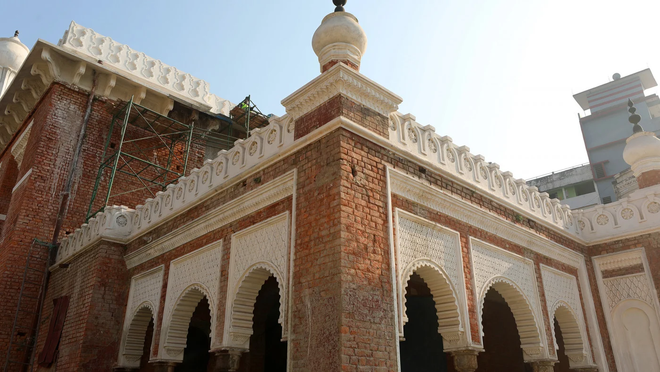
Northbrook Hall does not look like it is carrying a hundred and fifty years of somebody else’s history. It looks like it is carrying its own roof, and barely. I stood across the road from it, past the rickshaw jam at Bangla Bazar, and watched people walk past it without a second glance, the way you pass a neighbour you’ve seen every day for years.
Laal Kuthi, everyone still calls it. The red house. Nobody I asked could tell me who Northbrook was, and I did not ruin the afternoon by explaining that he was a viceroy who never lived here.
The hall exists because of a single visit. Lord Northbrook, Viceroy of India, came to Dhaka in 1874, and the city’s zamindars and affluent citizens, led by a man named Raja Rai Bahadur, decided the occasion deserved a monument. They raised the money themselves, ten thousand taka here and five thousand there, and built a town hall in his name, finished by 1879.
When the commissioner inaugurated it the following year, the entertainment came courtesy of Nawab Abdul Ghani’s own orchestra, which is its own small irony standing where I was standing, because the Nawab family’s founding fortune, as I would spend the rest of that afternoon rediscovering, had an Armenian merchant or two quietly folded into it.
A library went up beside the hall in 1882. A clubhouse called Johnson Hall went up after that. Tagore stood inside it in February 1926 to be honoured by the city he rarely bothered visiting. By 1930, the river that used to be visible from its windows had already vanished behind newer buildings, the way most things here vanish, not with an event but with an accumulation of other things simply built in front of them.
None of that is why I had come. I had come for the road that runs past the hall, the one that still carries, in its name, the only trace left of a people who used to run this city’s trade before anyone here was born to remember them doing it. Armanitola. The Armenians’ quarter. Say it out loud, and nobody looks up anymore. There is no one left to answer it.
The last man who answered to it
The last known Armenian of Dhaka, a man named Michael Joseph Martin, died in 2020. With him went the final living thread connecting this city to a community that had been here for three hundred years, which had financed its weavers, built its first private school, and quietly helped decide who its Nawabs would be. The street kept his people’s name. The people did not stay to hear it.
Following the cloth
The Armenians did not arrive in Dhaka by accident. They came following a trade route they had been walking for generations, out of Persia and the old merchant hub of New Julfa, pushed east by Safavid domination of their homeland, pulled towards Bengal by the promise of its cloth. A tombstone in Armanitola dated 1714 is the earliest hard evidence of their presence, though they were almost certainly here before that stone was cut. By the early eighteenth century, they had a settlement. By the mid-eighteenth century, they had become indispensable.
The art of standing in the middle
What made them indispensable was not wealth alone. It was a translation, in the fullest sense of the word. The Armenians learnt Bengali. They learnt the etiquette of the Mughal and later the Nawabi court. They understood European contract law well enough to represent European trading companies as Vakils, or Pleaders, at the royal courts, while also understanding the local textile economy well enough to finance the weavers who made Dhaka’s muslin the most sought-after cloth in the world. They stood, deliberately, in the middle. By 1747, Armenian merchants were reportedly responsible for something close to a quarter of all textile exports leaving the city. A community running a meaningful share of one of the most valuable industries on the planet at the time, from a neighbourhood most of Dhaka can now walk through in fifteen minutes without noticing it.
Fingerprints in stone
Their fingerprints are on institutions that outlasted their community by more than a century. Nicholas Pogose, an Armenian merchant, founded what is widely credited as the first private school in the country, a school that still operates today under his name, largely unremarked by the students who attend it. The Nawab family of Dhaka, the dynasty whose palace still sits on the riverbank as the city’s most photographed ruin, traces its founding fortune in part to Khwaja Hafizullah’s dealings with Greek and Armenian merchants, a lineage his nephew, Khwaja Alimullah, would later convert into the first Nawabship. Dhaka’s most visible symbol of Muslim aristocratic power has an Armenian merchant somewhere in its financial bloodline.
The Church of the holy resurrection
In 1781, the community that had been burying its dead in a small chapel amid the graveyard in Armanitola built something larger. The Armenian Church of the Holy Resurrection was funded by donations from men whose names now mean nothing to almost anyone in the city they gave money to: Agah Catchick Minas, who gave the land, and Michael Sarkies, Astwasatoor Gavork, Margar Pogose and Khojah Petrus, who gave the money to build it. Between 1833 and 1918, the church’s own records list over two hundred deaths, two hundred and fifty baptisms, fifty marriages. A congregation doing the ordinary work of being a community, generation after generation, in a city that was never their homeland and that they made a kind of home anyway.
The tide that stopped coming in
The decline did not have a single dramatic cause. It rarely does. Historians generally trace it to the tightening grip of British colonial trade after the mid-nineteenth century, which squeezed out the kind of independent merchant intermediary the Armenians had spent a century perfecting. There was no expulsion, no date to point to. Just an economy that stopped needing what they were good at, and a diaspora that had never fully stopped moving in the first place, drifting towards Calcutta, towards Rangoon, towards wherever the next trade route was still open.
Martin’s own life traces that drift almost exactly. He was born in Rangoon in 1930, to an Armenian father and a Parsi mother, in a family that had followed the jute trade the way earlier generations had followed muslin, city to city, wherever the ledgers made sense. The family moved to Dhaka in the 1940s. Martin became custodian of the Holy Resurrection Church in 1986 and held the post for nearly three decades, leading what prayers there still were, keeping the building standing, hosting, at one point, Mother Teresa within its walls. After his wife died in 2014, he left for Canada. He died there in 2020, and the obituaries, correctly, called him the last Armenian of Dhaka.
Sediment, not erasure
Dhaka has done this before. A few streets from Armanitola sits Farashganj, named for a French trading post, without a French speaker in it for generations. The city specialises in this particular kind of afterlife: the name of a people surviving as a place name, long after everyone who could explain the name is gone. It is not erasure, which implies intention. It is closer to sediment. A community moves through a city for three hundred years, does the work, builds the school, funds the church, marries the marriages, buries the dead, and then simply stops being replenished, the way a river stops being fed by a tributary that dried up somewhere far upstream.
Nobody renamed Armanitola. Nobody needed to erase the word to erase the people. The name kept doing its job long after the thing it named had stopped existing. Dhaka is full of names like this, still working, attached to nothing.
The church gates are usually locked. Someone will let you in if you ask at the right hour. Two hundred names on stone, in a language almost nobody in the city can read anymore, sitting inside a neighbourhood that still says their name out loud, every day, without knowing it.
I left Laal Kuthi behind me and walked into Armanitola proper, past shops selling things the Armenians never sold, thinking about how a road can carry a people’s name for three hundred years without carrying a single one of their footsteps anymore. A few roads away, past Sadarghat, there is another place that carries a similar story, only this time the name belongs to the French. They built their quarter by the river, close to the water that brought them here and carried their spices away. I think I’ll find a rickshaw and go looking for it. By the time I reach Farashganj, there should be enough river between us and Armanitola to start asking what the French were doing here in the first place.