The love story that ended in two PhDs
There is a photograph that Dr SK Tasthekur Hossain Kowshik and Dr Fariha Hossain will keep for the rest of their lives. In it, they stand side by side, graduation gowns draped over their shoulders, bonnets perfectly level.
The love story that ended in two PhDs
There is a photograph that Dr SK Tasthekur Hossain Kowshik and Dr Fariha Hossain will keep for the rest of their lives. In it, they stand side by side, graduation gowns draped over their shoulders, bonnets perfectly level.
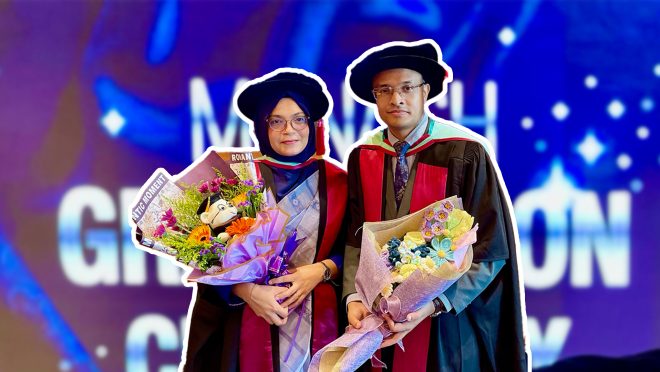
One couple, two PhDs, one shared dream finally made real. The date was 11 April 2026.
Their story begins not in a laboratory or a lecture hall, but at international academic conferences in Malaysia in 2017. Tasthekur had just finished his Bachelor of Business Administration at American International University-Bangladesh when he attended a conference and wandered onto the Monash campus. He discovered the pathway from the Postgraduate Diploma in Business and Commerce directly into a PhD programme, with fully funded scholarship possibilities. The global ranking, the proximity to home, the opportunity: it all aligned. He applied, and was accepted.
Fariha’s arrival at Monash was almost poetic in its coincidence. A pharmacy graduate from BRAC University, she attended a separate conference in Malaysia and visited the campus on a whim, with no prior plan. The welcoming staff, the well-equipped laboratories at the Jeffrey Cheah School of Medicine and Health Sciences, the warm atmosphere: she felt an immediate connection. The couple, already together at the time, had independently discovered the same destination. Both enrolled in the Postgraduate Diploma, both graduated with High Distinction, and both were awarded the fully funded Monash University Graduate Research Merit Scholarship to pursue their PhDs. Then COVID-19 arrived.
For Tasthekur, whose doctoral research in the School of Business relied on data collection, the pandemic brought fieldwork to a standstill. Rather than stall, he redesigned his entire research direction, developing new expertise in systematic literature review and meta-analysis. He would later present his work at leading international forums including the Academy of Management, the British Academy of Management, and the Asian Academy of Management, completing his PhD with publications in ABDC A-ranked journals. What felt, in the moment, like a crisis became one of the most formative chapters of his doctorate.
For Fariha, whose cancer research in the Jeffrey Cheah School of Medicine and Health Sciences depended entirely on laboratory access, COVID-19 meant something more absolute: the lab simply stopped. A year and a half of research time, lost. When restrictions finally lifted, she made up for it with a discipline that was extraordinary by any measure, sometimes spending 18 to 19 hours a day at the bench, working with bacteria, cell cultures, and samples.
“There were days when we barely spoke, despite living under the same roof,” Fariha recalls. “Yet he never complained. Sometimes he would stay awake until two or three in the morning just to catch a glimpse of me after my long day.”
Tasthekur frames it simply. “Having someone who truly understood the highs and lows of doctoral life made all the difference,” he says. “She showed remarkable patience and sacrifice throughout our shared journey.”
The pandemic was not the only grief they carried. Fariha had been raised by her maternal grandparents in a large, loving joint family back in Bangladesh. Leaving that warmth behind was difficult enough. But fate delivered crueller tests. During her postgraduate diploma, her grandmother passed away and she could not attend the funeral. Then, in the first year of her PhD, as lockdowns sealed borders, she lost her grandfather too, and once again could not say goodbye.
Then came the accident. Tasthekur fractured his elbow playing badminton, just as both of them were approaching their mid-candidature reviews, and required major surgery. With Fariha buried under her own laboratory obligations and approaching a critical academic deadline, the couple made a painful decision: he would return to Bangladesh alone to recover, while she stayed in Malaysia to complete her experiments.
“It was an emotionally and physically exhausting period,” Fariha says, “but it taught me an invaluable lesson: that not everything is within our control, yet we are stronger than we believe. I discovered a deeper sense of resilience, patience, and inner strength that carried me through that phase.”
For Tasthekur, the experience carried its own reckoning. “Research often comes with uncertainty, long hours, and periods where progress feels slow,” he reflects. “During those times, I reminded myself why I started: to grow as a scholar and contribute to my community through teaching and research. That sense of purpose kept me moving forward.”
Amid those years of strain, there was one memory that both of them return to with something close to wonder. Tasthekur was awarded a fully funded place at a conference in Japan through the Monash Business School, and Fariha went with him. They walked under cherry blossoms together, wandered through quiet shrines, and allowed themselves, for the first time in years, to simply breathe.
“In that moment,” Fariha says, “everything, the struggles, the sacrifices, the long nights, felt worth it. It wasn’t just a trip. It was a reminder of how far we had come.”
Coming home to give back
Neither of them sees their story as an individual triumph. Both chose, upon completing their degrees, to return to Bangladesh first, not for career prestige, but out of a deliberate sense of duty. Tasthekur joined the University of Liberal Arts Bangladesh as an Assistant Professor, spending two years teaching and mentoring students before taking up a lectureship at the AACSB-accredited Sunway Business School at Sunway University. “I always wanted to complete my higher studies and then return to Bangladesh to serve my community for a few years,” he says. “I wanted to encourage young minds to dream bigger by embracing their potential.”
Fariha, now a Senior Lecturer in Pharmacy at Daffodil International University in Dhaka, describes her role in terms of a childhood vision. Raised by a mother who was a headmaster of a government primary school, she had always known she wanted to teach. “I have always envisioned myself as an academician, with a strong desire to give back to my community,” she says. “This role allows me to contribute to education and inspire future generations, just as I was once inspired.”
For Tasthekur, one memory from that week stands alongside the ceremony itself: his main supervisor, Dr Elaine Chew, travelled from another country to attend his graduation in person. “That gesture meant more than words can express,” he says, “and reminded me that success is never achieved alone.”
Their story is, at its heart, a story of sacrifice and ambition, of family left behind in service of a larger dream, of two people who chose each other and then chose, together, to be extraordinary. They began as students. They ended as doctors. And through every sleepless night, every closed border, every goodbye said from thousands of kilometres away, they remained, simply, partners.
Some love stories end with a wedding. Theirs found its crescendo on a graduation stage.