Pixel 11 review: Google’s smartest Pixel yet
Pixel 11 review: Google’s smartest Pixel yet
Google has once again made a strong case for choosing its standard flagship rather than paying extra for a Pro model. The Pixel 11 combines capable cameras, long-term software support, a bright display and a growing collection of useful AI tools, making it one of the most complete phones in its price range.
The phone starts at $899, an increase over last year’s Pixel 10. The rise comes as higher memory costs continue to push up prices across consumer electronics, according to The Guardian. Even so, the Pixel 11 includes 256GB of storage as standard and remains £200 cheaper than the Pixel 11 Pro.
It also goes head-to-head with Samsung’s Galaxy S26.
Google has made relatively subtle changes to the design. The Pixel 11 still features a glass front and back, flat aluminium edges and the distinctive horizontal camera bar that has become a signature of the Pixel range. The biggest visual change is that the camera bar is around 40% thinner than before, giving the phone a less bulky appearance.
Once the phone is placed inside a case, the camera bump is barely noticeable.
The 6.3in OLED display is another highlight. It is sharp, bright and capable of refreshing at up to 120Hz, making scrolling and animations feel fluid. The fingerprint reader built into the screen is quick and dependable, while Google’s facial recognition works particularly well during daylight. Unlike many Android facial-unlock systems, it is secure enough to be used with banking applications.
Key specifications
- Display: 6.3in FHD+ OLED, 120Hz, 422ppi
- Processor: Google Tensor G6
- RAM: 12GB
- Storage: 256GB or 512GB
- Software: Android 17
- Rear cameras: 48MP main, 13MP ultra-wide, 10.8MP 5x telephoto
- Front camera: 10.5MP
- Connectivity: 5G, eSIM, Wi-Fi 6E, UWB, NFC, Bluetooth 6 and GNSS
- Water resistance: IP68
- Dimensions: 152.8 x 72.0 x 8.6mm
- Weight: 197g
Tensor G6 brings modest but useful gains
At the heart of the Pixel 11 is Google’s latest Tensor G6 processor. It represents a performance improvement of up to 20% in testing, although Google’s chip remains behind the fastest processors from Qualcomm and Apple.
That gap is unlikely to trouble most users. The Pixel 11 responds quickly during everyday activities such as browsing, messaging and switching between applications, and it is capable of handling moderately demanding games.
Battery performance is another area where Google has made progress. Under relatively light usage, the phone can run for around 54 hours between charges. That figure includes more than seven hours of active screen time involving browsing, messaging, photography and apps across both 5G and Wi-Fi.
Heavy gaming and other demanding workloads reduce that figure considerably, but the Pixel 11 should still comfortably last through a busy day.
Charging is reasonably fast. With a 30W or faster charger, the phone can reach 53% in approximately 30 minutes and take less than 90 minutes to reach a full charge. The charger is sold separately. Wireless charging is supported at up to 25W using Qi2.2.
Android 17 puts AI front and centre
The Pixel 11 arrives with Android 17 and is scheduled to receive operating system and security updates until August 2033. That gives the phone an unusually long software lifespan.
Google’s software remains one of the Pixel’s biggest advantages. The interface is smooth and highly customisable, while a large number of AI features are processed directly on the handset.
One of the most notable is Magic Cue, Google’s proactive assistant. In the UK, it can appear within messages and other supported applications to surface information that might be useful at that particular moment. This can include flight details, upcoming appointments, order information and restaurant suggestions.
In some other markets, including the US, Canada and Australia, the equivalent feature is known as Gemini Proactive Assistance.
According to The Guardian, these suggestions can be surprisingly useful when used within compatible applications such as Google Messages. However, the feature’s inability to work with popular third-party services such as WhatsApp and Signal limits how broadly useful it can be.
Gemini also moves beyond simply providing suggestions in some markets. It can perform tasks on a user’s behalf, including helping to arrange restaurant bookings through OpenTable.
Google’s AI ambitions extend to its keyboard, too. Rambler is an enhanced voice-dictation system designed to turn conversational speech into polished text. It automatically removes hesitations and filler words, making it useful for quickly dictating a message while on the move.
The main drawback is that users cannot see the generated text until they finish speaking and stop the recording.
Photography remains a major strength
The Pixel 11’s camera system is arguably its biggest selling point.
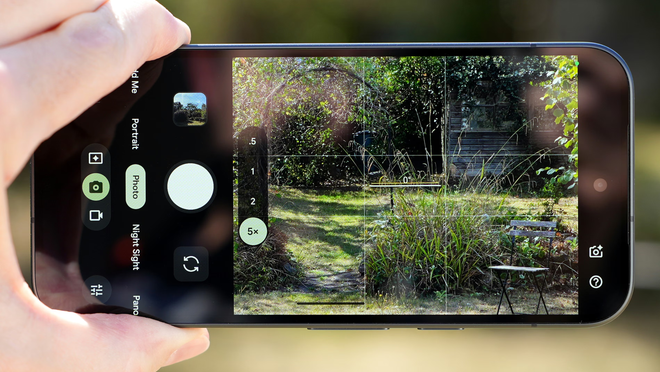
On the back are three cameras, comprising a 48MP main sensor, a 13MP ultra-wide and a 10.8MP 5x telephoto lens. A 10.5MP camera handles selfies and video calls.
The main sensor produces detailed images in a variety of conditions and performs particularly well in low light, where its larger sensor helps capture more detail.
The ultra-wide camera is also impressive for a phone at this price, providing a wider field of view without a major compromise in image quality.
The telephoto camera is perhaps the most significant advantage over cheaper rivals. Its 5x optical zoom makes distant subjects considerably easier to capture, while Google’s digital processing allows the camera to reach 30x zoom in good lighting while maintaining surprisingly usable results.
Google has also introduced a new photography system called Looks. Instead of applying a basic filter after an image has been taken, Looks influences the way the phone captures and processes photographs.
There are nine options in total, ranging from more restrained settings such as natural, vanilla and shadows to more stylised choices. The digi setting, for example, attempts to reproduce the appearance of older digital cameras, tapping into the recent revival of that aesthetic.
Users can further adjust colour, tone, grain and sharpness, providing considerably more creative control than conventional smartphone filters.
For people who have previously found Pixel photographs too cool, dramatic or heavily processed, the feature offers a way to customise the phone’s photographic character.
Video recording goes up to 4K at 60 frames per second. Google’s new Magic Capture mode is designed for occasions when users want to participate in an event rather than spend the entire time operating their phone. With a single button press, it automatically captures photographs and video.
The new Creator Suite is aimed at people who want to produce short-form video. It allows footage to be organised and quickly edited, while additional tools include a teleprompter, social media framing guides and speech enhancement for reducing background noise.
These features sit alongside existing Pixel functions such as Auto Best Take, Add Me and Camera Coach.
A more repairable and recycled phone
Google has also placed some emphasis on the Pixel 11’s environmental credentials.
The battery is designed to retain at least 80% of its original capacity after more than 1,000 complete charging cycles.
The handset can be repaired through Google, independent repair shops or by users themselves, with repair documentation and replacement components available.
Google says recycled materials account for 33% of the Pixel 11’s weight. The company has also published an environmental impact report for the device and provides free recycling for old phones.
Its biggest achievement is how much of the flagship experience Google has managed to include without pushing buyers towards the more expensive Pro models. The phone has a strong camera system, a high-quality display, lengthy software support, useful AI capabilities and dependable battery life.
The Tensor G6 is not the fastest smartphone processor available, so demanding gamers may find better options elsewhere. For everyday use, however, its limitations are difficult to notice.
The camera system remains the strongest reason to consider a Pixel. The combination of a capable main sensor, useful ultra-wide and 5x telephoto camera gives the Pixel 11 considerable versatility. The new Looks feature is an especially welcome addition for users who want greater control over the style of their photographs.
Its AI features are similarly impressive, particularly the improved voice typing and proactive assistance. Their usefulness will depend partly on where the user lives and which applications they use.
According to The Guardian, the Pixel 11 is not a major leap forward from the already strong Pixel 10. It also cannot compete with the Pixel 10a on price. But for anyone looking for a well-rounded flagship below £900, it remains an exceptionally compelling option.