From birth attendant to ‘smart’ farmer: Renuka’s journey of resilience
From birth attendant to ‘smart’ farmer: Renuka’s journey of resilience
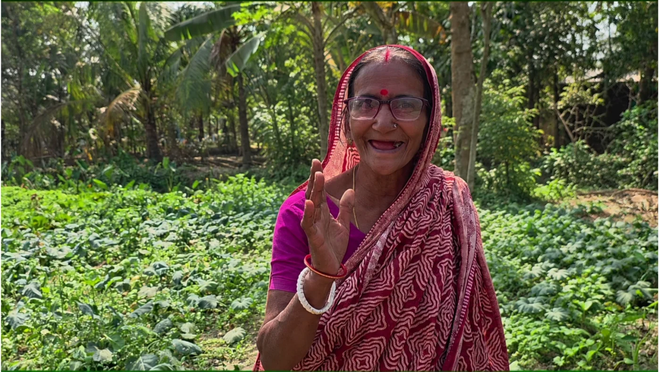
Once known in her Bagerhat village as a trusted birth attendant, 63-year-old Renuka Rani Mistry has built a new identity as a successful small-scale farmer after learning climate-resilient cultivation techniques through the Adaptation Clinic under Aporajeyo Desh, an initiative of BRAC Bank in collaboration with BRAC.
In Purba Amragachia village of Bagerhat, Renuka Rani Mistry was known for her role in one of life’s most critical moments – as a birth attendant.
For years, her work carried responsibility and trust within the community. But like many forms of informal rural service, it offered limited financial stability.
At 63, Renuka has taken on a new identity. Today, she is recognised as one of the “smartest” small-scale farmers in her locality.
With a family of four and a household partly dependent on agriculture, her economic circumstances had remained constrained for years. Her husband had been engaged in farming for nearly a decade, but returns were inconsistent – shaped by salinity, unpredictable weather and limited access to modern agricultural practices.
The situation began to change when Renuka enrolled in the Adaptation Clinic under Aporajeyo Desh, an initiative of BRAC Bank in collaboration with BRAC.
Through the training, she learnt climate-resilient vegetable cultivation, seasonal planning, soil management and the use of biological pest control. More importantly, she came to understand how these elements are connected – and how making the right decisions at the right time can influence both crop yields and income.
Equipped with this knowledge, Renuka began cultivating vegetables on her homestead land.
She planted sweet gourd, bottle gourd, broccoli, squash, beetroot, radish, turnip, cauliflower and cabbages of different colours, selecting the crops based on both her training and demand in the local market.
Regular care, improved cultivation techniques and timely decisions soon produced visible results.
Within a single season, Renuka earned approximately Tk50,000 from selling her produce.
Asked how many vegetables she had grown over the year, she said, “How many shall I name? With the seeds and fertilisers I received through the Aporajeyo Desh programme, I have been able to grow around 20–50 varieties of vegetables.
“The weekly weather updates through phone calls and SMS, along with agricultural advice, also help me decide when to plant and when to harvest. They have made a real difference to my family.”
Renuka now continues cultivating vegetables while encouraging other women in her community to explore similar opportunities.
She shares her experience in practical terms – what to plant, how to manage crops and how to approach farming as a source of income.
Her journey reflects a broader transformation taking place across Bangladesh’s coastal communities.
Under Aporajeyo Desh, nearly 3,700 farmers in Bagerhat’s Sarankhola, Morrelganj, Mongla and Rampal upazilas are receiving support through climate-resilient seeds, biofertilisers and environmentally friendly farming techniques.
Demonstration plots are showcasing adaptive agricultural practices, while solar-powered irrigation systems are helping farmers reduce costs and their dependence on diesel.
At the centre of the initiative is the Adaptation Clinic – operating through both static and mobile facilities – which provides real-time advisory services on crop management, soil health and pest control.
More than 4,000 farmers are also receiving agrometeorological voice messages, enabling them to align their farming decisions with changing weather patterns.
Renuka’s experience offers a practical example of what this approach can achieve.
With access to the right tools, knowledge and support, participation in agriculture is expanding – and with it, the possibility of building more stable and climate-resilient livelihoods.