Farashganj: A French name, a spice market, and two brothers who outdid a Nawab
The rickshaw dropped me somewhere near BK Das Road, and the answer to that question was already in the air before I asked it.
Farashganj: A French name, a spice market, and two brothers who outdid a Nawab
The rickshaw dropped me somewhere near BK Das Road, and the answer to that question was already in the air before I asked it.
Turmeric, whole sacks of it, stacked outside warehouses that have been doing this exact job since before anyone’s grandfather was born, ginger and garlic and dried chilli behind them, porters moving through the smell like it was nothing at all. Farashganj still smells like what it has always been, which is not something most of Old Dhaka can say about itself anymore.
A market by permission
The French did not seize this ground; they asked for it. In 1740, the French East India Company received permission from Naib Nazim Nowazish Mohammad Khan to build a kuthi, a trading post, near what is now Ahsan Manzil, and set up a market around it. Before the pink palace existed at all, there was a French factory standing more or less exactly where it would later rise. The market took the name French Ganj, and by the time a document from 1790 mentions it by name, it had already outgrown the thing that started it.
It was not entirely peaceful. In 1750, the French seized the neighbouring English factory outright, a piece of aggression bold enough to require a Mughal official, Naib Nazim Jasarat Khan, to step in and settle it before it turned into something worse. The seized building went on operating under a new name, Dhaka Factory, functioning right up until 1757, the year the last independent Muslim ruler of Bengal fell at Plassey and the whole political order the French had been navigating simply stopped existing. Farashganj, strangely, did not stop with it. The market kept growing for decades after the empire that gave it permission to exist had lost the ground to give permission for anything.
The business of spice and muslin
What the French built here was, before it was anything else, a wholesale operation. Warehouses went up along the riverbank for turmeric, ginger, garlic, chilli, the raw material of every kitchen in the region moving through a handful of French ledgers before it went anywhere else. Dhaka’s muslin passed through the same quarter on its way out to the rest of the world, another thread tying this stretch of riverbank to a global cloth trade that most of the people working in it would never see the far end of. The French presence lasted only until the early nineteenth century, when the British East India Company absorbed what was left of it. But the market itself did not fold, because a market this useful does not need the people who founded it, it only needs a river and a reason. Farashganj has had both for nearly three hundred years.
The house an Armenian built
Some of what happened next in Farashganj belongs to the last piece I wrote, whether I meant it to or not. In 1825, an Armenian businessman named Stephen Aratoon built a mansion on the northern bank of the Buriganga, at the western edge of the old French quarter, and called it, unremarkably, Aratoon House. It is one more small proof of something I keep running into every time I walk this stretch of the city: that the merchant communities who passed through Old Dhaka rarely stayed in their own lanes. French spice traders, Armenian financiers, English factors, all of them working variations of the same riverfront, close enough to borrow each other’s buildings.
Aratoon did not keep the house for long. In 1840, two Bengali brothers, Ruplal Das and Raghunath Das, bought the property, pulled it down, and rebuilt it at considerable expense with an architectural firm from Calcutta. It took their name instead. Aratoon House became Ruplal House, and it is Ruplal House that still stands there today, or what is left of it.
The ball that beat the Nawabs
By the 1880s, Ruplal House had become something close to a rival court. When Lord Dufferin, Viceroy of India, visited Dhaka in 1888, the city’s elite competed for the honour of hosting him, and the Nawabs of Dhaka wanted nothing more than to show off Ahsan Manzil for the occasion. They lost. Ruplal and Raghunath spent an extraordinary sum, by one account forty-five thousand taka, decorating the mansion for a single evening, and won the ball for their riverfront dance hall instead. Two merchant brothers, descended from a family that made its money in jute, out-hosted the ruling family of the city in its own capital, in a house built on land an Armenian trader had once owned outright. Dhaka has never been short of these small, specific ironies, if you know where to stand to see them.
What Farashganj kept
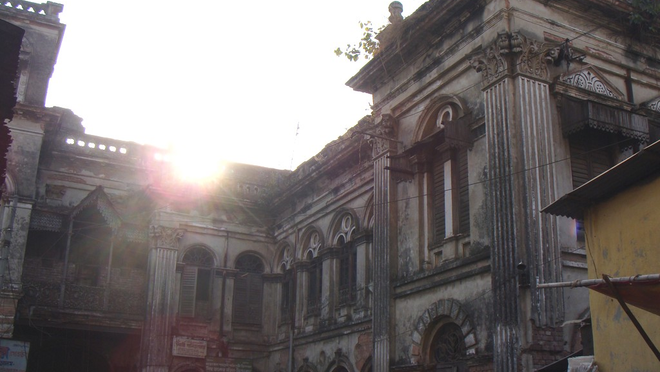
Walk it today and the grandeur is mostly a rumour you have to take on faith. Ruplal House survives under a different name to most of its current occupants, Jamal House to some, Nurjahan House to others, its ballroom subdivided, its riverfront colonnade partly swallowed by shops that were never supposed to be there under the law that protects it. Only three buildings in Farashganj carry official protected status. The rest is doing what the rest of Old Dhaka does, aging in public, unbothered by its own significance.
But the spice trade never left. That is the part of this story that has no elegy in it. Some names in this city survive as ghosts, attached to nothing. Farashganj is the rarer kind, a name still doing the job it was given, on the same riverbank, in the same trade, three centuries on.
Behind me were the warehouses, the old houses and Ruplal’s ruined ballroom. Ahead, somewhere beyond the riverfront, was Ahsan Manzil, the palace the Nawabs built, the palace they wanted the city to admire, and the palace that had already lost one contest to two merchants from this very neighbourhood.
I had started this walk with the French.
It seems only fair that the next one belongs to the Nawabs.