NCTB promises textbooks by new year, over one-third yet to go to printers
NCTB promises textbooks by new year, over one-third yet to go to printers
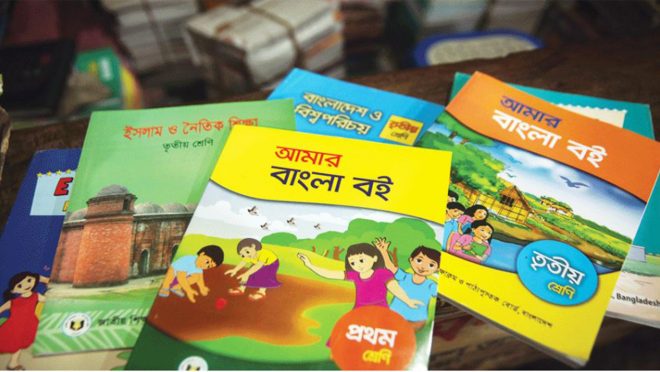
Students will receive their textbooks, some with revised or new content on history and political events, at the beginning of the 2027 academic year, the National Curriculum and Textbook Board (NCTB) has assured, although more than one-third of the planned books have yet to be allocated to printers.
According to NCTB’s monitoring report dated 24 September, printers have yet to be selected for 346 of the 672 lots, covering around 10.44 crore of the 30.29 crore textbooks planned for the year.
“Students will definitely receive their books at the beginning of the new year this time. We are working with special attention. We have completed most of the work,” said NCTB’s new Chairman Professor Mohammad Fakhrul Mawla.
Alongside the printing work, major changes are being made to textbooks for the new academic year, including new books for Classes 4 and 6 and revisions to content on history, the Liberation War and political events.
NCTB said work on the remaining books was progressing quickly and that the printing process was nearing completion.

Infograph: TBS
So far, 326 lots have been awarded to printers, with 172 printing firms involved. However, no printers have yet been selected for the remaining 346 lots.
These include Class 8 and Class 9-10 books under the general, madrasa, technical and vocational streams, along with 11 smaller lots for Classes 4 and 6.
The unawarded lots cover around 10.44 crore books, or more than one-third of the total planned for the academic year. None of the books under these lots had been printed as of 24 September.
The report shows that 19.03% of the allocated printing forms had been printed. Around 5.31 crore books had been bound, while 2.27 crore had completed pre-delivery inspection.
So far, 1.99 crore books have been supplied, accounting for 6.57% of the total planned for the year.
Almost 31 crore textbooks are planned for students from pre-primary to Class 9 in the next academic year, including books for ethnic minority and visually impaired students.
More than 22 crore books are for the secondary level, while around 8.20 crore are for the primary level. The estimated cost of printing the books is Tk1,879 crore.
New books, changes to history content
Class 4 students will get two new books, one on sports and another on Bangladeshi culture. The sports book will introduce students to eight sports, including football, cricket, kabaddi, swimming and martial arts.
Class 6 students will get two new books – “Learning with Happiness” and another on technical education. There will be no separate annual examinations for these subjects. Students will instead be assessed continuously.
Changes are also being made to Bangla and Bangladesh and Global Studies textbooks for several classes.
A new text titled “Third Language”, focusing on the importance of learning an additional language, will be added to the Class 6 Bangla textbook. Biographies of the seven Bir Sreshthos will be included in the Bangladesh and Global Studies textbook for the same class.
The Class 8 Bangla textbook will include content on different brigade forces during the Liberation War.
The Bangladesh and Global Studies textbooks for Classes 8 and 9 will include the role of Begum Khaleda Zia in the 1990 mass uprising.
Changes are also being made to Bangladesh and Global Studies textbooks from Classes 6 to 9, with content on the 7 November 1975 events, known as the Sipahi-Janata Revolution, being added.
Ziaur Rahman’s “Memories of the War of Independence” will be included in the Bangla textbook for Classes 9-10.
Four ICT textbooks covering Classes 6 to 9-10 have also been approved for revision and updating.
‘History should be presented accurately’
Educationist Rasheda K Choudhury said history and heritage should be included in textbooks, but they must be presented accurately.
“Whether it is 1952, 1969, 1971 or 2024, there is no problem if the events are presented accurately,” she said.
She also stressed that history should not be used to impose political ideas.
Rasheda said previous textbooks had sometimes reduced the spirit of the Liberation War to a slogan or commodity and that history should instead be presented based on facts.
SM Hafizur Rahman, professor at the Institute of Education and Research at Dhaka University, said the current curriculum was not being scrapped entirely.
“Rather, the focus was on making it more effective and practical,” he said.
He said particular attention was being given to making content easier for students to understand and ensuring the accuracy of information.
Work to improve and revise the curriculum would continue, he added.
Educationist and BRAC University Professor Emeritus Manzoor Ahmed said what was written in the curriculum was important, but so was how it was implemented in classrooms.
Changing textbooks alone would not produce the desired results without adequate teacher preparation and effective classroom implementation, he said.
“Students often memorise textbook content instead of engaging with the books, while how they would learn from a curriculum should also be considered before frequent changes are made,” he added.