How Kagan and Soai solved a mystery of life’s mirror-image molecules
Did you know that one of biology’s strangest puzzles is that life is strictly one-sided?
How Kagan and Soai solved a mystery of life’s mirror-image molecules
Did you know that one of biology’s strangest puzzles is that life is strictly one-sided?
If you look inside your own body, your DNA twists exclusively to the right. Meanwhile, every single amino acid building your body’s proteins tilts to the left. It is an absolute rule across all living things.
But if you take those same simple chemical building blocks and mix them up in a lab beaker from scratch without any biological templates, chemistry defaults to a dead-even 50/50 split of left-handed and right-handed shapes. This leaves us with a fundamental mystery: how did early Earth’s chaotic, unguided chemical soup manage to pick a single direction and stick with it for billions of years?
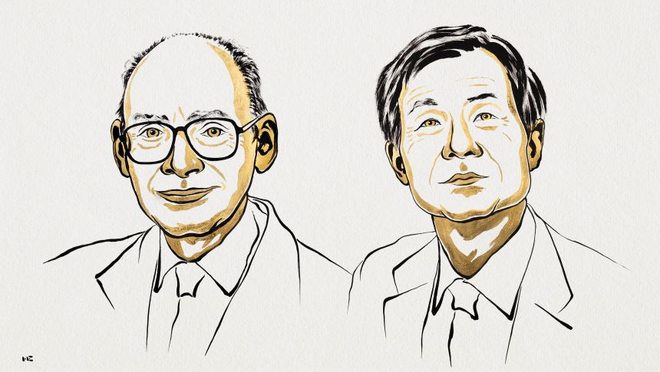
French chemist Henri B. Kagan and Japanese researcher Kenso Soai won the 2026 Nobel Prize in Chemistry for demonstrating how to guide these mirror-image reactions. They proved that a tiny nudge in a chemical mix can snowball. Eventually, one shape takes over the entire batch.
Why should anyone outside a lab care about it? If you take prescription medication, your life probably relies on this precise trick.
Molecules often exist as twin pairs, like our hands. They contain the exact same atoms and share identical chemical formulas, but their spatial layout makes them functionally distinct. However, forcing a right-handed molecule into a left-handed cell receiver causes problems, just like how your right-hand glove wouldn’t fit your left hand. Cells rely on shape-sensitive locks. One twin might cure a disease in minutes, while its mirror image sits around doing nothing, or worse, binds to the wrong target and causes dangerous side effects.
For decades, chemists operated under a strict rule of thumb: you get out only what you put in. Chemists used to think that a catalyst’s purity directly capped the product’s purity. Wanting a 98% pure left-handed drug meant starting with a helper molecule that was already 98% pure left-handed.
Henri Kagan flipped that assumption in the mid-1980s. He discovered non-linear effects in these reactions. Introducing an impure helper molecule with a weak 10% left-handed majority produced a final product with disproportionately high left-handed purity. Small, subtle structural nudges were somehow producing massive, amplified outputs.
While Kagan proved that reaction outputs could far exceed the purity of their inputs, Kenso Soai found the self-driving engine to finish the job a decade later. In 1995, Soai achieved what many scientists considered pure theoretical fantasy: asymmetric autocatalysis. In what is now famously known as the Soai reaction, the newly created single-handed product immediately turns around and acts as a catalyst to speed up the creation of more of itself.
Soai proved that any microscopic starting bias is enough to trigger this self-amplifying feedback loop. Scientists suggest that an initial tiny imbalance eons ago could have come from something as subtle as a random subatomic flicker or a passing cosmic ray. Over repeated reaction cycles, the growing chemical majority relentlessly eats up all the available raw ingredients. Eventually, the mixture reaches over 99.5% single-handed purity from virtually nothing.
As Nobel committee member Peter Somfai pointed out during the prize announcement, “This is probably the coolest experiment in organic chemistry.”
Kagan and Soai did not definitively prove what happened on early Earth billions of years ago. What they did was give us a concrete, brilliant mechanism showing how single-handedness can emerge spontaneously out of total randomness. Beyond solving a major evolutionary cold case, their work gives drug makers the exact framework needed to build cleaner, safer, hyper-targeted medicines today.