It's still not too late for Inktober 2026
Every October a quiet tradition spreads across sketchbooks, tablets and the margins of lecture notes, as artists of every level commit to making one ink drawing a day for thirty-one days. It is called Inktober, a blend of ink and October, and although we are already ten days into this year’s run, the beauty of the challenge is that nobody is standing at the door checking whether you arrived on the first.
It's still not too late for Inktober 2026
Every October a quiet tradition spreads across sketchbooks, tablets and the margins of lecture notes, as artists of every level commit to making one ink drawing a day for thirty-one days. It is called Inktober, a blend of ink and October, and although we are already ten days into this year’s run, the beauty of the challenge is that nobody is standing at the door checking whether you arrived on the first.
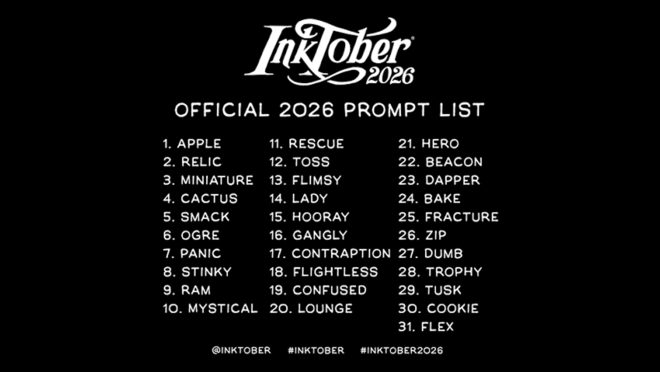
It began in 2009 with an illustrator named Jake Parker, who, according to a guide written by a long-time participant, noticed a weakness in his own inking and set himself a challenge to master it as quickly as possible. What he probably did not expect was that a personal exercise would grow into a worldwide habit.
In its initial years, it was little more than an idea shared online, and he has released the official prompt list every September since 2016, which gave the challenge the shape it has today: a list of words, one per day, that you can follow closely, bend creatively or ignore entirely. In 2020, he extended the idea with Inktober 52, a year-round version with a new prompt released every Friday, for people who found that thirty-one days was not enough to satisfy the habit.
The rules are gentler than most people expect. According to the team behind the official prompt list, which is run by the learning platform Jake Parker helped found, you simply make a drawing in ink, with a pencil underdrawing allowed if you like, and share it on social media or even on your fridge, tagging it with #inktober and #inktober2026. The stated goal is to improve your drawing skills and build a daily habit, which is a far more forgiving ambition than producing thirty-one masterpieces. That forgiveness is the secret of why it works, because the pressure to be good is replaced by the much lighter pressure to simply show up, and anyone who has ever stared at a blank page for twenty minutes knows how powerful that swap can be.
This is also why Inktober inspires so many people who would never call themselves artists. A single word as a prompt removes the hardest part of drawing, which is deciding what to draw, and it often pushes you towards subjects you would never have chosen on your own. The guide writer mentioned earlier says the prompts nudge her to draw outside of her comfort zone, and she turns her best entries into a calendar each year, a lovely reminder that a month of small daily efforts can add up to something you are proud to hang on a wall.
Others treat the challenge as a chance to discover new artists, since the feeds fill with thousands of interpretations of the same word, each one a little window into a different mind. Parker himself has even made a large A3 piece by adding a little more to the same sheet every day, proof that the challenge can be as playful or as ambitious as you like.
And you do not need to spend money to join, which matters in a place where art supplies and tablets can feel like luxuries. If you own an iPad, the most accessible starting point is the Notes app that is already installed, since it is described as 100 per cent free and available the first time you turn the device on, and it lets you sketch with an Apple Pencil or even a fingertip.
Apple’s Freeform app is another built-in option that gives you a large, flexible canvas, which suits rough ideas and loose compositions. If you want something closer to a proper art studio, several dedicated apps offer free versions, among them Autodesk Sketchbook, Adobe Fresco and ibis Paint X, though it is worth remembering that some of these include ads or keep their more advanced features behind optional upgrades. Procreate gets mentioned in nearly every list because artists love it, but it is a paid app, so for a challenge built around keeping things simple you may prefer to begin with the free tools and decide later whether you want more.
A practical trick for digital inking is to treat the screen like paper. Choose a single black pen brush instead of scrolling through dozens of options, draw a quick light sketch on a separate layer if the app allows it, and then ink over the top before hiding the sketch, which mirrors exactly what the official rules suggest for traditional drawing. Keeping one brush and one colour also removes the temptation to fiddle with settings for an hour, so you actually finish the drawing and get on with your day.
If you would rather stay away from screens entirely, pen and paper remain the purest way to take part. A ballpoint, a gel pen or a cheap fineliner on ordinary copy paper is more than enough, and using a pen that cannot be erased is part of the charm, because every wobbly line teaches you to commit and to treat mistakes as texture rather than disasters. Some people keep a small notebook in their bag so they can finish the day’s prompt on the bus or between classes, while others draw on the back of used printouts, and nobody has ever been disqualified for choosing a humble medium. The challenge is built around ink as an idea, so a pencil sketch followed by a confident pen outline fits comfortably within its spirit.
What makes the whole thing worth the effort is the cumulative effect. A single drawing is just a doodle, but a stack of ten, twenty or thirty tells a story about your growing confidence, and most participants are surprised to see how clearly their line quality, composition and speed improve by the end of the month.
You will also have days when the prompt feels impossible, the page looks ugly and you are tempted to skip, and those are precisely the days when a quick, imperfect drawing teaches more than a polished one ever could. If you miss a few days, nothing breaks, because the guide writer admits to carrying her list over into November or leaving some prompts undrawn, which proves that even devoted participants treat the list as a companion rather than a master.
So if you have been watching other people post their drawings and still wondering whether it is too late or whether you are good enough, the honest answer to both is that it is not and you are. Open the Notes app, pick up a pen or tear a page from an old notebook, check the official list for today’s word, and start with whatever comes to mind first. Share it, hide it in a drawer or tape it to the fridge, because the point was never the audience. The point is that by the end of October you will have a month of evidence that you made something every single day, and that is a gift you can only give yourself.