To the friends who stick with us
For me, my core friends’ group formed after I moved out of my hometown in the hope of a better future and education in Dhaka. I had the privilege of studying at a “well-known” school.
To the friends who stick with us
For me, my core friends’ group formed after I moved out of my hometown in the hope of a better future and education in Dhaka. I had the privilege of studying at a “well-known” school.
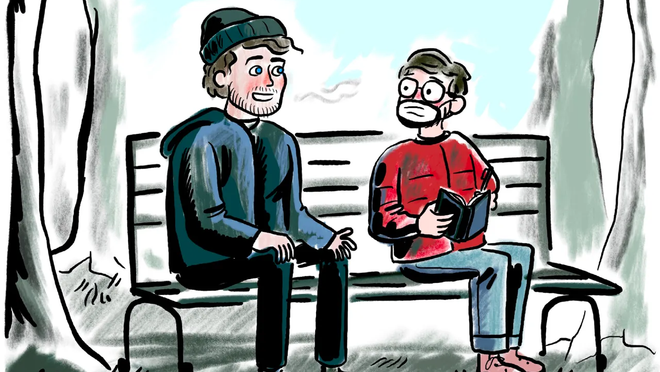
Living in our young adult lives, how many of us can say we have people with whom we can open up during moments of crisis? It’s often our friends who act as our free therapists, though some may be the reason for needing therapy in the first place. Even though family is our existential connection, good friends are most influential in our social development.
A person’s relationship with their parents can vary. At a certain age, one cannot express his or her intrusive thoughts, emotions, and experiences. Once we grow older, we may not even share our daily hurdles, but with friends, specifically with one’s core inner circle, there are supposed to be practically no boundaries and filters.
Let’s recall the first day at school. We were all strangers stranded inside a classroom. We were practically forced to socialise, and with that, the first group of friends was created.
As years passed, the groups became larger and larger. The longer we stayed together, the more memories we created. Those naughty habits, sports sessions, punishments, and addas during tiffin time created such moments that might live on until our last breath.
These school groups become inseparable. Unfortunately, these butterfly days are not constant. Most friend circles start to get smaller and smaller as we age, and with time, the pressure of academics, work, and career creeps in. Suddenly, addas became a place to rant and share one another’s anxiety. The problem with adult life is the hesitation to share our struggles as we grow older. Friends may be the only ones to see the vulnerable side of us that others most often ignore.
As a town boy coming to Dhaka, I just entered the school bus and sat in the front seat. The first person to approach me was a guy named Pranta. He asked if I was looking for a teacher. I replied yes, and with that, I had just found a friend with whom I had shared the same coaching and school for five years. I would spend six to seven hours after school going coaching from coaching, playing in what little time we got, and it was done only with Pranta. He helped me commute across Dhaka as a teen, and I was the semi-scared but bold enough friend who always said yes to his crazy adventures.
We got separated after school, in theory, but we kept on giving adda in our free time.
This kept that bonding alive. For me, my friends’ circle is therapy, helping me keep my mental health in check. The addas did help to navigate college life, and I had the luxury of finding them in my toughest phase. I just failed my first attempt at the Public University Admission Test. It was devastating at first. But they helped me remain motivated through my second attempt, which eventually helped me secure a position at Jahangirnagar University.
Just their presence alone reduced the burdens and brought a sense of calm throughout my journey.
Now, it is an entirely new campus, atmosphere, people, and an unfamiliar life in the dormitory. Our entire friend circle, which we call “WE BE LIKE,” was already tasting the drifting of adulthood. Our friends Tausif and Pranta were studying at NSU, Samiul at AIUB, Mugdho at ULAB, and Rudhir, Siyam, and Azmir at Daffodil. These addas with them were a way to vent my struggles in adjusting to my new life at Jahangirnagar University. Even though we were all at different universities, these constant addas kept us connected.
Suddenly, the news broke that two of my friends were moving abroad! Pranta was going to India and Siyam to Italy. But by this time, the eventual separation had arrived!
I was extremely happy to hear that they had such wonderful opportunities. But the news slowly started to make sense. The addas we often gave weekly would now be scheduled at certain times of the year. What made me realise is that adult life is extremely cruel, as these selfless relationships are tested in a world where we have to balance academics, family, and work.
It’s going to be hard to get out of the comfort zones of our daily schedules. But hopefully, our friends can excel at the upcoming destination, and I can achieve my personal goals as well. I can proudly claim to have a fresh group of people outside of my family as my close ones.
They have introduced me to a new world where I don’t shy away from sharing my vulnerabilities and difficulties. Even though my parents have given me a wonderful life, it was they who gave me the social courage to excel in extracurriculars, meet new people, and face the world with a renewed sense of confidence.
Even though our growth has scattered us across the globe and into different cities, it is inevitable for our well-being. We have all taught each other some core experiences of life, and we should be proud of it. Now our addas might be virtual or may span across multiple months; the comfort of having people who have seen us across our childhood, school, and multiple transitions of life is nothing short of a luxury. Yet, the beauty lies in its continuity in impacting someone’s personal development well after its physical existence.