Beyond grades and publications: How Sumaiya Razzak won the Hardiman PhD Scholarship
Having completed her LLB and LLM in Bangladesh, Sumaiya Razzak recently started her journey at the University of Galway, pursuing a PhD on women’s access to justice through an intersectional socio-legal lens.
Beyond grades and publications: How Sumaiya Razzak won the Hardiman PhD Scholarship
Having completed her LLB and LLM in Bangladesh, Sumaiya Razzak recently started her journey at the University of Galway, pursuing a PhD on women’s access to justice through an intersectional socio-legal lens.
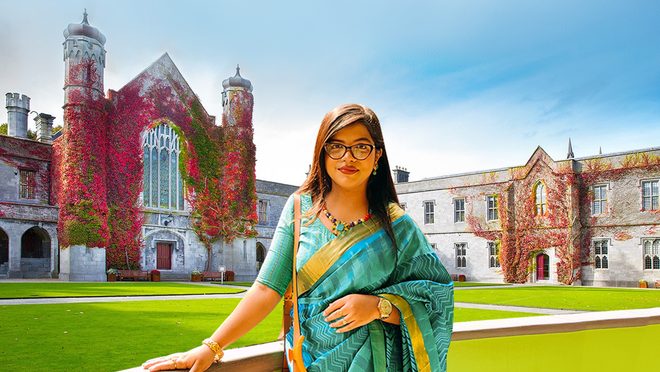
Before her PhD, she had worked at BRAC University’s Centre for Peace and Justice (CPJ), leading internship units, research coordination, along with other programmes such as youth-led initiatives and academic work.
With the Hardiman PhD Scholarship, she aims to produce research that is not only centred around academics, but informs policy and strengthens survivor-centred justice frameworks.
The first exposure to research
“My research journey began during my LL.B., but it became serious during my LL.M. when I started working on genocide, gender-based violence and refugee rights. That was the moment I realised research wasn’t just academic; it had a real impact,” stated Sumaiya.
Despite not having many journal publications, Sumaiya’s application was strengthened primarily by her strong academics, extensive fieldwork, and a thoroughly visible intention towards human rights. Her research proposals had a clarity of purpose, along with an array of strong recommendation letters.
When asked about her CGPA, Sumaiya said, “Looking back, I would say academic results matter but they are only one piece of a much bigger picture. For a PhD, what truly stands out is your ability to think critically, design research, and demonstrate real engagement with your field.”
According to Sumaiya, a clear sense of purpose carries far more weight than grades alone. “Strong recommendation letters from mentors who know your work deeply can shift an application in your favour,” added Sumaiya.
A well-written research proposal is also important. “A successful PhD application includes quality research experience and a proper research agenda, and meaningful achievements, whether publications or impactful projects, show that you are already operating as a researcher.”
Choosing the right path
“I chose the University of Galway because it is one of the strongest institutions in Europe for human rights and socio-legal research, while the Hardiman PhD Scholarship offered a competitive and supportive environment,” expressed Sumaiya.
She mentioned that she had identified her supervisor by following and studying their work and recognising how closely their expertise aligned with her own. And she had started reaching out to potential supervisors even before finalising her area of interest.
“Yes, I contacted them before applying to discuss my research idea. That conversation helped refine my proposal and confirmed that Galway was the right place for me.”
She also talked about the expensive nature of Galway, which does not allow room for unnecessary spending. The high living costs are quite manageable because of the Hardiman PhD Scholarship, as it covers her entire tuition and offers an annual stipend and research support.
Her life at Galway so far has been a mixed bag. Much of her week is spent reading literature and writing sections of her thesis, along with other associated tasks that come with her degree.
The life of a researcher
“The biggest misconception is that a PhD is only suited to intelligence. In reality, it’s about discipline, resilience, emotional strength, dealing with uncertainty, and managing slow progress.”
Another misconception she mentioned is that motivation is never a constant. It isn’t. But the work becomes meaningful when one has a clear sense of purpose.
She told us that it was important for undergraduate students to develop strong academic foundations, primarily in their writing and reading skills.
“Once those skills are in grasp, attend workshops to gain experience and explore interests. Small research projects during the last two years can also immensely help,” added Sumaiya.
During the fourth year, applying early and securing strong recommendation letters is the way to go, as well as preparing a polished SOP and strong research proposal.
A PhD application is built over years, not overnight. Consistency, clarity, and commitment matter more than anything else. She also spoke about the importance of developing certain skills.
“I didn’t come from a technical background and I wasn’t familiar with R or Python beforehand because my field is qualitative. I learned my skills through coursework, fieldwork, research coordination and extensive reading.”
Sumaiya Razzak’s journey shows how the pursuit of higher education can go far beyond earning another degree.
Her work in human rights, her experience with research and fieldwork, and now her PhD all come from a desire to use what she learns to create a meaningful impact.