I played F1 for a year and this is what happened
Having no clue about what the sport actually was, or any of the drivers, I decided on a fine day that I’m downloading F1 18. Why 18? Because it was the only free one.
I played F1 for a year and this is what happened
Having no clue about what the sport actually was, or any of the drivers, I decided on a fine day that I’m downloading F1 18. Why 18? Because it was the only free one.
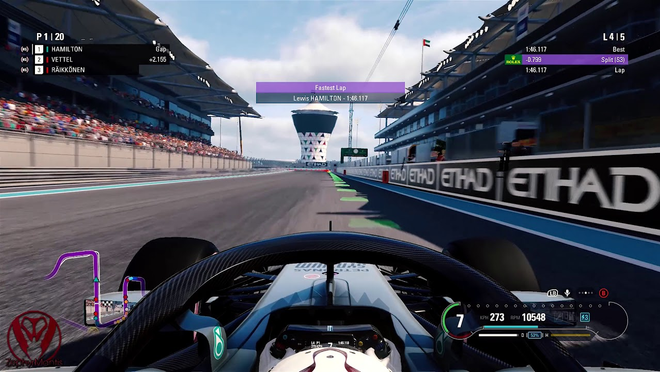
Regardless, I considered myself a driving elite. I had completed Need for Speed: Most Wanted multiple times, and had even driven in Forza Horizon for a bit too. The file was huge, so it took a while until I could finally get out of the pit lane.
My first lap wasn’t really a lap, probably because I was in the wall. I figured I needed to pick the best driver, and a good track. Moments later, I googled who the world champion was and found myself in a Red Bull as Max Verstappen. I also switched to Monza, which apparently is the temple of speed and a rather easy track. I ended up in the wall regardless.
Steering, braking, traction, you could name any assist and it’d be on my car when I finished my first lap around any circuit. I stopped twice mid-track, but then I completed it.
“Welcome to the world of F1,” my friend told me.
They say the key to learning anything new is to completely surround yourself with it. The modern-day take on that could be that to learn something new, you turn your entire Instagram feed into a carnival based on it.
I find it quite fitting to throw around the term for such learning, which Gen Alpha calls larping. Once you are good enough to larp, you open yourself to endless possibilities. With each scroll, I learned more and more about how slipstreams work, what ERS and DRS were (crucial since this is the first question any F1 fan would quiz you with), and how Kimi Raikkonen once bankrupted Lotus by driving too well. Amidst all of it, I found a sense of speed that had been missing in my life for a while.
This urge to go faster and faster each lap, where you don’t really think about anyone else but you, trying to beat that personal best you had set three days ago is extremely addictive. One lap would turn into twelve laps before I’d know, and each time I’d go quicker. The frustration of completely losing the car after hitting two purple sectors during qualifying makes one feel as if they genuinely are in a racing car.
Slowly, I took control of the steering, then the braking, and at last the gear shifts. It’s almost a dance at 300 km/h. You see the signboards on the sides and brake, then shift from 8th to 2nd gear, only to let the car rotate and blast past the crowd at 8th gear again. One of my favourite tracks, i.e. the Jeddah Corniche Circuit, has around 27 corners. Putting it into perspective, there are about 80 gear shifts in one lap, meaning that in a 15-lap race, you make around 1,200 gear shifts.
One badly executed brake or a miss in gear shifts can cause someone to lose places in a race, or at worst, find themselves in the wall. One wonders why it is a big deal for all of that to happen on a virtual track in a virtual car. Well, the point is that the physics, the incredibly realistic visual and audio effects culminate in a simulation that is ridiculously accurate.
It would have been a complete experience had the physical aspects of the car been present too, but the mental elements create significant changes in the human mind and body. I certainly have experienced certain benefits from playing the game, which have aided me a lot in my daily life. The most notable one could be my ability to concentrate for longer periods. In a lap, one must turn one’s DRS on 2-3 parts of the track, switch the battery on multiple times, and make changes to the balance of the car to maximise its speed. All of this is done while keeping an eye on the road, as well as braking and gear shifting, as I have mentioned.
Now, do this for 15 laps straight. It is the sort of endurance in your mind that builds a longer attention span, a key commodity in today’s world. Along with that, my capacity to multitask has increased a whole lot more, and I don’t get as overwhelmed as before when I have multiple assignments to do and a long to-do list to complete.
What is even more interesting is that my understanding of time has developed over this period. They say time is relative, and how being in a tense situation can make time move faster. But what if I redirect time into a place I know, where time moves much slower? I remember how tired I felt after 5 laps on the Baku circuit because each lap was 2 minutes long.
While 10 minutes fly past you during an exam, if I redirect my thinking and see those 10 minutes through the lens of Baku, it slows time down to a pace I like. It’s ironic to think that in a game that rewards each extra second of speed, one could slow time down in their minds using the same machine.
Lastly, the most fun aspect is that I’ve developed is spidey skills. I grab things much quicker, which helps someone as clumsy as me. Even though it’s not enormous, it’s noticeable.