Tired of being ghosted by employers? Meet Porjay
Tired of being ghosted by employers? Meet Porjay
Safa was a university graduate working in a job she had already outgrown. She had spent months trying to find a way out. The job was hard on her, and she felt her work was worth more than what she was being paid.
So she started applying. One application became five. Five became ten. The final tally may have crossed 20. She hoped one of the organisations would finally give her a real chance. Then came a Management Trainee position that looked promising. She prepared hard, passed the early stages, and reached the interview round.
Sadly, then came the silence, entailing no rejection email, no update or no explanation. Days passed. Eventually, she understood that the company had moved on without telling her.
The above pattern was observed by Raiyaan, founder of Grow Your Career (GYC), quite often. Candidates go through aptitude tests, group discussions and interviews. Then, instead of hearing from the company, they turn to each other for answers.
“Imagine checking your inbox repeatedly, asking your friends if they received an email, looking through Facebook groups for updates, and continuing to wait anxiously, only to find out later that the recruitment process was actually completed a week ago,” he said.
For Raiyaan, the real problem is not the rejection part. “The bigger problem is not knowing what happened after you invested so much into the process.”
Silence just leaves people waiting and distressed; this is the problem Porjay was built to solve.
The name comes from the Bangla word “porjay”, which means “stage”, fits just right, because every worried applicant is asking the same question: which stage is this hiring process at, and am I still part of it?
The idea started inside GYC’s Facebook group. The same questions came up every hiring season. “Bhaiya, has anyone received the mail?” “Is the process still going on?” Hundreds of people were trying to answer a question that only the company could really answer.
What Porjay does
In simple terms, Porjay takes scattered rumours about a company’s hiring process and turns them into one clear timeline. Instead of guessing from comment sections, users can check one page to see if a hiring process is still going on, if a stage is finished, and how many other candidates reported the same update.
Building this was harder than it sounds. The information was already out there, but it had no clear shape. “A post saying ‘got the viva call today’ doesn’t tell you which programme, which round, or whether one person got that call or two hundred did,” Alvi explained.
The bigger problem was not the information itself, but getting people to share it. Worried candidates will happily comment on a Facebook post, but they will not fill in a form.
His team rebuilt the reporting process six times before it became simple enough. Now, each screen asks one short question: has this stage happened yet? Simple options follow: yes or not yet.
No account is needed, and it takes less than a minute. The plan manifested quite superbly, and Porjay collected more than 100 reports on its very first day.
There is one small extra touch that shows the same care. The homepage shows Dhaka’s live weather. “It turned out to be a nice echo of the name,” Alvi said, “because a day has its own porjays too.”
The efficacy
A tool built from public reports only works if people can trust it. Both founders treat this trust as the whole point of the product, not just an extra feature.
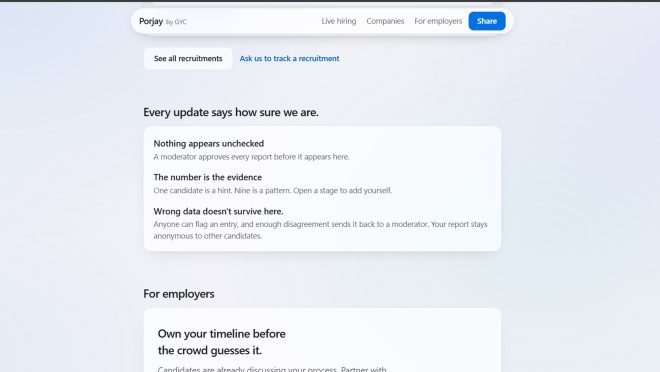
Every update on Porjay carries a label that shows how sure it is: Reported, Corroborated, or Verified. Candidates can push an update up to Corroborated, no matter how many of them agree.
Only the employer can make an update Verified. This means the crowd can build confidence in an update, but it can never make it fully certain on its own.
Before any update gets a label, it has to come from somewhere. Porjay gets its information from three sources.
The first source is candidates. When someone gets a test invitation, an interview call, or a rejection, they can report it in under a minute. Nothing appears right away.
A moderator checks every report before it is shown, and as more people confirm the same update, the page shows a simple count instead of a vague summary. If twelve people say they got a call, the page says exactly that, so one report is never mistaken for a bigger trend.
The second source is GYC’s own team. They actively check official career pages and company announcements, instead of only waiting for candidates to send in reports. This extra check helps catch updates that candidates might miss.
The third source, and the one both founders see as the goal, is the employer. Porjay is building direct ties with companies and HR teams so that updates can come straight from the source, instead of being pieced together from candidate reports. Any HR team can ask for this through the employers section of the Porjay website. Once they do, the company gets its own dashboard and login.
With that access, updating candidates takes minutes instead of weeks.
“With a Porjay company login, they update the stage and its details once, in a couple of minutes, and every candidate sees it straight away, marked as coming from the company,” Alvi explained.
One update now replaces what used to be an HR manager answering the same email again and again from hundreds of applicants.
Even with all three sources working together, both founders are honest about the limits. “Porjay isn’t perfect, and it never claims to be,” Raiyaan said.
“There will always be limitations when dealing with recruitment information, but within those limitations, we’re trying our best to make the information as useful, authentic and transparent as possible,” Alvi shared.
Whenever there is not enough proof, the system says nothing rather than guesses, and a stage with no reports simply stays empty. Candidates can also flag anything that looks wrong. That sends the update back for review and marks it as disputed until it is checked again.
Why working with companies matters
Both founders are careful to say Porjay is meant to help employers, not expose them. Companies that get thousands of applications for one role are usually overwhelmed; they are not silent on purpose. Sending the same update to every candidate by hand takes real time away from HR teams who are already busy with screening, testing and interviews.
Porjay’s offer to these teams is simple. Instead of repeating the same message many times, one post on the platform can reach every candidate following that hiring process at once.
Raiyaan is also careful not to make this sound like pressure on companies. “I don’t think transparency has to come from forcing companies to do something,” he said.
“If we can build a system that makes transparent communication easier and more convenient for employers, there is a much better chance of it becoming a normal part of the recruitment process.”
What comes next
Beyond helping one candidate at a time, Alvi sees Porjay building something Bangladesh’s job market has never had: real timestamps on hiring.
As more hiring processes get tracked, and as more companies share updates through their own dashboards, clear patterns should start to appear. For example, how long a graduate programme usually takes from the first job post to the offer, how many weeks usually pass between a written test and an interview, and which industries leave candidates waiting the longest.
Alvi believes companies can benefit from this too. “Our hope is that transparency becomes an advantage in hiring rather than something to fear.”