5 economical cars to beat rising fuel costs
5 economical cars to beat rising fuel costs
With octane now costing Tk165 per litre, getting more kilometres out of every litre has become the topmost priority
At the beginning of this year, octane, the fuel most commonly used by private cars in the country, used to cost Tk120 per litre. Following multiple price revisions, it now stands at Tk165 per litre in October. That is an increase of Tk45, or 37.5%, in a matter of months.
Suddenly, watching the fuel gauge drop feels considerably more personal.
Thankfully, economical cars have also moved beyond the familiar Toyota hybrid formula. Though the reconditioned hybrid models remain the obvious choices, plug-in hybrids from other brands and especially the Chinese range-extended electric vehicles (REEVs) now complete much of a normal working week while barely troubling their petrol engines.
There is one important catch. Hybrid, PHEV and REEV economy figures cannot be compared directly. A plug-in hybrid charged every night might consume almost no petrol on a short commute, while the same car driven hundreds of kilometres without charging will tell a very different story.
With that in mind, here are five of the most economical cars currently available in Bangladesh.
1. Toyota Aqua

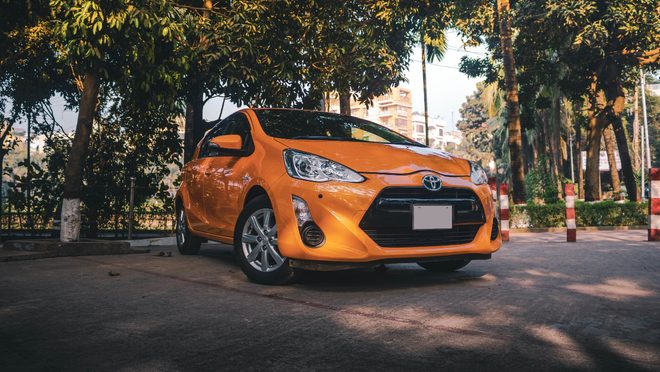
For more than a decade, Toyota’s little hybrid hatchback has become almost synonymous with economical motoring here. Photo: Akif Hamid
The Aqua remains perhaps the easiest answer to the fuel economy question.
For more than a decade, Toyota’s little hybrid hatchback has become almost synonymous with economical motoring here. The first-generation Aqua commonly seen on our roads pairs a 1.5-litre Atkinson-cycle engine with an electric motor, producing around 99 hp combined.
That is not exactly hot-hatch territory, unless the hatch in question has somewhere particularly unimportant to be.
What it lacks in performance, however, it makes up for at the pump. Well-maintained Aquas can return roughly 22 to 24 km/l depending on traffic, battery health and driving style.
The hybrid system works particularly well in Dhaka’s stop-start traffic, where regenerative braking constantly recovers energy.
More importantly, there is nothing to plug in. Fill it up, drive it normally and let Toyota’s hybrid system do the complicated bits.
It is not fast, glamorous or particularly exciting, but with octane at Tk165 per litre, boring has suddenly developed considerable charm.
2. Toyota Prius

In heavy city traffic, local examples of the Prius can return around 15 km/l, while significantly better figures are possible on longer journeys and with careful driving. Photo: Akif Hamid
Think of the Prius as the Aqua after getting a better job.
The fourth-generation Prius, particularly the 2016-2021 cars widely available in the reconditioned market, combines a 1.8-litre petrol engine with Toyota’s hybrid system for roughly 121 bhp.
That will not rearrange your organs under acceleration, but that was never really the point.
In heavy city traffic, local examples can return around 15 km/l, while significantly better figures are possible on longer journeys and with careful driving.
The Prius also gives you considerably more space, comfort and highway refinement than an Aqua without suddenly developing the drinking habits of a large petrol sedan.
For someone who wants genuinely useful family-car practicality with strong fuel economy and absolutely no interest in installing a charger at home, the Prius remains difficult to argue against.
It may have spent years being the punchline of automotive jokes, but these days, the joke might be on whoever is filling a 2.5-litre SUV every week.
3. BYD Sealion 5 DM-i

For someone travelling 30 to 40 kilometres daily and plugging in overnight, the petrol engine of the Sealion 5 may remain dormant for much of the working week. PHOTO: Collected
The Sealion 5 shows just how quickly the definition of an economical car is changing.
BYD’s plug-in hybrid SUV combines a 1.5-litre petrol engine with an electric motor, producing 156kW, or around 212 hp, along with 300Nm of torque.
So unlike an Aqua, pressing the accelerator actually produces something resembling urgency.
The Bangladesh-market model offers up to 71 kilometres of pure-electric driving and a claimed total range of around 1,000 kilometres.
International WLTP figures quote weighted combined fuel consumption as low as 2.1 to 2.7 litres per 100 kilometres, meaning you’d get a fuel economy of at least 37 km/l. Although that assumes you actually charge the car rather than treating the charging cable as an expensive piece of boot decoration.
For someone travelling 30 to 40 kilometres daily and plugging in overnight, the petrol engine may remain dormant for much of the working week.
Once the battery runs down, consumption naturally rises. But used as intended, the Sealion 5 can make a conventional petrol crossover feel unnecessarily thirsty.
4. Deepal S05

The electric motor produces 218 hp and 320Nm, which means the S05 has considerably more enthusiasm than its fuel-saving credentials might suggest. Photo: Collected
The Deepal S05 takes a slightly different approach.
Its 1.5-litre petrol engine primarily acts as a generator, while a rear electric motor handles propulsion. That makes it closer in character to a range-extended EV than a conventional hybrid.
The electric motor produces 218 hp and 320Nm, which means the S05 has considerably more enthusiasm than its fuel-saving credentials might suggest.
Its 27.28kWh battery provides up to 158 kilometres of electric driving, while the claimed combined range reaches 1,234 kilometres.
In simple terms, most daily journeys can be completed electrically if you charge regularly. When you need to leave Dhaka, the petrol engine quietly steps in and removes much of the anxiety surrounding charging infrastructure.
It is essentially an EV with a backup plan, which in Bangladesh remains a fairly persuasive argument.
At Tk49.50 lakh, it is obviously not an Aqua substitute. But considering its size, performance and potential EV-mode running costs, it represents a very different type of fuel-efficient car.
5. Omoda C9 PHEV

The Omoda C9 demonstrates how dramatically electrification has blurred the traditional relationship between performance and fuel consumption. Photo: Ahbaar Mohammad
A large luxury SUV with 590 hp appearing on a fuel-efficiency list sounds like someone has made an accounting error.
Yet here we are.
The Omoda C9’s Super Hybrid System combines a 1.5-litre turbocharged engine with three electric motors. Despite its considerable performance, Omoda recently completed a Bangladesh endurance run covering 1,255 kilometres on one 65-litre tank and a full battery charge.
The route stretched from Dhaka through Cumilla, Chattogram, Cox’s Bazar and Teknaf before returning via the Padma Bridge. Omoda calculated the running cost at roughly Tk5-Tk6 per kilometre during the test.
No, that does not make a 590hp luxury SUV cheaper to run than an Aqua. Physics has not resigned just yet.
But it does demonstrate how dramatically electrification has blurred the traditional relationship between performance and fuel consumption.
A decade ago, nearly 600 hp used to be a sports car category, designed to chug down on fuel. Today, apparently, a 600hp vehicle can take your family through a cross country drive and back in one full tank and some charge.