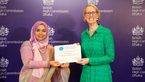
How Nazifa won Oxford’s fully funded ODID DAC Scholarship
Every year, thousands of students dream of studying at the University of Oxford. Very few get a fully funded scholarship, and even fewer become the annual sole recipient of a scholarship open to applicants from 141 countries. Nazifa Binte Harun is one of them.
How Nazifa won Oxford’s fully funded ODID DAC Scholarship
Every year, thousands of students dream of studying at the University of Oxford. Very few get a fully funded scholarship, and even fewer become the annual sole recipient of a scholarship open to applicants from 141 countries. Nazifa Binte Harun is one of them.
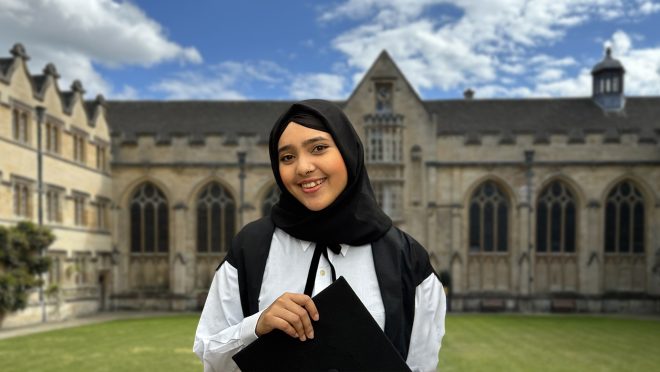
Nazifa is currently studying for an MPhil in Development Studies at Oxford’s Department of International Development, funded entirely by the ODID DAC Scholarship.
The scholarship is also extremely selective, since it is awarded to only one student among 141 countries on the OECD list every year.
Nazifa describes herself as “a young woman raised in a traditional Bangladeshi society with a liberal upbringing and education.” She studied science through much of her school years before her interests shifted towards world systems and human societies, which led her to pursue a BA in Politics, Philosophy and Economics (PPE) at the Asian University for Women (AUW).
During her studies, she was awarded a full Erasmus+ ICM scholarship to spend an exchange semester at the University of Trento in Italy. After graduating, she worked as a development practitioner with BRAC and later the Mai Soli Foundation, before starting her MPhil at Oxford.
This ability to string together the right opportunities early on, an exchange programme, then fieldwork, then further study, became one of the quiet threads running through her eventual success.
Her interest in development and social justice began at home. “Growing up watching my parents taught me that whatever you do, always question those with more power and stand beside those with less.”
She recalls how a lot of that education happened at their dinner table.
Her time at AUW itself was formative. “One of the major turning points for me was having the freedom to choose my own major,” she says, rather than being pushed straight into sciences or social sciences. Her exchange semester in Italy established her independence too. She ended up travelling to 21 countries across Europe on a modest budget, an experience that built the confidence she would later draw on.
The requirements of ODID DAC
“More than two-thirds of Oxbridge graduate scholarships require no separate scholarship application,” Nazifa explains. “If you apply for a graduate course by the Dec/Jan funding deadline, in the same application portal you can also tick the scholarships you are eligible for.”
On the academic side, strong results clearly matter, and this is where Nazifa’s preparation began years in advance.
She graduated Summa Cum Laude with a CGPA above 3.9, which she believes “definitely helped in convincing the committee” of her sincerity in academics. She also added a section to her CV highlighting courses relevant to the programme, to show her academic grounding in the field. Interestingly, she admits her results were not flawless throughout: “I did have one or two semesters where my grades dipped quite a bit,” but she retook courses where possible and let her stronger semesters make up for it.
Leadership experience and extracurricular involvement also counted, though not simply as a list to buff up her CV. Nazifa served in the top leadership of two flagship university clubs, led an academic team in her freshman year and worked as a peer tutor. Her work experience and filmmaking projects rounded out her profile in a similar way. Roles with BRAC and an international NGO mentoring adolescent girls at risk of child marriage gave her, in her words, “a more ethnographic perspective on communal life,” while her documentary and fictional short films showed that engagement with social issues was not limited to essays or research papers.
What mattered, she says, was framing: “I focused on showing their impact, rather than just naming the roles.”
The application process
Nazifa describes the Oxford scholarship process as “essentially a funnel.” First, Oxford assesses applicants for course admission. If successful, the applicant receives an offer. Then scholarship eligibility is checked, departments rank or nominate the strongest candidates, and finally scholarship committees compare the shortlisted applicants. “Successful candidates typically receive funding offers between late February and June,” she notes.
The Statement of Purpose, Nazifa says, was the hardest part of the entire process, and it is also where her preparation was most deliberate.
“I had to resist the temptation to tell my entire life story. Every sentence had to earn its place,” Nazifa shared while explaining her SOP writing process.
She focused on answering two core questions: why her and why this programme. For the “why me” part, she followed a simple progression: “I encountered this issue, it raised certain questions for me, later experiences deepened those questions and that is why I now want to research it further.” For why this programme, her logic was equally structured: “My research asks X, so I need to learn Y; this learning module teaches Y and that helps me answer X.”
She offers three specific techniques that made her SOP stand out.
First, she anchored her research question in a niche theory from one of her undergraduate courses, giving her interest a clear intellectual backbone.
Second, she broke her main research question into four sub-questions and linked each to relevant course modules, showing exactly how the programme would help fill her knowledge gaps.
Third, she made sure to address not only what she would learn from them but also what they could learn from her.
References mattered just as much, and Nazifa treated them as a long-term relationship rather than a last-minute task.
“Oxbridge usually wants two to three academic references,” she explains, and their role was to support the story her SOP told. “My SOP told my side of the story, while my recommendation letters showed that credible academics could back that story up.”
She had built genuine relationships with her referees since her undergraduate years, discussing her academic interests and future plans along the way, long before any application was due. “Around four months before the deadline, I reached out to a few of them, explained the course I was applying for and why, shared my CV and prepared a short bullet-point ‘brag sheet’ of mine” to make it easier for them amid their busy schedules.
When asked about the most common mistakes applicants make, Nazifa was direct: “One of the missteps is trying to sound impressive instead of trying to be precise.”
She also warns against generic statements: “If you could replace ‘Oxford’ with another university and the statement still makes sense, it is probably not specific enough.”
Her own application avoided exactly this trap by staying rooted in specific questions, specific modules and specific personal experience rather than vague enthusiasm.
Her advice to Bangladeshi students who dream of studying at top-ranked universities sums up the philosophy behind her own journey: “Don’t reject yourself before they get the chance to know about you.”
She also urges applicants not to underestimate their own background: “It is rather an asset that these universities are actively looking for to bring to their table.”
And finally, she cautions against relying on one single scholarship.
She advises: “Don’t bet everything on one famous scholarship. Build a funding portfolio. Look across university-wide, departmental, college and external scholarships.”