From BUP to the judiciary: Arnab Sanjarah Elma’s BJS journey
Among the various career opportunities one could follow, becoming a judge is probably one of the most prestigious and respectable choices available for law graduates.
From BUP to the judiciary: Arnab Sanjarah Elma’s BJS journey
Among the various career opportunities one could follow, becoming a judge is probably one of the most prestigious and respectable choices available for law graduates.
In order to chase that dream, one not only needs to have a keen interest, but also prepare for the dreaded Bangladesh Judicial Service examination, an exam that is required for any aspiring law professional to enter the coveted legal system and be addressed as “My Lord”.
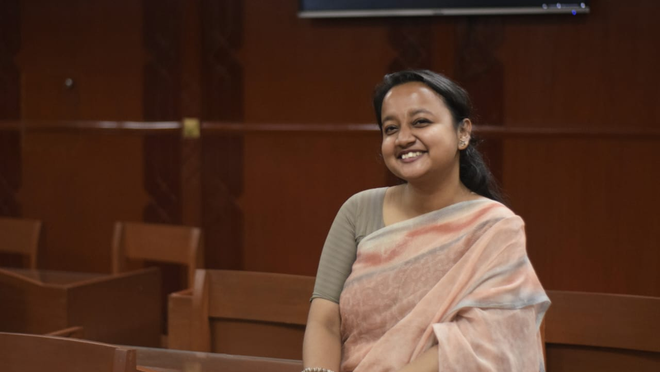
To understand what it takes to overcome the BJS steps, I talked to Arnab Sanjarah Elma, a recently recommended appointee in waiting.
Inspiration
“I never planned on studying law. Honestly, I didn’t choose law; law chose me.”
Arnab shared her incidental appointment first as a law student herself. En route to becoming a zoologist in another university, she quickly switched when the opportunity to study law came up at Bangladesh University of Professionals (BUP).
“I still remember my admission viva, when I was asked what a constitution is. I answered ‘shongbidhan’, and when asked what shongbidhan is, I replied ‘constitution’, with full confidence!” added Arnab.
This unfamiliarity with the subject did not remain for long, as she quickly fell in love with her studies and committed herself fully to the legal world. She shared, “I genuinely came to enjoy studying it. The different ways of interpreting the law, the varying perspectives behind it, and the creative reasoning embedded in judgments, all of that fascinated me and ultimately kept me here.”
Preparation
Becoming a judge was not the first call. Wanting a good result to back her up, her first intentions were to go into the field of academia.
“I had originally wanted to be a teacher, but my LLM result fell short of my expectations. One of my seniors then encouraged me to prepare for the BJS, and that literally changed my career path.”
She began preparing for the judiciary after her LLM. And at the start, finding someone to emulate was not realistic, as BUP at that point had little to no presence in our legal system. She, however, did find one female judge who sat at the Metropolitan Magistrate Court.
“I was fascinated by how she dealt with the lawyers and the justice seekers. I want to be like her.”
Arnab mentioned that she didn’t let the gravity of the preparation consume everything in her life. She added, “I rarely postponed events, gatherings, or anything in my personal life. At that stage, protecting my mental health mattered just as much as the preparation itself.”
She started by analysing previous years’ questions, practising mathematics regularly. “I also installed several news apps to stay updated on current affairs, watched news analysis of different news channels on YouTube and kept notes, and read opinion pieces regularly,” mentions Arnab.
The biggest misconception, as she mentions, is that BJS is “purely a memory test.” According to Arnab, “the preliminary stage does demand strong retention, but the written and viva voce test something entirely different: how you reason, how you interpret laws with precedents, how you apply a provision to a messy fact pattern, and how you hold your ground or revise your position under pressure. Candidates who treat it as rote learning often struggle precisely at the viva, where the board is testing perception, not recall.”
The most unique aspect of her preparation was that she did not sit for any mock test.
“Instead, I used to read different books on the same subject to know the subject better, kept notes from that reading, and discussed what I’d learned with friends and seniors who teach at various universities. Those conversations gave my confidence a real boost.”
Her routine was meant to reflect her needs most, and not be fixed or followed by others’ suggestions. She added, “I didn’t follow a fixed routine. I studied when I wanted to and never forced myself when my mind resisted. Studying was my escape from everything around me. But what I did was set specific targets, such as finishing certain subjects within a week or a month.”
Challenges
The hurdles of preparation did not contain themselves only to the studies themselves. “Since the process is lengthy and the world keeps rushing ahead, everyone around me seemed almost certain about their careers. During that long process, I had days of self-doubt and reconsidered my decisions,” mentions Arnab.
Her willpower came into effect at these critical junctures, and although she had moments of doubt, giving up was never an option. “I had many ‘what if’ moments, but I never seriously considered abandoning it. Since I had already invested so much time, stopping midway would have meant wasting everything I’d put in. I trained my mind to accept that, at that point, there was no option but to continue.”
Her perseverance made it through, and as she concluded our interview, she expressed how she wants to contribute to her society through her place in the judiciary.
“I believe courts have a role in protecting collective rights, not just resolving individual disputes. For me, morality is not personal opinion imposed from the bench; it is the discipline of applying the law fairly, even when the outcome is difficult or unpopular. I hope to serve as someone whom citizens can trust to listen carefully and decide honestly.”
Her parting advice is this: “Find your purpose and figure out which method of study suits you best. Take opinions and advice from everyone, but follow your own ideas. Especially for women: don’t wait for permission or reassurance that this path is ‘for you.’ Remember that self-doubt during preparation is normal. It doesn’t mean you’re unfit; it means you’re taking it seriously.”