The bureaucracy wants space. SAU students won’t budge, rightfully so!
The roads on Sher E Bangla Nagar are at their prettiest right after the sun graces us at dawn and in the afternoon right before dusk.
The bureaucracy wants space. SAU students won’t budge, rightfully so!
The roads on Sher E Bangla Nagar are at their prettiest right after the sun graces us at dawn and in the afternoon right before dusk.
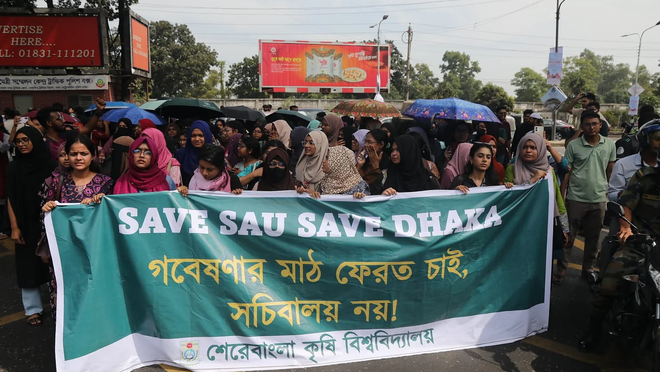
The wide roads were perfect when I had a cycle to roam around along their long stretches, and I must say when I heard the dreaded secretariat would be moving here, a piece of my heart suffered, not just because I knew this land would be infested with irrepressible over-bloated maggots who occupy Paltan today, but because the middle class would be losing its one place of breathing space in Dhaka, since the closest environment to Sher E Bangla Nagar is the roads of Baridhara where the ambassador class enjoys the fruits of taxpayer-paved infrastructure behind closed walls.
Not having any free time to cycle around anymore, I had forgotten how important the area was not only to me, but especially to the students that occupy Sher e Bangla Agriculture University. Right after the cabinet decided to announce the news of relocation, the internet flooded with issues ranging from land disputes to the logic of agricultural science requiring empty spaces for “research”.
This sounded ludicrous, and my interpretation was that students were agitated just because they would be losing a large playground.
However, just like any government policy, there is more than what meets the eye, no matter how tired the eye is investigating and vilifying the ever so omnipresent bureaucracy.
According to The Calcutta Gazette, Notification No. 6914P, these lands were used for research by the Bengal Agriculture Institute in the 1940s and were declared “custodian” to the institute for its use in research and accommodation. And in the 1960s, the Pakistan government decided to use it for administrative purposes and it started using the land and dispersing it for various institutions. After 1971, the expansion continued, but it saw its last round of reallocation after Sher E Bangla Agriculture University was established in 2001.
The point to be noted here is that, although having its own act, Sher e Bangla Agriculture University Act 2001, the university does not hold authority over expansion or use of already dispersed government-allotted lands. As it clearly states in the university’s Act of 2001, subsection 4, “Subject to the prior approval of the Government and as deemed appropriate by the University, establish other centres or campuses at any other suitable locations in Bangladesh for conducting education, research and outreach activities.”
The key phrase being “subject to prior approval by the government,” so if the government feels like moving its operation from Paltan to Agargaon, then it has full legal authority to do it. I do not believe any amount of historical deeds or documentation will hold up in court.
Therefore, I saw no point in starting to write this piece, however, one article from a Karwan Bazar outlet caught my eye, justifying the move from Paltan.
Having read that godawful piece, I just wanted to write another article in support of the students in the space of a 1,000+ word article writing genre.
Their logic for the move can be summarised in this quote.
“Ministries spread across different premises are currently facing coordination difficulties. Bringing offices together may improve working relationships, accommodation and access to shared facilities.”
I didn’t know whether to laugh or cry reading this masterpiece of logic. You can’t transfer paperwork from Paltan to Agargaon? Why? Because of the traffic? Or is it because you have bureaucratic red tape intertwining 5 ministries to implement a single policy?
The article continued, stating, “Proximity to parliament will make sure that the policymakers and the bureaucratic enablers work in tandem.”
The distance from the parliament building to the metro station located on the steps of the secretariat is a little over 8 KMs, starting from the Agargaon Metro Station, it would take probably 15 minutes on the metro.
You mean to tell me, these 8,000 metres were a justifiable reason for policies being delayed, distorted, and files being disappeared all these years? And close proximity of 500 to 600 metres would magically act as a remedy for such inadequacies?
The laughter would have continued on but the very sentences this outlet chose to publish next didn’t allow me to take this below-average writing light-heartedly. The writer quite condescendingly stated, “the university must also be willing to ask whether agricultural education requires every activity to remain in central Dhaka.”
A gentler way of stating that Agriculture students should study agriculture where it persists, in the countryside I presume. To that logic, I don’t see any need for the Ministry of Fisheries, the Navy headquarters, nor the old airport existing within the confines of Dhaka. The Buriganga doesn’t churn out any appetising fish, the navy cannot run its boats and kayaks on the streets of Banani, and in no civilisation has a densely populated capital city hosted flight training for new pilots in the middle of the capital city.
What made me angry is that people like them, while claiming always to be cognisant about the plight of the common man, do not hesitate for a second when it comes to running them over by their benevolent bulldozer of “greater good.”
Who defines the greater good? No, it certainly cannot be the SAU student studying at a dormitory right in the centre of Dhaka, the only viable metropolitan where he can make himself economically productive, the definition of what the greater good is must be defined by the “true” inhabitants of Dhaka, the Prado-riding, air-conditioned fatsos, who know what’s best for everyone, because some outlet in Karwan Bazar gave them a weblink to post their opinions.
“The university’s relocation should add any released land to the nearby greenspace of Chandrima Udyan. Dhaka needs connected green space and safe pedestrian routes and places where people can gather. The newly planned ministry buildings should employ landscaped space to add to the much-needed greenery.”
The greenery he so desperately aches for already exists in the open spaces of Zia Uddan, he, however, thinks that isn’t enough. Believe me, he isn’t speaking for the need for “safe pedestrian” routes here, the elite don’t walk the open fields of Zia Uddan enjoying a Tk10 peanut packet.
This is an outcry of the elite and their expression of disgust towards the pesky students of SAU, who by name, ooze the very resemblance of the lower classes they have discontent for.
The condescension and blatant “I’m better than you” vibe is what led me to this long rant. It is another instance of the state, and its willing beneficiaries spouting what is intended to serve themselves only, but in the guise of the “greater good”.
SAU is a campus full of greenery and impeccable beauty, the roads I so wish to walk around today are some of the cleanest and well-maintained in all of Dhaka, and just when the state felt uncomfortable in the alleyways of Paltan, it decided to ruin the area with its overbearing presence.
A presence that doesn’t talk about why we have 2 ministries for education, an Agriculture Ministry and a Ministry for Jute, another one for Fishers, a Ministry for Road Transport, but another separate two for water shipping and railway. It won’t talk about the level of CFC its AC rooms emit, or why a policy of a particular ministry is delegated among 3, no outlet will ask the question of too much government expenditure with too little tax revenue.
The only target or threat worthy enough of questioning is, why do agriculture students need so much? If they require land for classrooms, dormitories, or research, can’t they just relocate and find farmlands where they “truly” belong?
Disclaimer: The views and opinions expressed in this article are those of the author and do not necessarily reflect the opinions and views of The Business Standard and TBS Graduates.