From kitchen waste to aviation fuel: Bangladesh team wins second place in Hong Kong
From kitchen waste to aviation fuel: Bangladesh team wins second place in Hong Kong
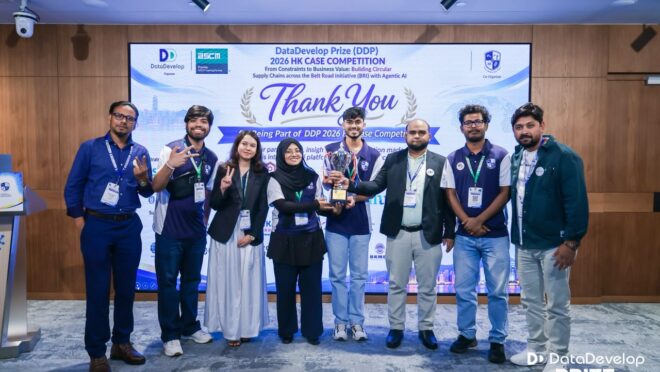
Used cooking oil, often discarded as household or restaurant waste, could have a second life as fuel for aircraft. Exploring that possibility, a team of six young innovators from Bangladesh secured second place at the Data Development Prize (DDP) 2026 Hong Kong Case Competition.
Among the team members was Arian Aidid, a student of the 47th batch of the Department of Textile Engineering and Management at Bangladesh University of Textiles (BUTEX). Representing Bangladesh as Team Lazarus, they presented their project, Nexa Fuel: From Waste to Wings, which proposes converting used cooking oil into sustainable aviation fuel (SAF).
The idea addresses two growing concerns: environmental pollution and the aviation industry’s dependence on conventional fossil fuels. Hotels, restaurants and households generate considerable amounts of used cooking oil, much of which is discarded without proper management. The team sees this waste as a potential resource for producing an alternative aviation fuel.
According to Arian, using discarded cooking oil as a feedstock could help reduce greenhouse gas emissions without directly competing with food production. The proposed model could also create opportunities for better waste management, employment and new businesses in Bangladesh.
Team Lazarus did not begin with Nexa Fuel. Its journey started at the national round of DDP 2026, where 30 participants selected through an online quiz were divided into five teams of six through a lottery. Members had no opportunity to choose their teammates.
The team brought together participants from different institutions: Arian and Amit from BUTEX, Hossain from IUBAT, Syeda Fabiha from the University of Dhaka, Suravi from Green University and Atik Rahman from BGMEA. Amit served as a reserve member and did not take part in the international round.
Working with people who had not previously known one another meant the team first had to build coordination and find a common direction. Their national-round project focused on using Internet of Things (IoT) technology to monitor pollution and reduce resource wastage in the textile industry. The proposal involved installing devices in factories to identify environmental problems while offering potential financial benefits to businesses.
After winning the national round, the team had to develop a different proposal for the international competition. This time, they needed to demonstrate not only the potential of an idea but also its commercial viability.
They eventually developed Nexa Fuel around a proposed Bangladesh-Singapore supply chain. Under the model, used cooking oil would be collected in Bangladesh and transported to Singapore for processing into sustainable aviation fuel. The finished fuel would then be supplied back to Bangladesh.
Developing the proposal required market research, financial analysis, supply chain planning and an assessment of its environmental impact. Coordinating the work among members from different institutions within a limited timeframe was another challenge.
Arian said the experience taught him that developing an innovative idea was only the beginning. Making it practical, financially viable and scalable required much more work.
Competing in Hong Kong also gave the team an opportunity to engage with participants from different countries and observe how they approached problem-solving and presented their ideas. Although they had hoped to finish first, securing second place was a significant achievement after months of preparation and uncertainty.
Recalling the announcement of the result, Arian said the achievement carried a meaning beyond the position they secured. “The most special thing is that we were not competing just for ourselves; we were representing Bangladesh. Being able to carry our country’s name onto an international platform means much more to me than the second-place finish itself,” he said.
Arian was careful not to claim the achievement as an individual success. He said every member contributed to the research, development and presentation of the project. Support from their families and mentors also played an important role. He particularly acknowledged Data Develop Consulting Limited and the Academy of Garments Technology Bangladesh for providing full sponsorship for their participation in Hong Kong.
The team now hopes to take ‘Nexa Fuel’ beyond the competition. Arian said they are interested in developing the proposal further if they can secure the necessary funding from the Hong Kong government. Further research, feasibility assessments and collaboration with industry representatives would be needed before the idea could move towards implementation.
For Arian, the experience has also offered a lesson for other young people interested in innovation. He believes they should not wait for perfect plans or complete knowledge before taking the first step. Instead, they should begin with what they have, learn from mistakes and improve through experience.
From an idea developed in a national competition to recognition in Hong Kong, Team Lazarus has shown how collaboration among young people from different institutions can bring a local problem to an international discussion. For Arian, however, the bigger challenge now is to see whether their competition proposal can eventually become a working solution.