Basic Ali @ 20: Growing up with the Alis
Two decades, countless jokes and a family that feels like our own: the story of Basic Ali
Basic Ali @ 20: Growing up with the Alis
Two decades, countless jokes and a family that feels like our own: the story of Basic Ali
I had barely settled into my post-lunch stupor when I was rudely awakened by the insistent drumming of that unruly woodpecker of memories. It had perched on an old newspaper – the editorial page of Prothom Alo, 26 November 2006, to be precise. Let us have a look, shall we?
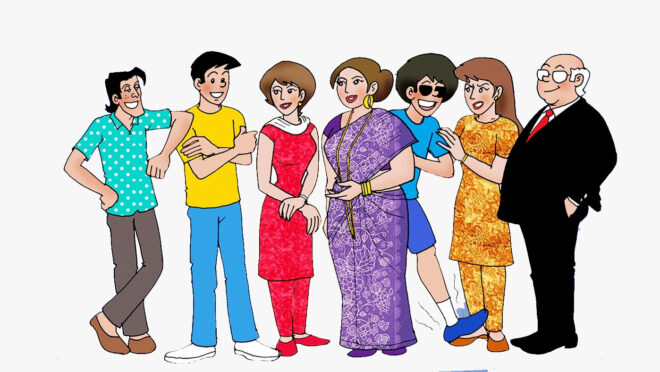
What is this? A brand-new comic strip with thoroughly desi characters: a lazy, wisecracking banker and his equally colourful friends and family, who never stop roasting each other.
The nostalgia hit like a sudden wave. Nearly two decades of lazy mornings spent reaching for the daily paper just to see what kind of chaotic shenanigans Basic and company were up to. That woodpecker had picked the perfect spot to dig its beak in.
So, how does Sharier Khan, the mind behind the madness remember where it all began?
“Ever since I was little, no matter what else I did in life, I wanted to create a cartoon strip that would run forever. It became a kind of stubborn obsession, so I drew cartoons by the dozen. In 2006, Prothom Alo asked if I could contribute daily to spice up their editorial page. I panicked a bit and stockpiled a whole month’s worth of strips. I never in a million years imagined this journey would stretch on for twenty years!”
Basic, the eldest son of the Ali household, is lazy by nature. His father, Talib, is a notorious loan-defaulting industrialist; his mother is Molly; sister Nature is a medical student; kid brother Magic is brilliant and mischievous. Hillol the friend, Riya Haque the love interest.
“I gave that fictional family the very values I grew up loving: parents who were open and approachable, and a house where everyone was constantly laughing at or poking fun at one another. Family members should tease each other and cause a little gentle trouble. That’s what makes a home!” — Sharier Khan, Cartoonist.
Say their names out loud in one breath and the pun lands with a cheerful thud: Basically, Naturally, Magically.
The Alis have long since packed their bags from the Prothom Alo centrefold and now happily reside on Splash, Page 12, The Business Standard, where their creator now works.
When Prothom Alo initially asked for a clean, family-friendly strip, Sharier who only had a few random drafts of friends and siblings sitting in his drawer decided to build an entire family unit around them.
“I gave that fictional family the very values I grew up loving: parents who were open and approachable, and a house where everyone was constantly laughing at or poking fun at one another. Family members should tease each other and cause a little gentle trouble. That’s what makes a home!”
While his other popular creation, Babu, lives in a chaotic teenage fantasy packed with aliens and Draculas, Basic Ali stays rooted firmly in the soil navigating the everyday messiness, warmth, and absurdity of real human relationships. That’s why kids buy Babu at the book fair, but Basic Ali is devoured by everyone from primary schoolers to grandparents.
That grounding comes directly from real life.
“Hillol is based entirely on a real person,” Sharier laughs. “He’s got full-blown obsessive-compulsive quirks, and I plucked him straight from reality. I realized early on that people fall in love with relatable characters far more than complicated plots. Every group of friends has the exact same line-up: a resident foodie, a lovable idiot, a mild rascal, and that one friend who insults you just a little too much [We all know who that last one is in our own group. If you do not, it is you.]”
The secret to surviving twenty years in print? Writing jokes that age like fine wine rather than cheap milk.
The secret of lasting 20 years, he says, is a joke that outlives its moment. “If I put a timeless joke in a book today, it’ll still deliver a hundred years from now. I’ve read comics from way back — like Mutt and Jeff from 1907. Some jokes didn’t age well, but others still make you laugh out loud. I always try to write humor that isn’t trapped in its own decade.”
To trace those roots, you have to picture a house full of books and a beloved little shop on Bailey Road, funded by carefully saved-up Eid money that went straight toward West Bengal classics like Bantul the Great and Handa-Bhonda.
“My father’s greatest gift to me was an endless supply of books and comics; whatever else our house lacked, it never lacked stories. After independence, we lived near a shop called Readers’ Corner on Bailey Road. I clearly remember buying a Hulk comic for 35 paisa, and then diving into Archie. Whether I actually understood the English back then or not, I was utterly hooked.”
By class nine, a friend’s prized stash introduced him to the English translations of Tintin. He already knew the explosive power of Spider-Man and Hulk, but Hergé’s clean, precise visual layout left an indelible mark on his imagination.
“When I set out to draw graphic novels, I wanted to capture that calm, clean Tintin style. Younger artists today use intense, cinematic camera angles, but I’ve always loved classic clarity. The camera stays fixed; a character walks into the frame laughing, and I give you the full figure against a simple wall.”
Manga came later, and with it Akira Toriyama’s Dragon Ball, whose fast, clear and funny storytelling and masterful scene-setting left him impressed.
Over the years, friends kept teasing him: would Basic ever advance?
So in December 2024, he answered with the graphic novel Basic Ali Superhero. Decked out in a suit with a giant “A” emblazoned on his chest, now: Advance Ali.
“I wanted to play around with the superhero genre, which has felt a bit stale lately. The superhero comics I devoured as a kid were light, joyous, and totally free-flowing.”
Basic even made the leap to television screens in 2017 via Channel i, becoming Bangladesh’s very first comic strip character adapted for a TV series. It was a massive milestone, even if the television industry proved to be a bumpy ride for Sharier.
Yet, after two incredible decades, the landscape has shifted.
“Readership has dropped drastically everywhere,” Sharier admits candidly. “It’s not just my work; people simply read less now. They watch more, and they comment even more. Reading means taking the time to step inside another human being’s mind, but people aren’t visiting each other’s minds as much anymore.”
Still, he isn’t hanging up his pen, nor does he plan on pulling the plug without saying a proper goodbye. Because this strip was built on love—by him and by generations of readers—its eventual finale will be wrapped in that very same warmth.
Until then, let that final panel stay far off on the horizon, and let our collective childhood linger just a little while longer.
From every single one of us who grew up turning the pages: Thank you for the last 20 years of laughs, Basic. Thank you, Sharier bhai.