Europe's Hera spacecraft begins close-up study of NASA-struck asteroid
Europe's Hera spacecraft begins close-up study of NASA-struck asteroid
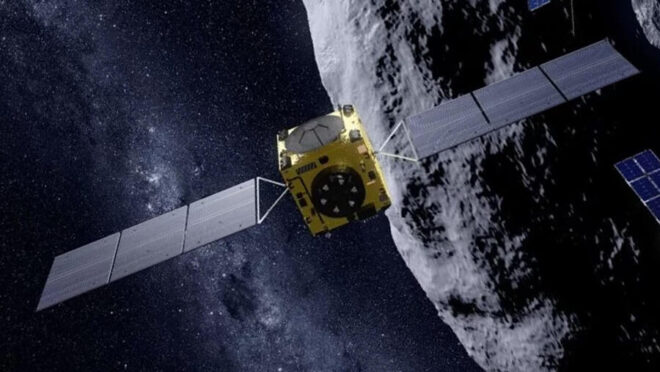
Europe’s Hera spacecraft has begun closely examining an asteroid system after NASA deliberately crashed a spacecraft into one of its asteroids in 2022 to test whether such collisions could help protect Earth from future asteroid threats.
The European Space Agency (ESA) announced Wednesday that Hera is surveying asteroid Didymos and its smaller companion Dimorphos from a distance of 25 to 30 kilometres.
NASA’s Double Asteroid Redirection Test (DART) spacecraft struck Dimorphos in 2022, successfully shortening its orbital period around Didymos and slightly altering its trajectory around the Sun.
Launched in 2024, Hera is expected to move even closer to the asteroid system next month, approaching within 20 kilometres.
Described by ESA officials as a “crash site investigation”, the mission aims to examine the aftermath of the impact and gather data to improve future planetary defence efforts.
The spacecraft, roughly the size of a small car, carries 25 scientific instruments and two shoebox-sized CubeSats designed to study Dimorphos in greater detail, with attempts planned to land them on its surface.
The DART collision sent large amounts of debris, including rocks and boulders, flying off Dimorphos. The resulting debris trail stretched more than 10,000 kilometres into space and remained visible for months.
Scientists believe some of the ejected material may still be present around the asteroid system.
Dimorphos is approximately 151 metres in diameter, while its larger companion Didymos measures around 780 metres across.