BRAC research highlights education, employment gaps among Rohingya youth
BRAC research highlights education, employment gaps among Rohingya youth
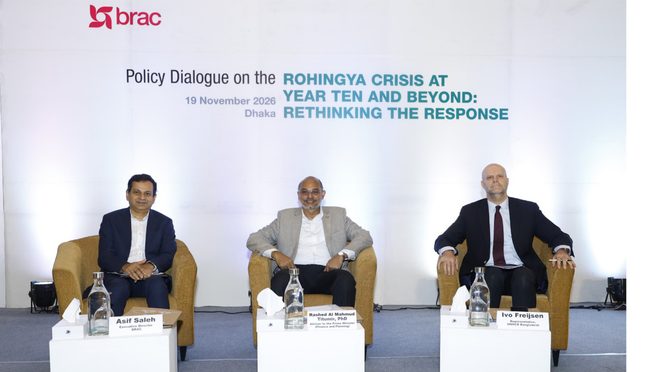
Two-thirds of surveyed host-community youth report harm to livelihoods, while both groups stress citizenship, rights and security as conditions for repatriation.
Nearly half of Rohingya youth surveyed in refugee camps are neither studying nor working, while two in three young people in surrounding host communities say the prolonged crisis has adversely affected their livelihoods, two BRAC studies have found.
The findings were presented at a policy dialogue titled “Rohingya Crisis at Year Ten and Beyond: Rethinking the Response” at Pan Pacific Sonargaon in Dhaka on Thursday, 19 November 2026, according to the press release.
Young people from both communities stressed the importance of citizenship, equal rights and security in Myanmar in enabling repatriation. The findings suggest that reducing assistance or worsening conditions in Bangladesh would have limited influence on their willingness to return.
BRAC Advocacy for Social Change conducted the studies, titled “Between Aspiration and Reality: Livelihoods, Camp Life and the Hope of Return through the Eyes of Rohingya Youth” and “Living in the Shadow of the Crisis: Livelihoods, Gender and Coexistence through the Eyes of Host Youth in Ukhiya and Teknaf”.
Conducted in March and April 2025, the research involved 1,152 people aged 15–35, comprising 576 Rohingya camp residents and 576 young people from neighbouring host communities. Researchers combined surveys with focus group discussions and in-depth interviews.
Education, employment gaps among Rohingya youth
The research found that 49.7% of surveyed Rohingya youth were neither studying nor engaged in any form of work. The proportion was 84.5% among young women and 14% among young men.
Only 17.9% were pursuing education, while 38.4% were engaged in livelihood activities.
Many of those working were NGO volunteers, day labourers or small business operators. They had access to work for a median of 15 days a month, with opportunities often disappearing when projects ended. Their incomes consequently remained uncertain, leaving many struggling to meet basic needs.
The research also found an association between income and willingness to return to Myanmar. Among respondents earning an income, 79.3% expressed willingness to return, compared with 53.4% of those without an income. Those who regularly followed developments in Myanmar were also more inclined to consider returning.
Overall, 76.7% said they would return if certain conditions were met. The proportion rose to 82.6% when citizenship and equal rights were guaranteed.
However, only 19.4% would consider returning if citizenship were granted without assurances of security and employment opportunities.
Asked about a scenario in which assistance and work opportunities in the camps declined while Myanmar offered only assistance and jobs, 52.6% preferred to remain in the camps and 35.6% would consider returning.
Some 27.8% would consider moving elsewhere if camp security deteriorated while conditions in Myanmar remained unstable. Among Rohingya respondents born in Bangladesh, that figure rose to 67.8%, while only 11.9% expressed interest in returning to Myanmar.
Host-community livelihoods under pressure
Among surveyed host-community youth, 66.7% said the Rohingya crisis had adversely affected their livelihoods.
Of those reporting adverse effects, 85.8% said finding work had become more difficult, 65.9% reported falling wages and 36.4% said they had lost their jobs.
The proportion reporting livelihood losses was higher in Teknaf, at 71.6%, than in Ukhiya, at 60.1%.
Young women in host communities had higher educational attainment than men but lower participation in paid work. Some 53.9% had completed secondary or higher education, compared with 41.4% of young men.
Yet only 20.8% of young women were engaged in income-generating activities, compared with 70.2% of young men. Men earned, on average, 4.3 times as much as women.
Social norms, requirements for family permission, unsafe travel, domestic responsibilities and low wages were identified as major barriers to women’s participation in the workforce.
Views on coexistence and repatriation
Some 72.2% of host-community respondents believed hosting Rohingya refugees had adversely affected the local population, while 57.3% described relations between refugees and host communities as poor.
Despite this dissatisfaction, only 23.4% supported forced repatriation.
Some 95.5% wanted the government to create more employment opportunities for local young people. Their demands included priority in government and NGO recruitment, preference for jobs within the camps, skills training and support for agriculture, fisheries and handicrafts.
The studies also found differing expectations about repatriation. While 76.7% of Rohingya respondents said they would return if the necessary conditions were met, only 39.8% of host-community respondents believed refugees would do so. Some 71.7% of local young people were pessimistic about the prospects of repatriation.
Host-community youth identified citizenship, full rights and security in Myanmar as essential conditions for return. Only 9.2% believed reducing humanitarian assistance in Bangladesh would encourage repatriation, while 5% believed deteriorating camp security would do so.
Calls for a sustained international response
At the dialogue, speakers said livelihood pressures on both communities required urgent collective decisions and effective action.
BRAC Executive Director Asif Saleh delivered the opening remarks, and BRAC Policy Analyst Tariqul Islam presented the research findings.
Dr Rashed Al Mahmud Titumir, adviser to the prime minister for the finance and planning ministries, attended the inaugural session as chief guest. Ivo Freijsen, UNHCR representative in Bangladesh, also spoke. Refugee Relief and Repatriation Commissioner Mohammed Mizanur Rahman joined online.
Titumir said the crisis must be resolved in Myanmar through the restoration of Rohingya political rights and the creation of conditions for return.
He urged the international community to fulfil its responsibilities, saying declining assistance and prolonged displacement were placing a disproportionate burden on Bangladesh’s limited resources. He called for a stronger international response grounded in justice and recognition of Rohingya rights to expedite their safe return.
Saleh said that while justice was being pursued, the years of waiting would be spent in Bangladesh. With a return to Myanmar unlikely in the near future, he described livelihood opportunities and skills development as preparation for a dignified return. He cited the finding that Rohingya youth earning an income were more likely to want to return home.
Host communities must also receive support for the economic costs of the prolonged crisis, he said. Without a clear policy framework, both communities faced risks of exploitation.
Saleh called for decisive action by the government, the UN and development partners to give direction to the response during the prolonged wait for repatriation.
Freijsen said the crisis was becoming more urgent while safe, dignified and voluntary return remained elusive. He called for sustainable, longer-term approaches that would support refugees during displacement and after their return.
Such measures would require policy changes and stronger international solidarity, alongside continued humanitarian assistance, he said.
Mizanur Rahman said the Rohingya had fled persecution and called for their identity and experiences to be recognised in the humanitarian response. He also urged open and fair opportunities for refugees to organise and participate in decisions about their future.
Investment in Cox’s Bazar, predictable financing urged
The closing session featured remarks from Nirjhor Adhikari, director general of the Myanmar Wing at the Ministry of Foreign Affairs, Muhammad Nazmul Abedin, head of the Refugee Cell at the Ministry of Disaster Management and Relief, and Carol Flore-Smereczniak, UN resident coordinator in Bangladesh.
Flore-Smereczniak said the response must address the long-term needs of refugees and host communities alongside emergency assistance.
She outlined three priorities – sustained humanitarian assistance and protection for Rohingya, greater investment in Cox’s Bazar’s services, livelihoods and resilience while advancing durable solutions for refugees, and stronger international partnerships to ensure coordinated and sustained support.
Adhikari conveyed a statement from State Minister for Foreign Affairs Shama Obaed Islam, emphasising that safe, voluntary, dignified and sustainable repatriation remained the ultimate solution. This required sustained diplomatic engagement and credible guarantees of safety and rights.
Abedin called for a phased, evidence-based approach that supported eventual repatriation, prioritised host communities and protected security and social cohesion. He urged predictable, multi-year financing and said dignity for Rohingya during their wait must be matched by fairness to host communities.
Dr Md Akramul Islam, BRAC’s senior director for health and humanitarian crisis management, delivered the closing remarks and vote of thanks.
A panel moderated by BRAC Senior Director KAM Morshed examined how a humanitarian-development-peace approach to livelihoods could support refugee self-reliance while protecting and expanding opportunities for host communities.
Panellists included Suhail Kassim, senior operations officer and Rohingya programme coordinator at the World Bank, Freijsen, Adhikari, and Abu Saleh Mohammad Obaidullah, director of Jatiyo Protibondhi Unnayan Foundation. Professor Nasir Uddin of the University of Chittagong’s Department of Anthropology and Bimal Chandra Dey Sarker, chief executive of Mukti, Cox’s Bazar, also participated.
The studies called for expanded access to education, skills development and livelihood opportunities for Rohingya youth, greater employment opportunities for host communities and increased economic participation for women. They also stressed the need for effective measures to create conditions for safe, voluntary and dignified repatriation to Myanmar.