6 decades on, Purnima remains Gulistan’s favourite snack joint
6 decades on, Purnima remains Gulistan’s favourite snack joint
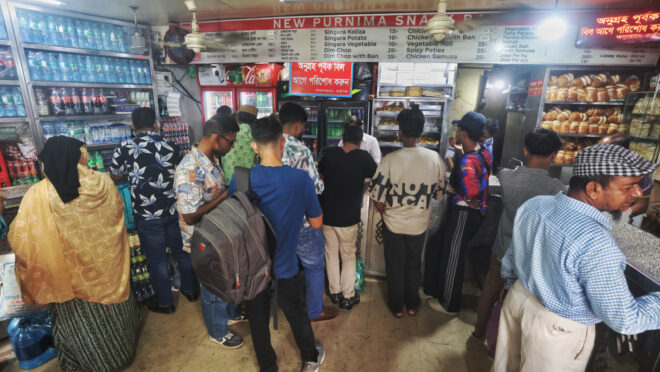
Pushing through Dhaka’s unbearable traffic, I stepped onto Bangabandhu Avenue (Shaheed Abrar Fahad Avenue) at noon, and the din seemed to have grown fourfold. Around the National Stadium came the calls of hawkers, the honking of cars, a stream of people who never stopped: the familiar restlessness of Gulistan. At road number 18, stands a shop that is hardly new, yet its signboard reads: New Purnima Snacks Bar.
I had not planned to go there that day. After finishing my classes for the day, a friend and I were mulling over where to have lunch. He said he had work in Gulistan and added, “Come with me. There is an old and well-known eatery there.” I took a bus from Farmgate, got off at Zero Point and followed my friend to Purnima.
It was much smaller than I had imagined. There is nowhere to sit; you eat standing. A red banner above the glass counter reads “Pay first.” Two young men in college uniforms, a passer-by tired from the sun and many others stand with steaming tea and a hot singara or samosa. Blue paper boxes line the back shelves; a fridge holds cold drinks.
In one corner, Mainul and Bahar make samosas. Three customers buy 200 at once, for an event they are organising. Through the bustle, a voice floats across the counter: “Khan Shaheb, what will you have: egg chop, or jilapi?”
The elderly customer replied, “Give me jilapi and a bun.”
Asked about his curious order, Khan said, “I have been eating here since the ’90s, when I studied at Dhaka College. There were no burgers then; for that strange taste of hot jilapi stuffed inside a bun, we stood in line! Even now, if I pass through Gulistan and don’t eat a hot jilapi, the day somehow doesn’t feel right!”
What brings old customers back and draws in a new generation? Not the taste alone, but one family’s story, and the memory of an older Dhaka, where a kilogram of jilapi cost Tk4 and even the country’s top politicians rushed over, drawn by the delicacy.
In front of the cauldron
I pushed through the crowd to the counter. To an elderly seller on the other side, I said, “Brother, give me some jilapi.”
“You will have to wait a little; stand in line,” he said. “Everything is gone the moment it comes off the cauldron.”
Standing in line, I asked how long he had been working there.
“In 1981, at a very young age, I joined this shop as a salesman,” he said, smiling faintly. “Before I knew it, so many years had passed here!” Md Halim Reza replied.
For more than four decades, Halim has worked from behind this same counter, tending to customers. The funniest of his memories involves former president Hussain Muhammad Ershad.
“Ershad Saheb came to inspect the kitchen market and suddenly appeared at our shop,” Halim said. “I was busy with my back turned, weighing jilapi. Someone in the crowd asked, ‘How much for a kilogram of jilapi?'”
Busy with the crowd, Halim had not noticed who it was. “Tk42 taka per kg,” he said bluntly. “Stand in line!”
He smiles at the memory. “A little later, I finished my work, turned and, oh! This was Ershad Saheb himself!”
My eyes went to the cauldron beside us. Finger-thick coils of jilapi came straight from the bubbling oil into sugar syrup, then were arranged in rows on a big platter: golden-brown, crisp outside, dripping with syrup inside. The board said Tk240 per kg.
Around 30 workers fill the cramped space. Some make jilapi; others prepare samosas. Craftsmen on wooden stools chop onions into red plastic baskets, and everyone sweats in the heat from the stove.
Liver, potato or vegetable singara costs Tk10-15, egg chop Tk25. Amid glossy cafés with sky-high prices, these rates soothe both pocket and heart.
While I waited, I asked Halim, “Why such a crowd here?”
“This is people’s love,” he said, moving his hands. “Whatever the fame of the jilapi, four things sell the most: jilapi, liver singara, egg chop and shami bun.”
In an age of disposable plates and cups, Purnima has held on to its old etiquette; at last a small plate of hot jilapi came into my hands, with cold water in a steel glass.
The first bite broke through the crisp coating into the soft, syrup-filled inside. Not overly sweet; it dissolved in the mouth.
Between bites, I asked how the shop began. Wrapping paper as he spoke, Halim said, “That was more than six decades ago! But it did not start with jilapi; it began by selling cloth!”

Sheikh Aminuddin introduced Nagpur-style thick jilapi to Dhaka, where the sweet, soon popularised as “Bombay jilapi” or “big jilapi” won over food lovers.
From Nagpur to Gulistan
How did a cloth shop become one of Dhaka’s most popular snack bars? I asked the current owner Sheikh Imran.
The area was then mostly home to clothing stores, he said. In 1962 the business began as a shari and cloth shop called Silk and Purnima. In 1968, it became a food establishment and was renamed ‘New Purnima Snacks Bar’. There were hardly any snack shops nearby then.
Its founder Sheikh Aminuddin had spent his childhood in Nagpur, India, in an ordinary family; his father worked on the railway line. He grew up watching the work of Nagpur’s local sweet-makers (halwaikars), and it was from there that he mastered the technique of making thick jilapi.
In 1947, he came to Saidpur with his family; later, driven by the need for study and higher education, Sheikh Aminuddin eventually settled in Dhaka.
Sheikh Imran, his son, recalled that at that time such jilapi was hard to find in Dhaka. His father began making thick jilapi in the style of Nagpur’s sweet-makers, which won people’s hearts in a short time. Known by the names “Bombay jilapi” or “big jilapi,” this item instantly gained tremendous popularity among food lovers.
The menu was short: kabab bun, mutton samosa, egg chop, potato singara, chicken fry and hot, juicy jilapi. Burgers were unfamiliar to customers at the time; the shami or kabab bun was the most ‘modern’ food for the young customers.
The shop used to open from 10am to 4pm, and this corner of Gulistan was not as loud with horns. Pepsi and Seven Up came in heavy glass bottles, cooled only by ice.
“A cup of tea was four annas, and so was a singara or samosa,” Halim said. “A mutton chop cost 60 paisa, and a kg of jilapi was around Tk4!”
Per kilogram of jilapi has since reached Tk240, but lines have not shrunk.
Changing times, enduring taste
Nowadays, the eatery opens at 7am, though rush hour begins from 9am. The shop now stays open until nine at night, serving 300 to 400 people daily.
Sandwiches, vegetable rolls, chicken paratha and cake have joined the menu, yet people mostly stick to the originals.
Nearby banks and offices supply busy regulars. Zahid, a bank officer, comes almost every day. “Their liver singara and jilapi are very good, and cheap,” he said. “A great breakfast for Tk20.”
In Ramadan the line grows longer, and handling the crowd becomes difficult. Halim said the pressure rises several times over once the fast begins. From half past three, more people arrive, and as iftar nears, the line stretches onto the footpath.