
Global warming may have stopped Earth's next ice age, study finds
Global warming may have stopped Earth's next ice age, study finds
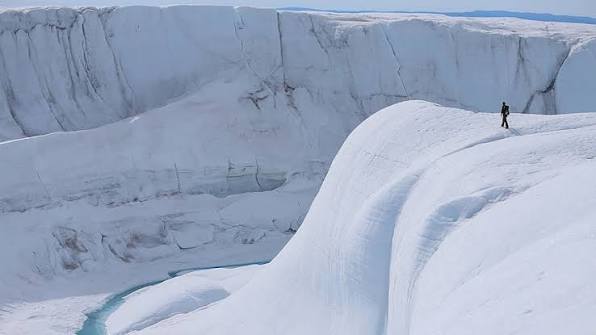
Earth’s next glacial period may have begun around 2,000 years ago but was interrupted by rising global temperatures, according to a new study by researchers at Columbia Climate School.
The study, published in the journal Science, found that an ancient ice sheet remnant in Canada’s Arctic began expanding around 2,000 years ago, potentially marking the beginning of a new glacial period. However, rising temperatures reversed the process by the 1960s, causing the ice to retreat.
Researchers studied the Barnes Ice Cap, a remnant of the massive Laurentide Ice Sheet that once covered much of Canada and the northern United States. Located on Baffin Island in Nunavut, Canada, the ice cap covers an area roughly the size of Delaware.
By examining ancient plant remains preserved beneath the ice, scientists reconstructed the ice sheet’s history and found evidence that it had reached its smallest extent around 3,000 years ago before beginning to expand again.
The team used radiocarbon dating to determine when the plants were covered by advancing ice, allowing them to trace the glacier’s expansion over thousands of years.
According to the researchers, the renewed growth began around 2,000 years ago as temperatures cooled. They argue that this marked the beginning of Earth’s next glacial period, challenging previous climate model projections that suggested the next major glaciation was still thousands of years away.
“It was just getting started, everything was normal, the next glaciation was about to happen – and yet it stopped,” said Nicolás Young, a geochemist at Columbia University’s Lamont-Doherty Earth Observatory.
By the 1960s, however, rising summer temperatures had reversed the ice cap’s growth, with more ice melting during summer than could be replaced by winter snowfall.
Researchers said the findings suggest human-driven global warming may have interrupted a natural glacial cycle that had begun thousands of years earlier.
The study also raises questions about future ice age cycles, as the Barnes Ice Cap could disappear entirely within the next few centuries, according to projections cited by the researchers.
The team noted that the disappearance of the ice cap could affect how future glacial periods develop, as existing ice masses can help facilitate further ice accumulation through positive feedback processes.
Technically, Earth remains within a long-running ice age known as the Late Cenozoic Ice Age, which began around 34 million years ago. Within this period, colder glacial phases alternate with warmer interglacial periods, including the current one.
The last glacial period ended approximately 11,700 years ago.