
A 226km journey at 40: How Sajia Sultana became Bangladesh’s first woman Ironman finisher
A 226km journey at 40: How Sajia Sultana became Bangladesh’s first woman Ironman finisher
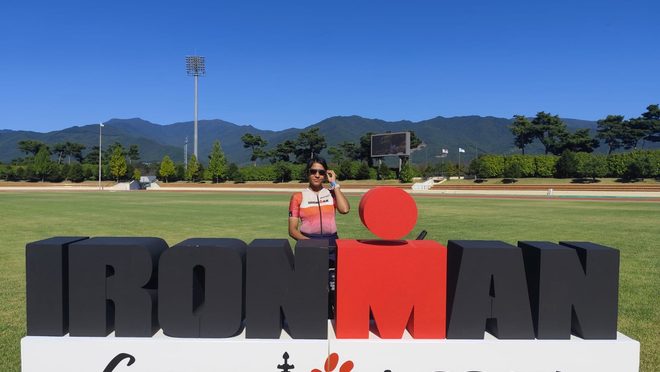
A lot of us have that one belief that, in order to become an athlete, one needs to have been an athlete since childhood. But Sajia Sultana proved them wrong.
Sajia is a Senior Principal Officer at the Investment Corporation of Bangladesh (ICB) and a mother of two. At 40, she became the first Bangladeshi woman to complete a full-distance Ironman triathlon.
An Ironman triathlon is not just any sport. A full-distance Ironman means a 3.8 km swim, a 180 km bike ride and a 42.195 km marathon, one after another without a break. That is about 226 km in total, and everything must be completed within 17 hours. There are cut-off times along the way, too: the swim must be completed within 2 hours and 20 minutes, and the swim and bike legs together within 10 hours and 30 minutes.
On 4 October 2026, the Ironman triathlon took place in Gurye, South Korea. Sajia was the only Bangladeshi participant in the race. It took her 15 hours, 16 minutes and 34 seconds to finish.
It almost sounds impossible, which is why I reached out to Sajia to learn how she prepared herself for the day.
Before the Ironman
Sajia holds a BBA and an MBA from the University of Chittagong and a master’s degree in Development Studies from the University of Dhaka. She also worked as a lecturer at City University Bangladesh before joining ICB.
Her central identity was not sports, but sports were always around her. At university, she was a big football and cricket fan. She volunteered as a yoga instructor at Ramna Park. At ICB, she organised football and cricket teams among her colleagues.
One day, she visited a running event at Hatirjheel and saw runners in matching shirts moving together with the same spirit. That one moment caught her attention and became a turning point in her life. She started reading about multisport, and curiosity slowly turned into passion.
After that, she won the Dhaka Dash 15K and the Tiger Pace Half Marathon, which gave her a confidence she had never felt before. That was when she started thinking about Ironman. She began preparing in July 2025.
Her first race was IRONMAN 70.3 Shanghai in China. Finishing it qualified her for the IRONMAN 70.3 World Championship in Nice, France. After that, she participated in the Ironman triathlon in South Korea. At Nice and in South Korea, she became the first Bangladeshi woman to finish.
Training around work and family
Sajia’s success required consistency and dedication. She woke up at around 5:00 to 5:30 every morning and trained for about two hours. Then she got her children ready for school and went to the office. Some days, she trained again in the evening.
Managing a job, home, children and a passion all together sounds impossible to many of us, but Sajia was the exception. She made it happen, and she does not deny that it was very hard. She considers her family the biggest source of her strength.
She said the biggest sacrifice was time with her children. Her family took care of the children’s studies, meals, sleep and playtime when she trained for long hours. She also gave up screen time, social media, late nights and social gatherings.
The triathlon
The triathlon was scheduled to take place in Gurye, South Korea. Her visa for South Korea arrived on 30 September, just days before the race.
The lake was icy cold, so she bought a wetsuit, something she had never swum in before. She practised for about 500 metres before race day.
During the bike leg, a box mounted on the front of her bicycle came loose after she crossed a speed breaker. Her front wheel hit it, and she fell among many other cyclists. She fractured the thumb of her left hand, cut her knee and felt pain in her head.
Medical volunteers wanted to take her to hospital. She asked only for first aid and a few minutes of rest. At that moment, she thought it was over for her, but she got going again with the encouragement of athletes who were passing by.
After about ten minutes, she got back on the bicycle. Her injured thumb made changing gears difficult, so she focused on maintaining control and staying within the cut-off times.
Then she started the marathon with an injured knee. The course was tough, and even the organisers advised her to stop. But then she saw the flag of Bangladesh among the flags of other nations.
She thought of her country, her children, her husband and her parents. She also thought of her brother, Dr Abu Helal, who registered her for the full distance and gave her the bicycle she trained and raced on. Then she stopped thinking about the whole marathon. She thought only about the next section, then the next step. This helped her through the rest of the journey.
At the finish, the commentator announced, “Sajia from Bangladesh”, and she ran in with the national flag above her head. “I forgot the pain. I cried with pride and gratitude. I will treasure that moment for the rest of my life.”
What she wants for women in sports
Sajia said the achievement has made her feel more responsible. She wants to do something for women’s health and encourage women to take up endurance sports.
She said funding is the main obstacle for women athletes, as Ironman training, equipment and international travel are expensive. She believes that no woman should have to give up her dream for lack of money. She hopes the government and corporate organisations will support women athletes, employers will encourage fitness at work, and sports bodies will offer beginner programmes, including for mothers returning to exercise.
“A woman athlete raises an athletic generation.”
Her next goal
Sajia is 40 now. She has just spread her wings in sports, and she wants to keep competing at higher international levels and representing Bangladesh. She also dreams of becoming a sports diplomat and wants to encourage more working mothers to take up sports.
She is a woman who has challenged many stereotypes that people have about female athletes. She is 40, a mother, a working professional, a homemaker and now an athlete who raises her country’s flag on the international stage. To women who think it is too late to start, she said age, motherhood and work do make things harder. But they do not mean you must give up your dreams.