ULAB hosts academic discussion on technology-assisted documentation of endangered languages
ULAB hosts academic discussion on technology-assisted documentation of endangered languages
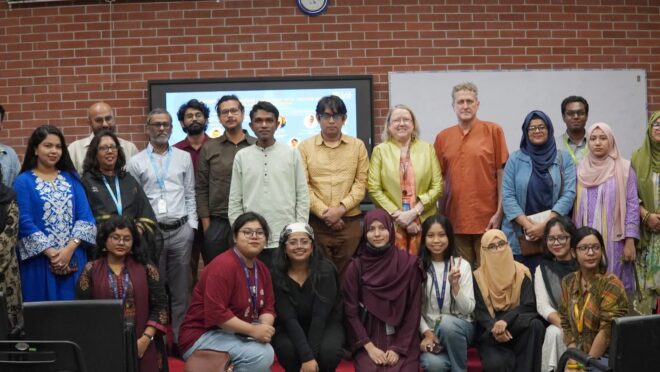
The Department of English and Humanities (DEH) at the University of Liberal Arts Bangladesh (ULAB) organised an academic talk and panel discussion titled ‘Documenting Endangered Languages with Technology: A Bangladeshi Perspective’ on 25 November 2026, bringing together academics, researchers, policymakers and language advocates to discuss the role of technology in preserving endangered indigenous languages.
The keynote address, titled ‘Thirty Years of Language Documentation in Bangladesh: A Retrospective and Thoughts on Future Prospects’, was delivered by Dr David A Peterson, Associate Professor of Linguistics at Dartmouth College, USA. Drawing on three decades of research and fieldwork across Bangladesh, India and Myanmar, he discussed the evolution of language documentation, challenges to preserving endangered languages and opportunities created by technological advancements.
The programme was attended by ULAB Vice Chancellor Professor Shamsad Mortuza, Dean of the School of Arts and Humanities Professor Kaiser Hamidul Haq, and Head and Associate Professor of DEH Arifa Ghani Rahman.
A subsequent panel discussion, moderated by Oliur Rahman Sun, Senior Lecturer at DEH, featured Dr Susan Vize, Head of Office and UNESCO Representative to Bangladesh; Dr Mahmud Hasan Khan, Professor at DEH, ULAB; Dr Mashrur Imtiaz, Associate Professor at the Department of Linguistics, University of Dhaka; Samar M Soren, Founder and Head of Language Resource Hub and Global Taskforce Member of Digital Equality for Indigenous Languages (IDIL) at UNESCO; and Mohammad Mamun Or Rashid, Associate Professor at the Department of Bangla, Jahangirnagar University, and Consultant at the Bangladesh Computer Council, ICT Division.
The discussion explored the role of technology, linguistic research, community engagement and policy in safeguarding endangered indigenous languages. Panellists emphasised collaborative initiatives, accessible digital resources and sustained institutional support to ensure linguistic heritage is documented, preserved and passed on to future generations.
Through the programme, ULAB reaffirmed its commitment to academic discourse, interdisciplinary research, linguistic diversity and the preservation of cultural heritage in Bangladesh.