Dhaka records 'very unhealthy' air quality, ranks 2nd globally
Dhaka records 'very unhealthy' air quality, ranks 2nd globally
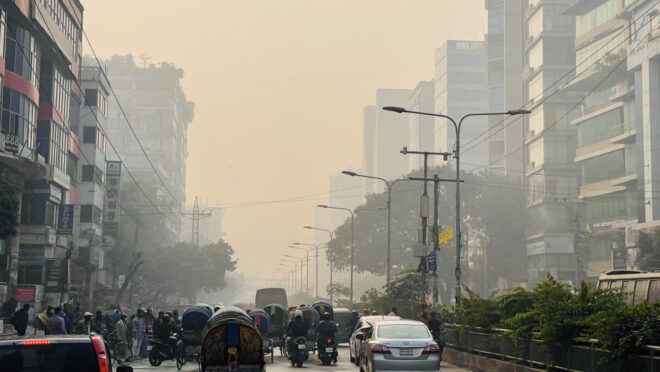
Dhaka ranked second among the world’s most polluted cities on Thursday (26 November) morning, recording an Air Quality Index (AQI) score of 233 at 10:20am.
According to the AQI scale, the city’s air quality was classified as ‘very unhealthy’, meaning everyone, regardless of their health condition, may experience more serious health effects from air pollution, even after short-term exposure.
According to the AQI ranking, Lahore in Pakistan topped the list with a score of 366, while Kolkata and Delhi in India ranked third and fourth, with scores of 221 and 216, respectively.
Under AQI standards, a reading between 101 and 150 is considered ‘unhealthy for sensitive groups’, while 151 to 200 is classified as ‘unhealthy’. A reading between 201 and 300 is considered ‘very unhealthy’, while levels above 301 are deemed ‘hazardous’, posing serious health risks.
The AQI provides daily updates on air quality, indicating how clean or polluted the air is and highlighting potential health impacts.
In Bangladesh, the AQI is calculated based on five major pollutants: particulate matter (PM10 and PM2.5), nitrogen dioxide (NO2), carbon monoxide (CO), sulphur dioxide (SO2) and ozone.
Dhaka has long struggled with air pollution, with air quality typically deteriorating during winter and improving during the monsoon season.
The World Health Organization estimates that air pollution causes around 7 million deaths globally each year, mainly from stroke, heart disease, chronic obstructive pulmonary disease, lung cancer and acute respiratory infections.