Banani turned a dumping ground into an urban forest. Can Dhaka follow?
Banani’s new urban forest has transformed a neglected dumping ground into an urban forest, home to 220 plant species from Bangladesh and abroad as well as wildlife. Experts say it could serve as a model for a greener Dhaka.
Banani turned a dumping ground into an urban forest. Can Dhaka follow?
Banani’s new urban forest has transformed a neglected dumping ground into an urban forest, home to 220 plant species from Bangladesh and abroad as well as wildlife. Experts say it could serve as a model for a greener Dhaka.
As soon as I got off at Kakoli crossing in Banani, I spotted the clusters of flowers. The colour is mindblowing, even from a distance. I walked a little closer. A fence ran along the pavement from the entrance to Kamal Ataturk Avenue. All sorts of plants peeped over the top.
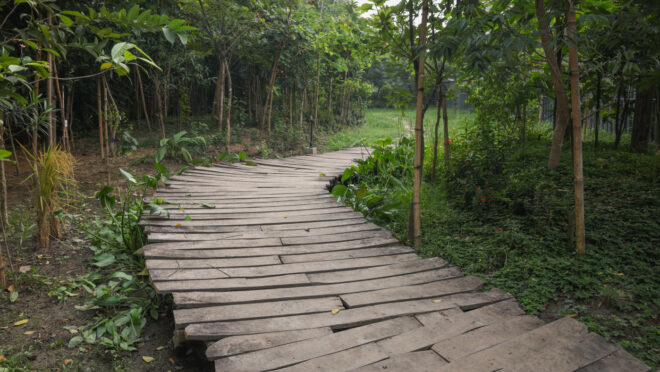
Curiosity drew me through the front gate into another world of green. Trees covered the hills, bamboo grew in thickets, and wildflowers bloomed along the earthen path. Walking through it felt like wandering deep into a forest.
Yet this was the heart of bustling Dhaka. A major road ran along one side, while the Dhaka Elevated Expressway loomed over a railway line on the other. Trains roared past now and then, yet the place felt strangely detached from the city.
I was walking through a roadside forest in Banani, home to 220 plant species from Bangladesh and abroad. Developed jointly by Dhaka North City Corporation (DNCC) and the Forest Department, it aims to restore some ecological balance and offer residents a respite from the city. The forest stretches nearly a kilometre along the eastern side of the Dhaka–Mymensingh Highway, from Kakoli crossing to Road 27 in Banani.

Flowering shrubs and young trees now grow on a former rubbish dump in Banani. Photo: Mehedi Hasan
The first phase of work has just finished. The forest is due to open to the public towards the end of this month.
From a rubbish dump to an urban forest
Years of dumping had left the place filthy. Rubbish lay scattered everywhere, and the heaps of waste gave off a stench. It was an eyesore beside one of the city’s main roads.
The DNCC decided to reclaim this stretch of Banani. It asked the Dhaka Social Forest Division to take on the work. The division began drawing up plans.
Sharmin Akter, deputy conservator of forests at the Dhaka Social Forest Division, said DNCC cleared the site and handed it to her team, which partnered with private landscaping firm Gardening Bangladesh to plan and plant the forest. The firm brought nearly 20 years of experience in landscaping and urban forestry to the project.
“There used to be wetlands and small pools here. When we started work, we found rubbish buried two to six feet deep, including non-degradable waste such as polythene, plastics and broken concrete. Small nurseries and makeshift food stalls had sprung up over the waste, taking over the entire site. It wasn’t even safe to walk through,” recalled Rakibul Amin, chief executive of Gardening Bangladesh.
Once a rubbish-strewn, foul-smelling stretch, the site has been transformed through careful planning, research and hard work. Plants, winding paths, seating areas and small ponds have turned the neglected pavement into a place where people can pause and unwind.

Photo: Mehedi Hasan
Sharmin Akter said work began in January 2026. Less than a year later, a forest stands where the rubbish used to be. The planting extends beyond the pavement. The trees beneath the flyover and along both sides of it are part of the project too.
A patch of green in the concrete jungle
Tall buildings rise on one side. A busy flyover runs along the other. The strip between them is now green. It is called Banani Urban Forest.
A path like a village lane runs through the middle of the forest. There are more kinds of plants on either side than I could count. Each carries a label with its name. Several small ponds hold the kinds of water plants you would find in a village pond. Brightly coloured fish swim among them.
Among the flowering trees and shrubs are palash, shimul, kadam, cherry and oleander. There are wild ferns, akanda, holy basil and chhatim trees too. Ornamental plants from abroad add colour. Climbers give the forest a wilder look. I also spotted several medicinal trees, including arjun, neem and haritaki.
I spotted a date palm with a pot tied to its trunk, perhaps in anticipation of fresh sap this winter. Further along, a path cut through a bamboo grove, evoking a village lane. For a moment, I felt far removed from Dhaka. Had it not been for the car horns, I could almost have forgotten the city outside.
There are benches at three spots along the edge of the forest. Once it opens, people will be able to sit there for a while.
I asked a few local residents what they made of the change. Hasan Farazi, who lives with his family on Road no. 23, was out for an afternoon walk. He said he liked the place now and went for a walk whenever he had time. He thought he would enjoy it even more once the tin fence came down.
“There used to be a few shops selling plants. You couldn’t go for a walk like this then. And there was the smell of rubbish. Now they’ve planted all these trees and the flowers are out. It’s nice to look at,” he said.
Ali Hossain and Mohammad Nayan have been working as security guards on the elevated expressway for years. They have watched the forest take shape.
“No one of any descent came here after dark. People used to sell flowering plants here. Then they planted these trees. We like it here now too,” Ali said.
Sharmin Akter said residents, particularly longtime neighbours, had welcomed the transformation, saying the greenery had brought them peace of mind.
“People who once endured the stench now enjoy their balconies. The trains are still loud, but residents tell us they feel more at peace,” she said.
A home-grown alternative to the Miyawaki method
Sharmin calls the approach an “urban ready forest”, where trees are planted in a way that lets them fill out the space very quickly.
“We’ve seen good results in a short time,” she said.
Sharmin said they brought in plants from forests in different parts of Bangladesh. “We’ve tried to bring our different types of forest together in one place. There are trees from sal forests and hill forests, from social forestry plantations and from coastal forests. We have fruit trees, forest trees, medicinal plants and ornamental plants too.”
Rakibul Amin said his team had worked with the Forest Department to develop its own alternative to the Miyawaki method. They call it Sampriti Bon, meaning ‘harmony forest’.
“This is a special kind of forest. It has its own planting method. It’s a new idea, and we tested it in several stages. We’d developed four or five eco-parks with the Bangladesh Inland Water Transport Authority. We used what we learnt there for our Sampriti Bon method,” he said.
Rakibul said the team had combined botany and engineering. They planned everything from soil preparation and irrigation to the use of fertiliser and the choice of plants.
“We’d already used this method on two or three projects. We planned this forest in detail. Our experience in the field helped us decide how many trees to plant and at what angle, right down to the degree. We worked out how far apart they should be and what should grow next to each one. We paid particular attention to preparing the soil.”
Rakibul said urban trees were difficult to sustain unless they grew quickly. He estimated the forest could achieve in one year what might take eight to ten years elsewhere.
“You can see it here. Within a year, the place has filled out with trees and flowers. Regular watering and care have made a difference,” he said.
A home to wildlife too
As the plants have grown, small habitats have begun to form among them. Butterflies, dragonflies and moths have appeared. Birds, including owls, have been spotted, as have squirrels and frogs. Closer to the ground, another world is taking shape. Ants and other insects are signs that the soil is coming to life.

Photo: Mehedi Hasan
Rakibul said the first habitats in a new forest usually take two to three years to form. In Banani, his team started seeing wildlife within six months.
“We’re already seeing butterflies, dragonflies, moths, birds, owls, squirrels and frogs doing well here. They’re coming here, building nests and getting ready to breed. We’re also seeing ants and all sorts of other insects in the soil,” he said.
Dr Reza Khan, an ornithologist, wildlife expert and conservationist, recently visited the forest. He believes more habitats will form naturally if the forest is protected a little longer. The change should be clearer if the plants and animals can grow undisturbed through this winter and the next monsoon.
“I think small birds in particular could do well here. Our moutushi and tuntuni, the sunbirds and tailorbirds, don’t need much space. Migratory warblers and flycatchers may come too. These little birds like places where there are insects, flowers or bushes they can hide in. This could be a good home for them. It could be a good place to breed too,” Dr Khan said.
“They could plant our native reeds or other water plants like them around the ponds. There’s water hyacinth here too. I’d keep that in check and leave room for native plants. Those would bring in dragonflies and more kinds of birds. Then the place could function as an ecosystem,” he suggested.
The team is also watching for changes in the soil, air quality and noise levels, as well as in the wider urban environment. Sharmin said there are plans to measure the forest’s environmental impact.
“We’re trying to find out how much the soil and air quality have improved. We want to see whether noise levels are falling and what effect this greenery is having on the urban ecosystem. We’re also planning a carbon assessment,” she said.
The people behind the project believe this patch of green could, in time, give wildlife a refuge in the city too.
A model for greener cities
In a city as crowded as Dhaka, a patch of green can be hard to find among all the concrete. Experts say the city needs more urban forests like this one. They could bring back some of the greenery Dhaka has lost and give wildlife new places to live.
According to Dr Reza Khan, urban planting schemes often focus on large trees and leave the ground beneath them bare. That gives small creatures few places to live. In Banani, he saw an attempt to fill that gap.
“In most places, you see big trees with bare ground underneath. In nature, plants grow in layers. There’s the canopy overhead. Below it there’s a middle layer and a lower layer. There are layers of shrubs, grasses and herbs too. My impression was that they’ve tried to recreate those natural layers here,” he said.
Rakibul believes forests like this could support pollinators for several kilometres around. That could mean more flowers and better crop yields, including in nearby rooftop gardens. He would like to see urban forests planted wherever there is room for them.
“We’ve been working on this for a long time. The present government has made tree planting a priority, and I hope it will fast-track projects like these. Whether it’s unused land in Dhaka or newly planned towns, we need to plant trees on a large scale,” Rakibul said.