Can Bangladesh afford a ‘cultural debate’ on child marriage?
A worrying rise has been observed recently. According to Bangladesh Bureau of Statistics, in 2020, 31.3% of women were married before 18, rising to 41.6% in just three years
Can Bangladesh afford a ‘cultural debate’ on child marriage?
A worrying rise has been observed recently. According to Bangladesh Bureau of Statistics, in 2020, 31.3% of women were married before 18, rising to 41.6% in just three years
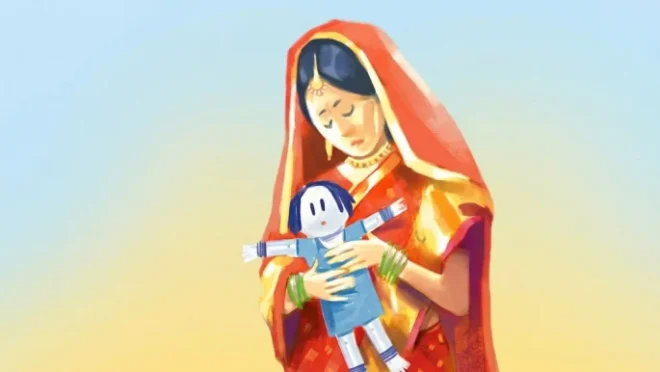
The debate surrounding child marriage in Bangladesh, long blamed on poverty, has recently begun focusing on morality: girls, according to proponents of early marriage, become “impure” or “indecent” if they are not married off young.
What started as a trend during the pandemic under extraordinary circumstances is now slowly becoming the new normal.
Amid Covid-19, with uncertainty and fear of death at peak, and schools closed, even financially well-off families started to marry off their daughters early. But since then, child marriage rates have kept rising in the country.
Recently, Lubaba, a 15 year old teenager who is popular online, got married and sparked debate.
Her marriage was celebrated online as a safeguard, weeks after a young woman was filmed in a private moment with her boyfriend. The two incidents were stitched together into a single argument: this is what becomes of girls who are not married young.
According to the Bangladesh Bureau of Statistics, in 2020, 31.3% of women were married before 18. By 2023, the number had risen to 41.6%.
But as this debate rages online, the issue of child marriages raises another important question: Can Bangladesh’s economy afford child marriages?
The economic backdrop
For an economy built on the labour of its women, the timing could not be worse.
Over the last few decades, Bangladesh has maintained steady economic growth. Since 2004, the country has been on an upward trajectory. With an almost 6% annual growth rate, the country is one of the fastest growing economies in the world, thanks largely to the ready-made garment (RMG) industry and remittances.
In FY25, Bangladesh’s RMG sector contributed roughly 84% of total export earnings. As the world’s second-largest exporter, the industry employs over 4 million people — mostly women — directly fueling poverty reduction and women’s empowerment.
This high contribution means that Bangladesh’s macroeconomic stability is almost entirely tied to the success of this one industry.
It provides the foreign exchange needed to pay for essential imports like fuel and food, and its growth directly dictates the rise of the national GDP.
The loop
A girl married at 15 does not simply lose her teenage years. She permanently loses her place in the economy.
First, she leaves school. Without a secondary certificate, the gates of the garment factories are closed to her. She has her first child at 16, perhaps 17. A second follows shortly after. By the time she is 22, she is managing a household, raising children, and entirely financially dependent on a husband who is likely himself young, undertrained and underpaid.
Multiply this by millions of households and the arithmetic becomes brutal. Bangladesh’s RMG sector — which runs almost entirely on young, educated, mobile women — begins losing its workforce before it even forms. The demographic dividend Bangladesh spent 50 years building starts bleeding out.
The country had targeted a fertility rate of 1.7 by 2021. Instead, the rate rose — reversing a 50-year declining trend. The birth rate keeps rising, which tracks closely with the rise in child marriage.
For a country already strained under the weight of its own population, this can complicate things even more.
Rumana Huque, professor of Economics at the University of Dhaka, sees the damage operating on two levels simultaneously.
“If we allow early marriage to become normalised in an economy as integrated as ours, a large segment of women will simply never enter the workforce,” she says. “And those who do will hit a ceiling far earlier than they should — because the years that should have built their careers were spent managing a household and raising children.”
She points to a cost that rarely makes it into the headline numbers: teenage pregnancy. A girl who marries young becomes pregnant young, and the health consequences fall on two people.
“The mother’s body is not ready. The child is at high risk of malnourishment. And that malnourished child grows up to be a less productive worker — someone who cannot fully contribute to the economy 20 years from now. So the loss is not just one generation. It echoes into the next.”
But her sharpest point concerns what happens in the mind of a parent. Decades of advocacy slowly convinced Bangladeshi families — including poor and middle-income ones — that educating a daughter was worth it. That she would get a job, contribute to the household, build a life.
“If early marriage becomes the norm again,” she warns, “that logic collapses. Why send a girl to school if she is just going to be married off anyway? And then we lose not just the worker. We lose the investment in her education before it ever pays off.”
She draws the connection to the 1980s directly.
Before NGO interventions reduced child marriage, Bangladesh’s development indicators were among the worst in the region. Countries that were our equals then — by GDP, by population, by poverty rate — have since fallen behind.
“We moved ahead of them partly because of what we did for girls. If we reverse that, we will find out what we gave up,” Rumana said.
Bangladesh is already racing against time. The demographic dividend window — the brief historical period when a country’s working-age population is large enough to power rapid growth — closes by 2040.
That is just 15 years away.
To capitalise on it, Bangladesh needs more workers, better educated, more productive. Instead, it is sending them home at 15.
A generation raised in poverty, born to teenage mothers, stunted by malnourishment, will not build the Bangladesh that is currently being promised. They will inherit it — broken, slower, and running out of time.