BRAC University hosts two-day celebration of environment, conservation days
BRAC University hosts two-day celebration of environment, conservation days
BRAC University Vice-Chancellor Professor Syed Ferhat Anwar has called for Bangladesh to take a leadership role in environmental conservation, highlighting the country’s unique natural assets, including the world’s largest mangrove forest, largest delta, longest natural sea beach and largest deep-sea submarine fan.
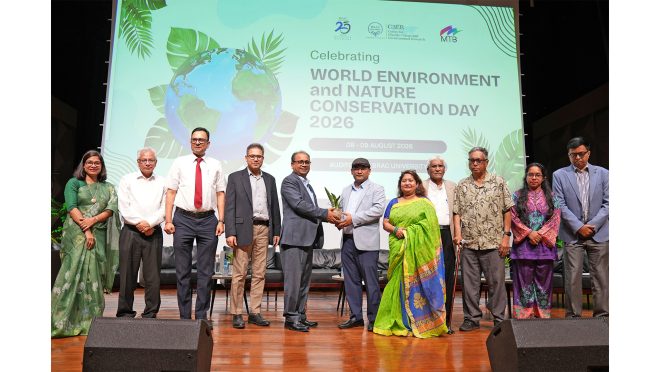
The Vice-Chancellor made the remarks while addressing the opening of a two-day celebration of World Environment Day and World Nature Conservation Day at BRAC University’s Merul Badda campus on 8 August 2026.
The celebration was organised by BRAC University’s Centre for Climate Change and Environmental Research (C3ER), with support from Mutual Trust Bank PLC (MTB). World Environment Day was observed by the United Nations on 5 June, while World Nature Conservation Day was observed on 28 July.
Professor Syed Ferhat Anwar said academia has a crucial role to play in addressing environmental challenges through research, innovation and youth empowerment.
“BRAC University possesses an advantage that many other universities do not, one that we are currently leveraging: our sister organisation, BRAC. BRAC has a presence across the entire country. We would love to capitalise on this advantage and help in any way possible to ensure we create a better world and a better Bangladesh,” he said.
He also highlighted Bangladesh’s geographical and environmental significance, including the Bengal Fan, the world’s largest submarine fan. The Bengal Fan extends across much of the Bay of Bengal, measuring approximately 3,000 kilometres in length, 1,430 kilometres in width and up to 16.5 kilometres in sediment thickness. Submarine fans are deposits of sediment formed near continental margins in deep-marine environments and can be potential areas for hydrocarbon exploration.
Chief guest Shaikh Faridul Islam, State Minister for Environment, Forest and Climate Change, announced a government initiative to plant 250 million trees nationwide, with mapping already underway to identify suitable species for different regions.
He also called for the elimination of wood-fuel brick kilns, replacement of single-use polythene with biodegradable alternatives and public health impact assessments before major development projects are undertaken.
Dr Md Saimum Parvez, Special Assistant to the Prime Minister for Environment, Forest and Climate Change, stressed the importance of the “Reduce, Reuse, Recycle” principle and the circular economy, where waste is converted into usable resources through the collective efforts of government, educational institutions, banks and civil society.
BRAC University Professor Emeritus Dr Ainun Nishat, also adviser to C3ER, said Bangladesh is facing the consequences of a climate crisis to which it has contributed relatively little. He noted that Bangladesh has signed around 40 to 50 international environmental agreements and called for stronger implementation of these commitments alongside greater domestic accountability.
Pro-Vice-Chancellor Professor Arshad Mahmud Chowdhury stressed the need for the government, academia, private sector and public to work together to address climate and environmental challenges, while reaffirming BRAC University’s commitment to sustainable development.
MTB Managing Director and CEO Syed Mahbubur Rahman highlighted the bank’s nature conservation initiatives under its corporate social responsibility programmes and encouraged students to take up environmental causes and lead Bangladesh towards a more sustainable future.
AKM Sohel, Additional Secretary and Wing Chief (UN Wing) of the Economic Relations Division, said Bangladesh is increasingly focusing on adaptation-oriented climate financing and improving access to global climate funds. He encouraged young people to develop skills in climate finance, project design and proposal development to contribute more effectively to the country’s climate resilience efforts.
C3ER Director Dr Golam Rabbani delivered the keynote presentation and called for greater emphasis on large-scale tree plantation, environmental restoration, greener and cleaner cities, and improved waste management.
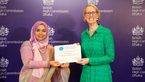
Awards were presented to the top three participants of the She4Climate Fellowship Programme, an initiative supporting women’s leadership in climate action.
The event brought together policymakers, environmental experts, researchers, private-sector representatives and students for five technical sessions covering climate resilience, biodiversity conservation, sustainable development, nature-based solutions and youth engagement.
The celebration, held as BRAC University marks its 25th anniversary, concluded with a collective commitment to strengthening environmental stewardship and advancing a more sustainable and climate-resilient Bangladesh.
The initiative contributes to Sustainable Development Goals (SDGs) 13 (Climate Action), 14 (Life Below Water), 15 (Life on Land) and 17 (Partnerships for the Goals).