BRAC University's BIGD launches annual democracy conference
BRAC University's BIGD launches annual democracy conference
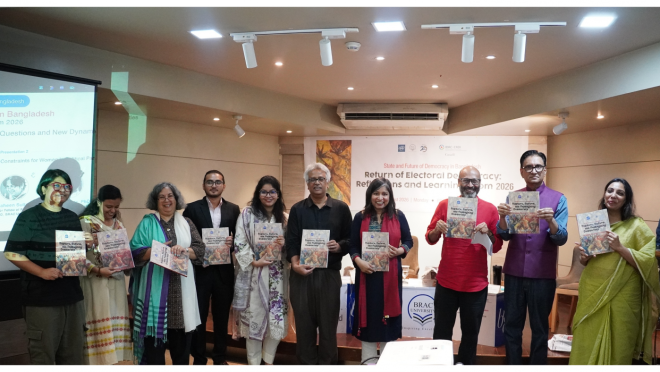
The BRAC Institute of Governance and Development (BIGD) at BRAC University has launched an annual conference on the state and future of democracy in Bangladesh.
The inaugural conference, titled “State and Future of Democracy in Bangladesh”, focused on “The Return of Electoral Democracy in Bangladesh: Reflections and Learnings from 2026”, according to a press release, inviting wider reflection on the theme.
The conference brought academic and analytical perspectives to Bangladesh’s democratic trajectory within a broader historical and global context.
It was based on the premise that the return of the ballot marked the beginning of a democratic transition, not its culmination, and thus required reflection on what electoral democracy had recovered and what remained to be secured.
Drawing on its research and field experience, BIGD explored the state of the transition, the opportunities it had created and the measures needed to deepen and sustain democratic governance.
Opening the conference, BIGD Executive Director Dr Imran Matin said, “Democracy is not a destination; it is a process. Ultimately, democracy is a design issue, and every society needs to rethink and reimagine it.
“We intend to reimagine the ethos of the July Uprising in the present context and consider what the future relationship between the state, society and democracy might look like.”
The conference began with a keynote address by BIGD Governance and Politics Adviser and Senior Research Fellow Dr Mirza M Hassan on Bangladesh’s democratic trajectory.
Three thematic sessions examined the dynamics of the 2026 election, the evolving role of political parties and democracy’s longer-term demands.
Delivering the keynote, Dr Hassan said, “Bangladesh has never satisfied the criteria for even a minimalist democracy. Its decades-long trajectory has been marked by authoritarian consolidation, a dominant-party state, dynastic rule and ‘rule by law’ rather than the rule of law.”
The first session, titled “Elections 2026: Unpacking Voting Behaviour and Dynamics”, examined what the election revealed about how Bangladeshis voted and what shaped their choices, with particular attention to women voters.
Researchers presented evidence on competing political narratives and their effects on democratic mobilisation, the factors influencing voting behaviour and polling-centre findings on women’s voting patterns.
IFPRI-Bangladesh Acting Country Director Moogdho Mahzab, University of Dhaka Department of Development Studies Professor Dr Shubhasish Barua, Netra News Executive Editor Nazmul Ahasan, Netra News Special Correspondent Aaqib Md Shatil and BIGD Senior Research Associate Tahrima Binte Tarique presented their research during the session.
Voice for Reform Coordinator and Bdjobs.com Co-founder and Chief Executive Officer AKM Fahim Mashroor moderated the panel discussion that followed.
Colgate University Associate Professor of Political Science Dr Navine Murshid, The Asia Foundation Bangladesh Country Representative Kazi Faisal Bin Seraj and University of Dhaka Department of Economics Assistant Professor Dr Rubaiya Murshed joined the discussion as panellists.
Reflecting on political engagement, particularly among young people, Dr Rubaiya Murshed said, “Education has a role to play, but our education system has never prepared us for civic engagement.
“Despite all its failures, we have seen the interesting use of historical allegories to capture the revolutionary spirit of the July Uprising. We need to understand better how education can play a more prominent role in creating a groundswell of civic engagement.”
The second session, titled “Politicians and Political Parties: Old Questions and New Dynamics”, shifted focus from voters to the political actors and institutions shaping the transition.
Presenters examined how opposition parties survived under autocratic rule and which activists the state targeted. They also discussed whether party structures could deliver gender-inclusive representation, the politics of young people in post-July Bangladesh and possible reforms to political party financing.
Pennsylvania State University Department of Political Science PhD Student Yasin Shafi, University of Sussex Institute of Development Studies Senior Research Fellow Dr Sohela Nazneen, BIGD Senior Fellow of Practice Maheen Sultan, Independent University, Bangladesh Department of Global Studies and Governance Associate Professor Dr Marufa Akter, BIGD Governance and Politics Cluster Head and Fellow of Practice Syeda Salina Aziz, BIGD Senior Research Associate Inteemum Ahsan and Dacca Institute of Research and Analytics Research Associate Ragib Anjum presented their work.
BRAC University Department of Economics and Social Science Associate Professor Seuty Sabur moderated the panel discussion that followed.
Researcher and Writer Sohul Ahmed, Alternatives Organiser Mahfuj Alam and Independent Politician and Physician Dr Tasnim Jara joined the discussion as panellists.
Discussing how political parties emerging from movements become disconnected from the public, Sohul Ahmed said, “Movements have, for a long time, not been led by established political parties. People often baulk at the idea of a movement led by a political party.”
He questioned why movements that entered formal party politics often distanced themselves from the people and the movements from which they had emerged.
Reflecting on his experience as part of a movement-based political party, Mahfuj Alam said, “We set out to reimagine the traditional left-right dichotomy through our movement party.
“However, we were not sufficiently prepared for the eventual split within the party because of ideological differences. Established parties capitalised on those differences in ways we were not prepared for.
“Ultimately, movement parties must find a way to establish internal consensus if they are to sustain their momentum.”
Dr Tasnim Jara highlighted the difficulties of raising women’s issues within political party structures.
“Political parties often relegate discussions of women’s issues to their women’s wings. There is also a tendency to pit women against one another within these wings, keeping them out of contention for major party positions,” she said.
The final session, titled “Future of Democracy”, brought together civil society and emerging political movements to discuss what was needed to deepen and sustain Bangladesh’s democratic gains.
Professor Asif Shahan, Department of Development Studies, University of Dhaka, moderated the session.
Alternatives Organiser Dr Tajnuva Jabeen, Network for People’s Action Founder Member Anik Roy and People’s Revolutionary Initiative Representative Arif Sohel took part in the discussion.
Dr Tajnuva Jabeen said, “Our differences are often highlighted more than our similarities. To create division, those differences are exaggerated and given disproportionate attention.
“There is a common misconception that rights-based issues are not matters for the political right to address, but I find that deeply disingenuous.”
Discussing changes in traditional political alignments, Anik Roy said, “To people of this generation, it matters less whether someone is on the left or the right. What matters more is whether that person is accountable and stands for what is right.
“That includes remaining true to one’s promises and speaking out against injustices committed against people from other political parties who are being unfairly targeted.”
Arif Sohel called for a departure from conventional political divisions and a new understanding of people-centred politics.
“So far, we have largely viewed democratic engagement as the right to vote. I believe the way we conceptualise democracy has changed, and we no longer see voting rights alone as the ultimate expression of democracy,” he said.
“The people are not a homogeneous group. Differences between the left and the right can coexist with common ground.
“We must move beyond the traditional understanding of the left-right spectrum and explore different ways of organising politically,” he added.
The conference also marked the launch of BIGD’s “State of Governance 2026” report, titled “Rupture, Reform, and Reimagining Democracy: Navigating the Agony of Transition”.
The latest publication in BIGD’s flagship State of Governance series, now in its 17th year, examines the aspirations that drove the July 2024 Uprising and how those aspirations subsequently evolved.