IUB hosts international RISK-E-SCAPE course on disaster health and climate resilience
IUB hosts international RISK-E-SCAPE course on disaster health and climate resilience
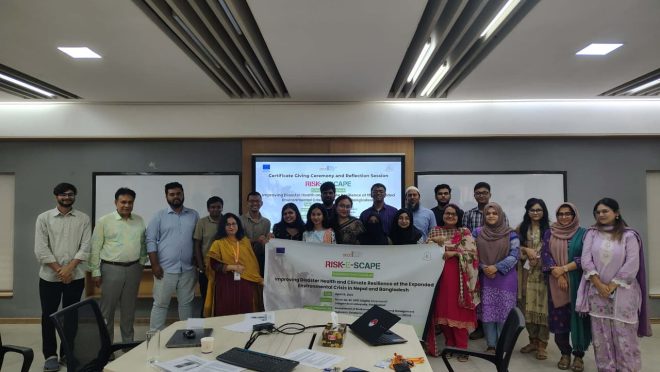
Independent University, Bangladesh (IUB) has hosted an international short course on “Improving Disaster Health and Climate Resilience in the Context of Environmental Crisis in Nepal and Bangladesh”, reinforcing its role as a leading institution in climate change research and education.
Conducted under the global RISK-E-SCAPE project, the programme brought together experts, academics, and practitioners to address the growing environmental and public health challenges faced by Bangladesh and the wider South Asian region.
A multilateral approach to crisis management
The RISK-E-SCAPE project represents a major international collaboration involving seven universities across Greece, Italy, Portugal, Nepal, and Bangladesh. At IUB, the initiative is led by the Department of Environmental Science and Management. The project adopts a holistic, community-based approach that integrates public health, disaster risk reduction, climate change adaptation, and interprofessional collaboration, moving beyond conventional academic frameworks.
Course highlights: from theory to field application
The four-day course was designed to provide comprehensive training across the disaster response spectrum. Participants engaged in specialised modules covering fundamental principles of disaster response, human displacement, low-resource and humanitarian medicine, and leadership and communication in crisis settings.
The programme also included a practical field exercise, enabling participants to apply theoretical knowledge in simulated real-world scenarios. The course concluded with a reflection session and certificate awarding ceremony, marking a key milestone in strengthening institutional collaboration under the project.
Building long-term sustainability
Beyond the training programme, the RISK-E-SCAPE project aims to establish dedicated hubs at partner universities. These hubs are intended to sustain the initiative by supporting continued training, research, policy development, and academic output in the field of disaster management and climate resilience.
As Bangladesh remains one of the most climate-vulnerable countries globally, initiatives such as RISK-E-SCAPE play a crucial role in bridging international expertise with local capacity-building efforts, contributing to more resilient and adaptive communities.