Jahangirnagar University students showcase archaeological dating methods
Jahangirnagar University students showcase archaeological dating methods
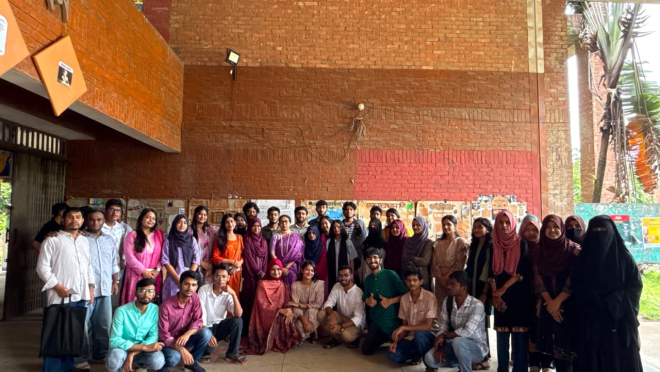
First-year students of the Department of History at Jahangirnagar University have organised an exhibition titled “Decoding Time: An Exhibition on Archaeological Dating Methods”, offering visitors an interactive introduction to one of archaeology’s most fundamental concepts, determining the age of historical objects.
The exhibition is being held from 26 to 28 July at the university’s New Arts Building as part of Course 109: Introduction to Archaeology for the 54th batch of undergraduate students.
Organised by seven student groups, the exhibition presents both relative and chronometric dating methods through informative wall magazines and handcrafted three-dimensional models.
Visitors can explore relative dating techniques such as stratigraphy, seriation and fluorine-uranium-nitrogen (FUN) analysis, alongside chronometric methods including radiocarbon (Carbon-14) dating, dendrochronology, thermoluminescence dating and potassium-argon dating.
One of the exhibition’s main attractions is a series of student-designed 3D models illustrating archaeological concepts such as soil stratification, forest environments, ancient hearths and charcoal remains. The displays use clay, colour and other materials to explain complex scientific methods through visual and interactive learning.
Sabikun Naher, Associate Professor of the Department of Archaeology and academic supervisor of the exhibition, said the initiative goes beyond a classroom assignment.
“This exhibition reflects our students’ creativity, research skills, teamwork and their ability to communicate scientific knowledge effectively. Such initiatives bridge theoretical learning with practical experience, making education more meaningful and engaging,” she said.
She added that students were involved in every stage of the project, from selecting topics and conducting research to building models, preparing exhibition panels and explaining the concepts to visitors.
The exhibition demonstrates the growing emphasis on experiential learning in higher education by transforming classroom theory into an engaging educational experience. Through their work, the students highlight archaeology as a scientific discipline that seeks to understand time, cultural change and human history, rather than simply the study of ancient objects.
The organisers hope the exhibition will encourage visitors to explore the science of archaeological dating while fostering greater interest in archaeology and the study of the past.