Santal flower festival ‘Baha Banga’ brings colour and tradition to JU
Known as the Flower Festival of the Santals, Baha Banga is observed during the spring months of Falgun and Chaitra as a symbol of gratitude to nature and prayers for the well-being and prosperity of the community.
Santal flower festival ‘Baha Banga’ brings colour and tradition to JU
Known as the Flower Festival of the Santals, Baha Banga is observed during the spring months of Falgun and Chaitra as a symbol of gratitude to nature and prayers for the well-being and prosperity of the community.
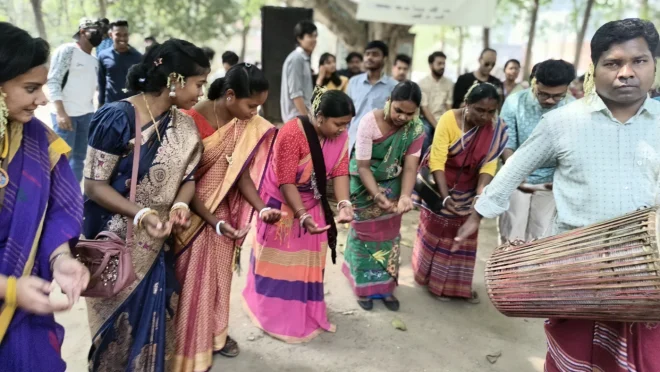
Baha Banga, a major traditional festival of the indigenous Santal community, was celebrated at Jahangirnagar University today (6 March) with colourful cultural performances, traditional music, and dance.
With the slogan “Unity in the strength of diversity, and rights in the strength of unity,” the Santal community celebrated the Santal Baha Parab Festival for the third time at JU’s Saptam Chhaya Mancha, with participation from students, teachers, and Santal community members from across the country.
Known as the Flower Festival of the Santals, Baha Banga is observed during the spring months of Falgun and Chaitra as a symbol of gratitude to nature and prayers for the well-being and prosperity of the community.
Through this festival, the Santals also welcome the arrival of the New Year.

The festival began in the morning with Bahapuja, held adjacent to the TSC of JU. People from different regions, especially members of the Santal community, took part in the ritual.
Participants dressed in traditional Santal attire performed the famous Baha dance, accompanied by the rhythmic beats of Madal and Dhamsa drums.
The celebration also included rituals, flower offerings, music performances, and various cultural activities reflecting the rich traditions of the Santal people.
What is the Baha Banga festival?
The Baha festival is one of the main and the second largest festivals of the Santal people.
According to Santal beliefs, the festival dates back to the early period of their civilisation. Although there is no written record of its origin, the tradition has been preserved through stories and oral explanations passed down from generation to generation.
Explaining the origins of the festival to The Business Standard, Nirla Mari, convener of the Baha Banga Celebration Committee, said that in ancient times the Santals lived in forests, caves, and mountains, where they constantly struggled against natural disasters such as intense sun, rain, and storms, and faced threats from wild animals like tigers and lions during hunting expeditions.
Due to these challenges, they realised that living scattered across different places made survival difficult. As a result, they decided to gather and form a social structure.
People from various places gathered in a large sal forest, where it is believed they sat under sal trees and discussed how to organise their society.
There they formed an important institution known as the Manjhi Council, which consists of seven members. This governing system still exists in Santal society today, and many social rules, customs, and traditions were established at that time.
After creating this social structure, they decided to celebrate together. At that time sal flowers were blooming, and people placed the flowers on their heads while men also wore them on their ears.
They celebrated with dancing, singing, and traditional musical instruments such as the madal and tak.

Mari also said the Santals believe in a main deity called Marang Buru, which literally means “Great Mountain.”
Since mountains and nature had sheltered them for a long time, they placed a small stone as a symbol of Marang Buru and began worshipping it. From then on, the worship of Marang Buru became a long-standing tradition.
During the Baha festival, the Santals also worship Jaher Ayo, the goddess of the forest. Because forests provide fruits, roots, animals for hunting, and other food sources, the Santals regard the forest as a mother and honour Jaher Ayo as the symbol of this forest mother.
Mari further explained that the Baha festival includes several ritual stages. One important stage is called Moneku Turku, which is related to the social structure of the Manjhi Council.
The council includes several leadership positions such as Manjhi, Gomajhi, Jogmanjhi, and Jogranik, each with specific roles and responsibilities.
The ritual of Moneku Turku is performed to honour these leaders, who are believed to play a crucial role in managing society and are sometimes considered representatives of Marang Buru, Mari said.
Voices from the festival
Hema Chakma, an executive member of Dhaka University Central Students’ Union (Ducsu), attended the festival for the second time and shared her experience.
“Last year, I participated in the event at Sundarbans and really enjoyed it, so I didn’t want to miss it this year. In the morning, I saw the Santals’ traditional rituals and celebrations. The rituals and performances on the stage were as beautiful as last year, which I loved again,” she said.
“Universities play an important role in culture and politics. For example, at Dhaka University we recently had a language and cultural program where different communities performed songs, dances, and poetry. At Jahangirnagar University, this is the third time such an event has been held,” Hema said.
“Celebrating Santal festivals like Baha at universities not only preserves their culture but also spreads awareness across Bangladesh,” she added.
Hema further said, “If we don’t practice and celebrate these festivals, like Saraswati Puja, Ramadan iftars, or tribal festivals such as Chakma’s Bizu, Marma’s Sangrai, Tripura’s Boshu, and Santal’s Baha, these traditions may fade over time.”
“Even traditional Bengali cultural practices, like cinema songs and folk music, are being forgotten. Universities are essential for keeping these traditions alive and sharing them nationwide,” she said.
Shoma Dumri, a student of JU, said, “The Baha Festival is an important festival of the Santal community. Our main objective is to highlight the rich traditions of the Indigenous communities living both in the plains and the hills of Bangladesh, as well as their deep connection with nature.”
“With this purpose in mind, we have been celebrating this festival for the past three years, and we hope that this celebration will continue in the future as well,” Shoma said.