American children are forgetting how to read: Study finds
American children are forgetting how to read: Study finds
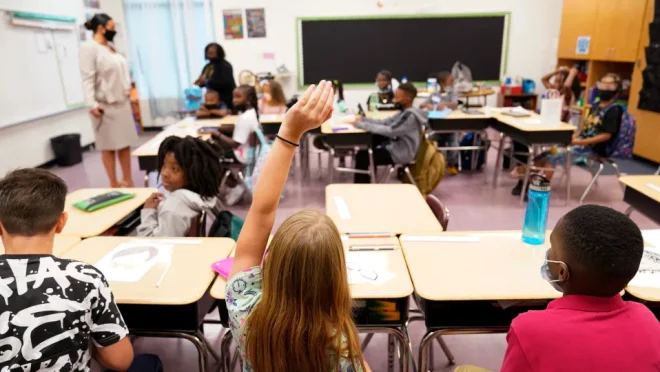
The United States is experiencing what researchers describe as a “reading recession,” with student reading performance continuing to fall nationwide even as some districts show local improvements, according to a new analysis.
At a classroom in Modesto, California, teacher Nancy Barajas uses an unusual pre-test routine — dimming the lights, playing music and letting her sixth graders dance under a disco ball — to boost confidence before exams.
The approach appears to be working locally. Schools in Modesto have recorded steady gains in both reading and math scores in recent years, though overall performance remains below grade level.
However, national data paints a more concerning picture. A study by researchers from Harvard, Stanford and Dartmouth examined state test scores for grades three to eight across more than 5,000 school districts in 38 states, compiled into a national Education Scorecard.
The findings show that only five states and the District of Columbia recorded meaningful improvement in reading between 2022 and 2025. Overall, students remain about half a grade level behind pre-pandemic reading benchmarks, with only marginal gains in math.
The decline in reading achievement, experts say, began well before the COVID-19 pandemic. Data from the National Assessment of Educational Progress shows falling reading scores for eighth graders since 2013 and for fourth graders since 2015.
Harvard professor Thomas Kane, who helped develop the Education Scorecard, said the pandemic worsened a longer-term decline, describing it as “a mudslide that followed seven years of steady erosion in achievement.”
Researchers point to several possible causes, including increased screen time and reduced recreational reading among children, as well as weaker accountability systems in schools.
Despite the national trend, some states — including Louisiana, Maryland, Tennessee, Kentucky and Indiana — have shown progress after adopting “science of reading” methods that emphasize phonics-based instruction over older approaches that relied more on context-based guessing.
Several states have also introduced dyslexia screening, teacher training programs and instructional coaching to improve literacy outcomes. However, the reforms have not guaranteed success everywhere, with some states still seeing declines.
In Modesto, schools have revamped reading instruction during and after the pandemic, while also expanding support for English learners and investing in teacher training programs, including a phonics-based initiative known as LETRS. The district reports gains equivalent to roughly 18 weeks of additional learning in math and 13 weeks in reading, though overall achievement remains low.
Other districts have also seen improvement by focusing on attendance. In Detroit, Michigan, increased school attendance combined with literacy reforms has helped boost performance, though scores still lag behind national averages. The district, once the subject of a lawsuit over the right to read, used settlement funds to expand learning support and improve school services.
In some schools, additional staff now provide small-group instruction, while attendance officers actively follow up with absent students to keep them in class.
In the southern United States, several states have led reforms in reading and math instruction. Louisiana and Alabama are among the few states where math scores have surpassed pre-pandemic levels. Louisiana is also the only state to exceed its 2019 reading average.
Alabama’s phonics-based reading reforms have contributed to notable gains, later expanded into broader math reforms requiring standardized instruction and regular student assessments.
Despite improvements in some regions, educators and researchers say nationwide recovery remains uneven. They stress that sustained investment, consistent instruction and stronger accountability will be needed to reverse the long-term decline in reading performance.