Sci-Hub’s new AI chatbot reignites debate over academic piracy
Sci-Hub’s new AI chatbot reignites debate over academic piracy
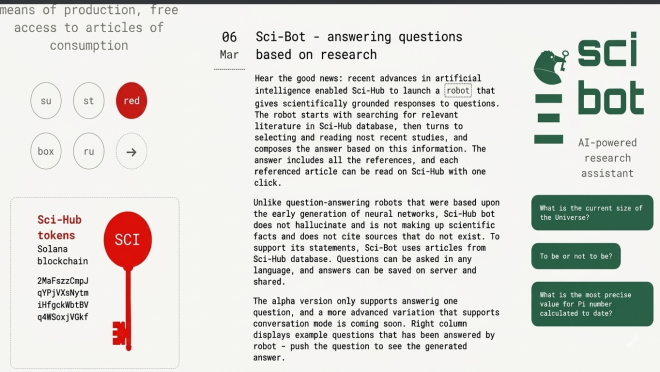
Sci-Hub, a controversial website known for illegally hosting tens of millions of scientific papers, has introduced an artificial intelligence-powered chatbot that searches its database to answer user queries.
Despite court orders in several countries requiring Sci-Hub and its affiliated platforms to shut down, the site continues to reappear under new domain names. Its persistence reflects an ongoing issue in academic publishing: although open-access models have expanded in recent years, roughly half of newly published research remains behind paywalls.
The chatbot, named Sci-Bot, provides answers along with references to papers available within the Sci-Hub database, which users can access freely. However, the current alpha version is limited. It can respond to only a single query at a time and does not support follow-up questions or extended conversations.
Sci-Hub founder Alexandra Elbakyan did not respond to requests for comment. However, three scientists tested the tool at the request of C&EN, a weekly news magazine published by the American Chemical Society.
Daniel Himmelstein, chief technology officer at AI firm RadOverlay, found that Sci-Bot was able to answer a radiology-related question effectively. However, he noted that the tool appears to lack access to more recent studies, likely due to improved security measures by publishers. According to him, this limitation may not affect all queries, particularly those based on well-established methods. “Many questions do not require the latest research,” he said, adding that his own query concerned techniques developed over decades.
Himmelstein also pointed out that Sci-Hub’s disregard for copyright restrictions allows it to draw from a much broader range of publications compared to conventional tools. This, he argued, gives it a notable advantage in terms of access.
In 2025, Elbakyan launched Sci-Net, a related platform that allows researchers to request papers not yet available on Sci-Hub. Academics who provide access to such papers can earn Sci-Hub tokens, a cryptocurrency introduced by anonymous supporters in November 2024.
According to Sci-Hub, Sci-Bot avoids a common issue seen in many large language models: generating false or “hallucinated” references. While Himmelstein acknowledged that such errors are still possible, he suggested that limiting the bot to a fixed set of studies helps reduce this risk.
Even so, Himmelstein said he is unlikely to use Sci-Bot or Sci-Hub in the future, mainly because he requires access to the most recent research. Instead, he relies on institutional resources, such as visiting Dartmouth College’s library to obtain up-to-date information.
Himmelstein and his former colleague Casey Greene previously co-authored a 2017 study analysing Sci-Hub’s coverage. Their findings indicated that the platform contained more than 90% of all chemistry literature, including nearly all papers published by journals of the American Chemical Society.
Meanwhile, some academic publishers have begun signing agreements with AI companies to allow their content to be used for training language models. At least one AI firm has admitted to using material from LibGen, another piracy-based repository linked to Sci-Hub.
Greene, now a bioinformatician at the University of Colorado Anschutz, described this situation as “deeply ironic”. He noted that while some technology companies have profited from using potentially copyrighted material, Sci-Hub has provided access for free while facing repeated legal challenges. In his view, the key difference lies more in motivation than in method.
After testing Sci-Bot himself with a question on ovarian cancer, Greene observed that the tool retrieved studies published up to around 2021 or 2022, but did not include more recent research.
Abdelghani Maddi, a research engineer at the National Center for Scientific Research and Sorbonne University, described Sci-Bot as a promising and user-friendly tool. However, he noted that it tends to rely on a limited number of references, often fewer than ten, rather than engaging with a broader range of literature.
Although Maddi agreed that the chatbot produced clear, structured, and generally accurate responses without obvious fabricated citations, he pointed out that the selected references were not always the most relevant.
He suggested several improvements, including the ability to track previous queries, share results privately, and allow follow-up questions. He also emphasised the need for deeper analytical engagement, encouraging the tool to go beyond listing findings and instead compare different methods and interpretations across studies.