Sweden goes back to physicals books and paper based classwork at schools
Sweden’s government is pushing a return to physical books, handwritten work, and paper-based learning in classrooms, aiming to counter a noticeable decline in literacy.
Sweden goes back to physicals books and paper based classwork at schools
Sweden’s government is pushing a return to physical books, handwritten work, and paper-based learning in classrooms, aiming to counter a noticeable decline in literacy.
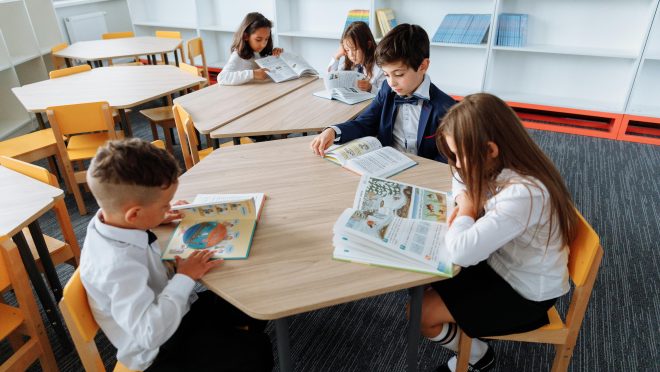
Yet this renewed emphasis on analogue methods has triggered strong criticism from tech firms, educators, and computer scientists, who warn it could leave students ill-prepared for the modern workforce and potentially weaken the country’s innovation-driven economy.
According to a BBC report, at a secondary school in Nacka, just outside Stockholm, final-year students now carry not only laptops but also stacks of printed materials, something they say was far less common just a few years ago.
“I often go home with new books and printed papers now,” says Sophie, 18. She notes that one of her teachers has begun distributing printed versions of all lesson materials, while a digital maths platform has been replaced entirely with textbook-based instruction.
This shift contrasts sharply with Sweden’s image as one of Europe’s most digitally advanced societies, known for its strong technological skills and vibrant start-up culture.
Digital devices became widespread in Swedish classrooms during the late 2000s and early 2010s. By 2015, roughly 80% of students in state-funded upper secondary schools had individual access to a digital device. In 2019, tablets were formally introduced into pre-school education as part of a broader effort to prepare children for an increasingly digital world.
However, the current right-leaning coalition government, in power since 2022, is taking a different approach.
“We are actually trying to reduce screen use as much as possible,” says Joar Forsell, education spokesperson for the Liberal Party. “Older students may use them to some extent, but for younger children, I don’t think screens should be used at all.”
The government has popularised the slogan “from screen to binder”, promoting the idea that screen-free environments help children concentrate better and strengthen their reading and writing abilities.
Since 2025, pre-schools are no longer required to use digital tools, and tablets are not provided to children under two. A nationwide ban on mobile phones in schools, including for educational purposes, is also set to take effect later this year.
Significant funding, more than 2.1 billion krona, has already been allocated to purchase textbooks and teaching materials. A revised curriculum reinforcing textbook-based learning is expected by 2028.
Forsell argues that traditional methods are more effective. “Reading real books, writing on paper, and solving problems manually provide a stronger foundation for learning,” he says.
The policy shift follows a 2023 consultation involving researchers, educators, and public institutions.
Dr Sissela Nutley, a neuroscientist affiliated with the Karolinska Institute, highlights growing concerns about classroom technology. She suggests that screens can easily distract students and cites research indicating that reading on digital devices may reduce comprehension. Excessive screen exposure, she adds, could even affect the cognitive development of younger children.
The government also hopes that this move will improve Sweden’s performance in international assessments such as the OECD’s Pisa rankings. Once a top performer, Sweden’s scores dropped sharply in 2012 and declined again in 2022, particularly in reading and mathematics.
Although still above the OECD average, Sweden’s literacy performance now trails countries such as the UK, US, Denmark, and Finland. Around 24% of 15 to 16-year-olds failed to reach basic reading proficiency in 2022.
Forsell links this trend to heavy screen use in schools. “Students who have gone through the system with extensive screen exposure are falling behind in international comparisons,” he says.
However, the OECD’s latest report presents a more nuanced picture. While acknowledging that digital distractions are widespread and excessive device use in maths lessons is linked to weaker outcomes, it also concludes that access to digital tools generally benefits students. Interestingly, results were still lower among those who used no digital tools at all.
Andreas Schleicher, the OECD’s director for education, cautions against drawing simple conclusions. He suggests that Sweden’s earlier, more aggressive integration of technology, often without clear educational purpose, may have contributed to the problem.
Despite these findings, the government’s back-to-basics approach has ignited debate within Sweden’s business community.
A report by the Swedish EdTech Industry warns that reducing digital exposure in schools could leave students lacking essential skills for the labour market. Its CEO, Jannie Jeppesen, notes that an estimated 90% of future jobs will require digital competence.
She also raises concerns about Sweden’s position as a leading hub for tech start-ups, including billion-dollar companies like Spotify and emerging AI firms. Without a digitally skilled workforce, she argues, such companies may relocate elsewhere.
The rapid global expansion of artificial intelligence adds another layer to the debate. While the government plans to introduce AI education at the secondary level, some critics argue that younger students should also be exposed to it.
Professor Linnéa Stenliden of Linköping University warns that delaying AI education could widen inequality. Children from wealthier families, who are more likely to receive guidance at home, may gain a significant advantage, deepening the digital divide.
Forsell rejects this concern, insisting that students must first master foundational skills before engaging with advanced technologies. He also dismisses claims that the policy could increase inequality.
However, critics such as Jeppesen describe the government’s stance as overly simplistic. They argue that focusing on the digital-versus-analogue debate distracts from deeper structural issues, including unequal access to resources and variations in teaching quality, problems highlighted in a recent report by Sweden’s Education Agency.
Among students themselves, opinions remain divided.
Alexios, 18, believes reducing screen use is beneficial. “The internet has taken over younger generations, and I’ve seen how easily they lose focus,” he says, adding that he would prefer his younger siblings to rely less on digital tools.
In contrast, Jasmine, 19, supports a more technology-driven approach. “We should focus more on computers,” she argues. “If we are honest, the whole world runs on them.”