China launches Shenzhou 24 with 2 Chinese, Pakistani astronauts aboard
China launches Shenzhou 24 with 2 Chinese, Pakistani astronauts aboard
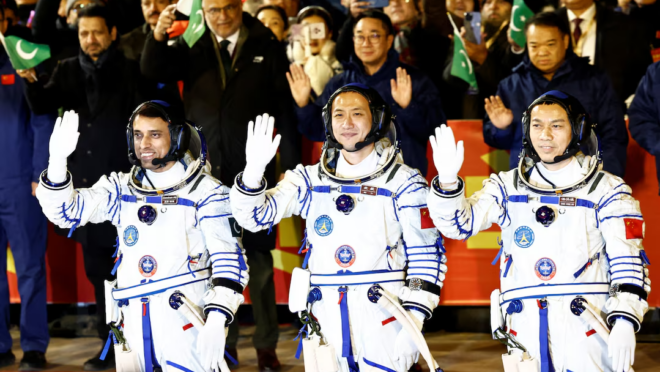
China launched the Shenzhou 24 spacecraft carrying three astronauts today, including two Chinese and one Pakistani, sending the first foreign astronaut to its space station.
Pakistani astronaut Muhammad Zeeshan Ali, 40, is travelling with Chinese astronauts Tang Hongbo, 51, and Wu Yi, 39, after the spacecraft lifted off from the Jiuquan Satellite Launch Center in northwestern China on Wednesday morning.
The spacecraft successfully separated from its rocket and entered its designated orbit.
The launch marked the first joint spaceflight involving Chinese and foreign astronauts in the history of China’s human space programme.
Earlier, crowds gathered at a send-off ceremony, with many people holding up their mobile phones to capture the moment.
In Pakistan, people cheered with cries of “God is great!” and “Long live Pakistan-China friendship!” as the spacecraft carrying Ali headed into space.
Families thousands of kilometres away from the launch site watched the historic moment through television broadcasts. Customers at restaurants also followed the launch on television, joining the celebrations and expressing their friendship with China. Scientists at the headquarters of Pakistan’s space agency watched the launch as well.
Pakistan’s Minister for Planning, Development and Special Initiatives Ahsan Iqbal told reporters at the launch centre that he hoped the mission would pave the way for greater cooperation in the future.
He also thanked Chinese President Xi Jinping, the Chinese leadership, scientists and engineers for their support.
Asked whether Pakistan could send astronauts into space independently, Iqbal said, “Certainly that day will come.”
He said Ali was carrying not only his name but also the Pakistani flag on his shoulders and uniform, taking the hopes, prayers and technological aspirations of the people of Pakistan into orbit.
“The sky is no longer our limit, it is our launching pad,” Iqbal said in a statement, describing the mission as an inspiration for young Pakistanis seeking careers in science and technology.
The joint mission is being carried out under an agreement signed between China and Pakistan in February 2025.
The astronauts will conduct more than 90 scientific experiments and technology tests during their mission, China’s official Xinhua News Agency reported earlier.
Ali will carry out an experiment involving photosynthetic cyanobacteria in orbit during his short-term mission before returning to Earth aboard the Shenzhou 23 spacecraft, Xinhua said.
The mission marks the first spaceflight for Ali and Wu, while Tang has already completed two previous missions. He is set to become the first astronaut to visit China’s Tiangong space station three times, state broadcaster CCTV reported.
At a news conference on Tuesday, Tang said differences in language, culture and psychology had made it more challenging for the crew members to learn to work together, but their efforts were beginning to pay off.
Ali’s Mandarin proficiency reflected those efforts during the news conference. He quoted a line from Chinese poetry about climbing one more floor to see farther.
“It’s like my daily training. Day after day, reaching new heights,” he said in Mandarin.
Speaking in English, Ali said he hoped the next phase of space cooperation between the two countries would expand from one astronaut on a single flight to multiple joint missions and eventually to the Moon, Mars and beyond.
China is preparing to carry out its first crewed lunar landing by 2030, while the United States, widely considered China’s main space rival, is aiming to land astronauts on the Moon in 2028 under NASA’s programme.