From Cox’s Bazar to the Asian Games: The coach building Bangladesh’s surfing future
Rashed Alam grew up by Cox’s Bazar beach. His connection with the sea led him to build a life around it.
From Cox’s Bazar to the Asian Games: The coach building Bangladesh’s surfing future
Rashed Alam grew up by Cox’s Bazar beach. His connection with the sea led him to build a life around it.
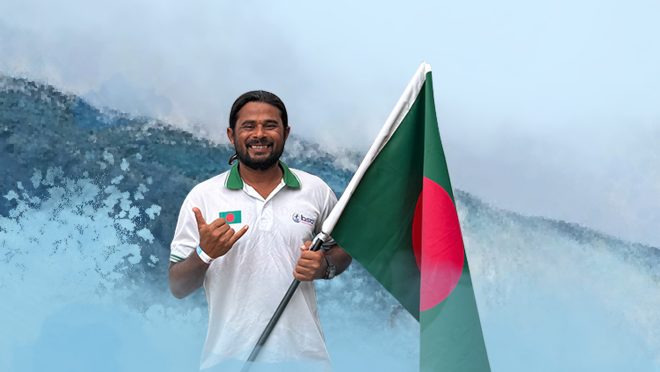
Rashed Alam is a trainer of the national surfing team of Bangladesh. He is also the founder and trainer of Bangladesh Surf Girls and Boys Club, the same club that trained Mohammad Mannan and Fatema Akhtar, both set to represent Bangladesh at the upcoming Asian Games.
Both spoke highly of him, which is what led me to reach out and learn more about his work.
Growing up
Rashed spent most of his childhood at Cox’s Bazar sea beach. His elder brother was a lifeguard, and Rashed followed the same path. Staying close to the sea eventually led him to surfing. He started surfing at 13.
As Rashed put it, “Finding a sport that takes place in the sea, I could not explain my excitement. It almost felt like magic.”
He had no trainer when he started. He learned on boards donated by foreign tourists. He started surfing with a small group of friends, teaching themselves as they went. Rashed and his friends did it because they simply enjoyed it, nothing more.
Eventually, with the passage of time, the group felt surfing needed a more organised structure. That led them to form clubs. Cox’s Bazar now has five surfing clubs.
Building the club
Bangladesh Surf Girls and Boys Club was founded in 2013. He simply persuaded kids to surf because he believed that one day surfing would get the appreciation it deserves.
He personally visited families to convince them to let their kids surf. Fatema’s path into the sport was shaped significantly by that effort. Convincing girls’ families was harder than convincing boys’. As Rashed explained, “Most of the girls come from vulnerable communities. Girls there often face eve-teasing and are at risk of child marriage, so convincing a girl’s family is tough. Very few agree.”
It was not just Fatema. Many other kids got their start the same way. Rashed said that out of every ten or twelve families he approached, only one or two would agree.
The path was not easy. From dealing with society to organising training equipment, from simply a hobby to a means of representing the country internationally, Rashed’s role in that shift is hard to deny.
Moving abroad
Rashed left for America in 2016, joining his wife in California, where he worked as a lifeguard and began training kids to surf.
Living there showed him the difference in how Bangladesh and America treat sports. In Bangladesh, sports are often seen as a waste of time, and parents rarely encourage them. In California, it was different. Parents surfed and swam themselves, which naturally pulled their kids towards the same activities. Kids there start swimming young. In Bangladesh, a significant number of people never learn to swim, let alone take up a sport.
That gap stayed with him. He returned to Bangladesh in 2020 and tried to close it.
During his years in the US, he built connections with locals there and explained Bangladesh’s situation: talented kids with no equipment. Through those connections, he was able to bring surfboards back to Bangladesh on every trip. Kids in his club still use those same boards today.
The success
Years of quiet work are now showing results. Cox’s Bazar now has around 70 to 80 boys and 10 to 20 girls surfing.
In 2025, two Bangladeshi girls represented the country abroad in an Asian championship for the first time.
This year, two surfers from his club are set to represent Bangladesh at the 2026 Asian Games in Japan. Their travel costs went from being raised through GoFundMe to now expected to be covered by the Bangladesh Olympic Association.
“I had a dream of representing the red and green flag in international surfing. Seeing these kids achieve that dream is a feeling I can’t explain in words,” Rashed said.
Rashed believes Bangladesh will eventually start manufacturing its own surfboards to meet demand, and that surfing will one day reach the same level of attention as football and cricket. But he says that depends on parents allowing their kids to surf and society changing its mindset. In Cox’s Bazar, many girls are forced to give up both studying and surfing once they get married.
Rashed does not blame the authorities or the government for the sport’s slow progress. He believes surfing has not yet had a moment that puts it in the national spotlight, but he sees the upcoming Asian Games as a start. “I always believed that one day surfing will reach a milestone in Bangladesh,” he said.
Rashed Alam started surfing without a trainer, without equipment, and without any real precedent to follow. What he built afterwards gave that same chance to others, and now, as coach of the national team, he is doing it on a bigger scale.